Jharkhand Civil Judge Mains 2014 Law Paper II Previous Year Question Paper

Jharkhand Government Jobs Judicial 2014

  • Year 2014
  • Conducted By Jharkhand Government Jobs
  • Questions 6
  • Maximum Marks 100
  • Duration 3 Hours
  • Languages English & Hindi

Exam Details

Detail Information
Examination CIVIL JUDGE (JD) MAIN EXAM
Year 2014
Conducting Body Jharkhand Government Jobs
Paper CJD(Mains-2014) Law Paper-II
Subject Law
Duration 3 Hours
Maximum Marks 100
Number of Questions 6
Question Type Descriptive / Subjective

This document contains the previous year's question paper for the Jharkhand Civil Judge (JD) Main Examination 2014, specifically Law Paper II. The paper is divided into three sections: Section A, Section B, and Section C, with a total of six questions, each carrying specific marks. Section A focuses on contract law, including concepts like privity of contract, exceptions to enforceability, and agreements without consideration, as exemplified by Hadley v. Baxendale. Section B delves into the Sale of Goods Act, covering the rights of an unpaid seller and the doctrine of caveat emptor, along with the 'nemo dat quod non habet' principle. Section C addresses negotiable instruments and banking law, discussing a banker's liability for wrongful dishonour of cheques, types of endorsements, and the distinction between a 'holder in due course' and a 'holder', as well as the definition of a Bill of Exchange and its difference from a cheque. The paper requires candidates to answer five questions, with at least one from each section, testing their comprehensive understanding of these legal domains. The total marks for the paper are 100, and the time allowed is 3 hours. This paper is crucial for

Major Topics Covered

  • Contract Law
  • Privity of Contract
  • Consideration in Contracts
  • Exceptions to Contract Rules
  • Damages in Contract Law
  • Sale of Goods Act
  • Unpaid Seller Rights
  • Caveat Emptor
  • Nemo Dat Quod Non Habet
  • Negotiable Instruments
  • Banking Law
  • Dishonour of Cheques
  • Endorsement
  • Holder in Due Course
  • Bill of Exchange
  • Cheques
  • Judicial Service Exams
  • Law Papers
  • Previous Year Questions
  • Legal Principles

Why This Paper is Important

  • Useful for CIVIL JUDGE (JD) MAIN EXAM preparation
  • Helps understand the latest exam pattern
  • Useful for practice and self-assessment
  • Covers frequently asked General Studies topics
  • Helpful for analysing question trends

Related Resources

Instructions

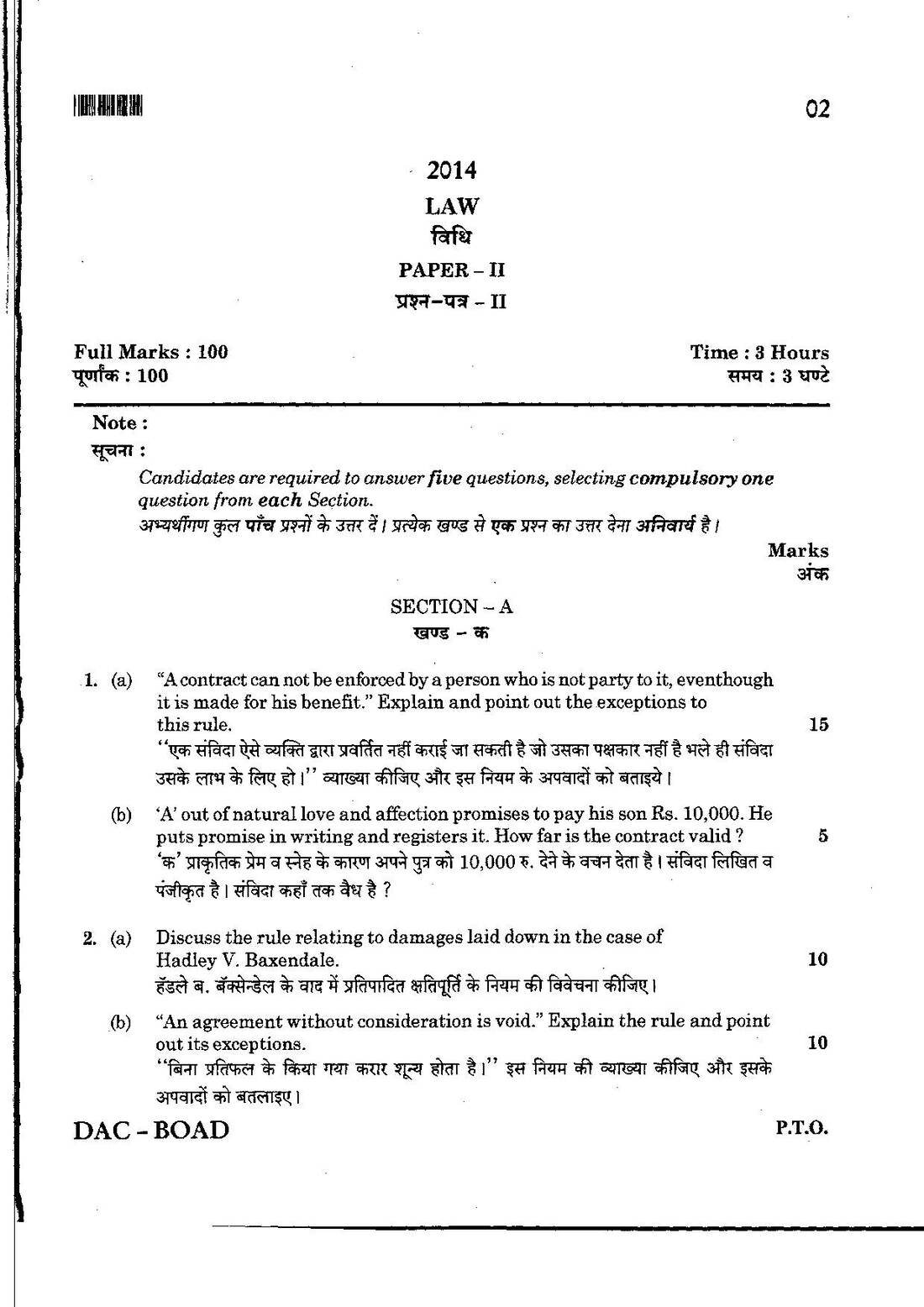
  • प्रश्न–पत्र – \Pi Full Marks: 100 Time: 3 Hours समय: 3 घण्टे पूर्णांक : 100 Note: सूचना : Candidates are required to answer five questions, selecting compulsory one question from each Section. अभ्यर्थीगण कुल पाँच प्रश्नों के उत्तर दें। प्रत्येक खण्ड से एक प्रश्न का उत्तर देना अनिवार्य है। Marks अंक SECTION – A खण्ड – क "A contract can not be enforced by a person who is not party to it, even though

Questions (page 2)

Q1. A contract can not be enforced by a person who is not party to it, even though it is made for his benefit." Explain and point out the exceptions to this rule. Marks: 15
‘एक संविदा ऐसे व्यक्ति द्वारा प्रवर्तित नहीं कराई जा सकती है जो उसका पक्षकार नहीं है भले ही संविदा उसके लाभ के लिए हो।’’ व्याख्या कीजिए और इस नियम के अपवादों को बताइये। अंक: 15

(a) A contract can not be enforced by a person who is not party to it, even though it is made for his benefit." Explain and point out the exceptions to this rule.
‘एक संविदा ऐसे व्यक्ति द्वारा प्रवर्तित नहीं कराई जा सकती है जो उसका पक्षकार नहीं है भले ही संविदा उसके लाभ के लिए हो।’’ व्याख्या कीजिए और इस नियम के अपवादों को बताइये।
Q2. ‘क’ प्राकृतिक प्रेम व स्नेह के कारण अपने पुत्र को 10,000 रु. देने के वचन देता है। संविदा लिखित व पंजीकृत है। संविदा कहाँ तक वैध है ? Marks: 5
'A' out of natural love and affection promises to pay his son Rs. 10,000. He puts promise in writing and registers it. How far is the contract valid? अंक: 5

(a) 'A' out of natural love and affection promises to pay his son Rs. 10,000. He puts promise in writing and registers it. How far is the contract valid?
‘क’ प्राकृतिक प्रेम व स्नेह के कारण अपने पुत्र को 10,000 रु. देने के वचन देता है। संविदा लिखित व पंजीकृत है। संविदा कहाँ तक वैध है ?

Q3.

(a) Discuss the rule relating to damages laid down in the case of Hadley V. Baxendale.
हॅडले ब. बॅक्सेन्डेल के वाद में प्रतिपादित क्षतिपूर्ति के नियम की विवेचना कीजिए।

Q4.

(a) "An agreement without consideration is void." Explain the rule and point out its exceptions.
‘‘बिना प्रतिफल के किया गया करार शून्य होता है।’’ इस नियम की व्याख्या कीजिए और इसके अपवादों को बतलाइए।

Q5.

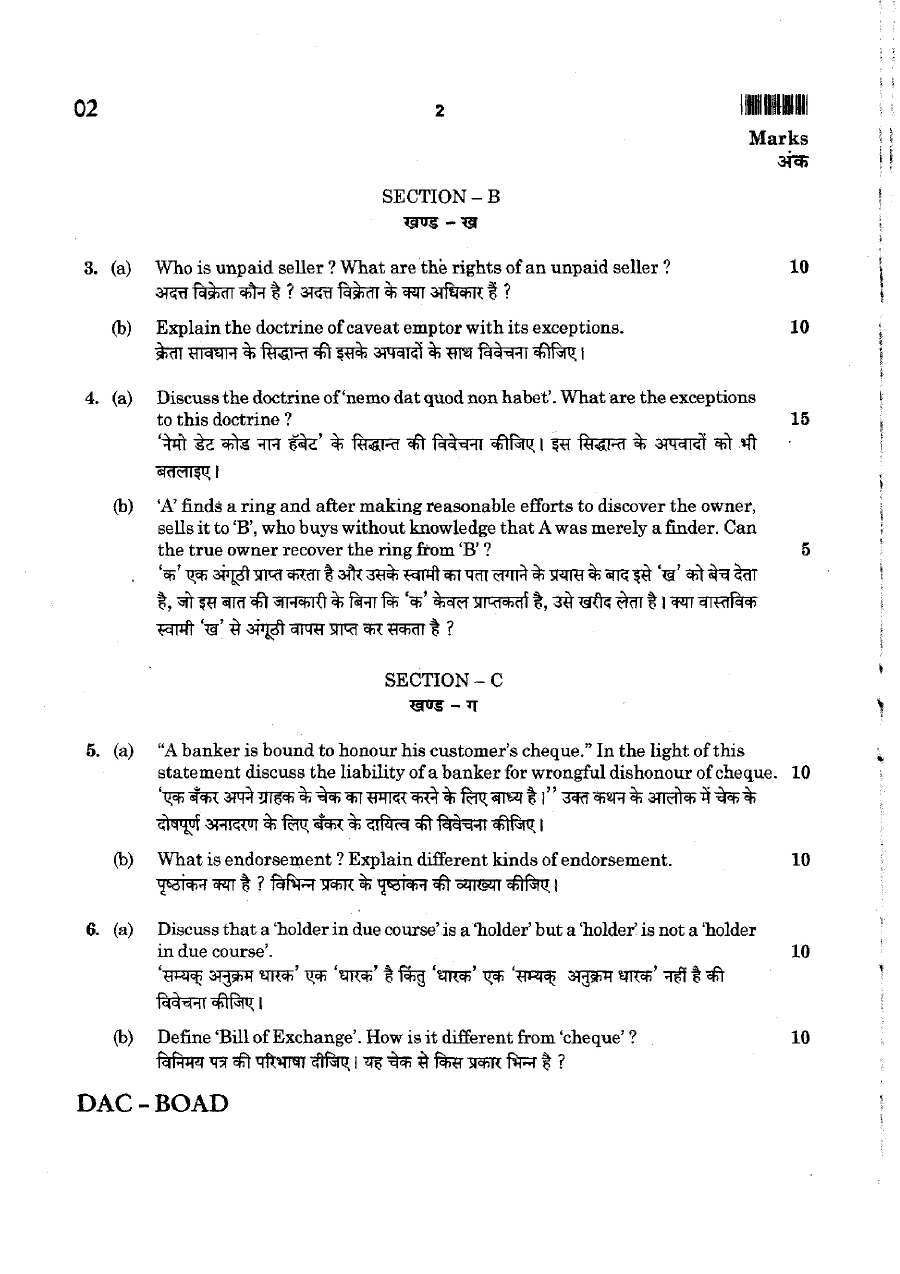
(a) Who is unpaid seller ? What are the rights of an unpaid seller ?
अदत्त विक्रेता कौन है ? अदत्त विक्रेता के क्या अधिकार हैं ?

Q6.

(a) Explain the doctrine of caveat emptor with its exceptions.
क्रेता सावधान के सिद्धान्त की इसके अपवादों के साथ विवेचना कीजिए।

Q7.

(a) Discuss the doctrine of 'nemo dat quod non habet'. What are the exceptions to this doctrine?
‘नेमो डेट कोड नान हॅंबेट’ के सिद्धान्त की विवेचना कीजिए। इस सिद्धान्त के अपवादों को भी बतलाइए ।

Q8.

(a) 'A' finds a ring and after making reasonable efforts to discover the owner, sells it to 'B', who buys without knowledge that A was merely a finder. Can the true owner recover the ring from 'B'?
‘क’ एक अंगूठी प्राप्त करता है और उसके स्वामी का पता लगाने के प्रयास के बाद इसे ‘ख’ को बेच देता है, जो इस बात की जानकारी के बिना कि ‘क’ केवल प्राप्तकर्ता है, उसे खरीद लेता है। क्या वास्तविक स्वामी ‘ख’ से अंगूठी वापस प्राप्त कर सकता है ?

Q9.

(a) "A banker is bound to honour his customer's cheque." In the light of this statement discuss the liability of a banker for wrongful dishonour of cheque.
‘एक बँकर अपने ग्राहक के चेक का समादर करने के लिए बाध्य है।’’ उक्त कथन के आलोक में चेक के दोषपूर्ण अनादरण के लिए बँकर के दायित्व की विवेचना कीजिए।

Q10.

(a) What is endorsement? Explain different kinds of endorsement.
पृष्ठांकन क्या है ? विभिन्न प्रकार के पृष्ठांकन की व्याख्या कीजिए।

Q11.

(a) Discuss that a 'holder in due course' is a 'holder' but a 'holder' is not a 'holder in due course'.
‘सम्यक् अनुक्रम धारक’ एक ‘धारक’ है किंतु ‘धारक’ एक ‘सम्यक् अनुक्रम धारक’ नहीं है की विवेचना कीजिए।

Q12.

(a) Define 'Bill of Exchange'. How is it different from 'cheque'?
विनिमय पत्र की परिभाषा दीजिए। यह चेक से किस प्रकार भिन्न है ?

Question paper preview

Scanned pages 1–2 for reference. Download the official PDF for the full paper.

Page 1
Jharkhand Civil Judge Mains 2014 Law Paper II Previous Year Question Paper — page 1 instructions scan PDF download
Page 2
Jharkhand Civil Judge Mains 2014 Law Paper II Previous Year Question Paper — page 1 instructions scan PDF download

Free question paper download

Download question paper PDF

  • 309 KB
  • 4 pages
  • PDF format

Frequently asked questions

What is the exam name and year for this question paper?

The exam name is CIVIL JUDGE (JD) MAIN EXAM, and the year is 2014.

What is the subject of Law Paper II?

Law Paper II covers various aspects of law, including contract law, sale of goods, negotiable instruments, and banking law.

What is the total marks and time duration for this paper?

The total marks for this paper are 100, and the time allowed is 3 hours.

How many questions are required to be answered?

Candidates are required to answer five questions, selecting at least one from each section.

What are the key topics covered in Section A?

Section A covers contract law, including the rule of privity of contract, its exceptions, and agreements without consideration.

What legal principles are discussed in Section B?

Section B discusses the rights of an unpaid seller, the doctrine of caveat emptor with its exceptions, and the 'nemo dat quod non habet' doctrine.

← Back to Judicial papers