Section A
Q1.
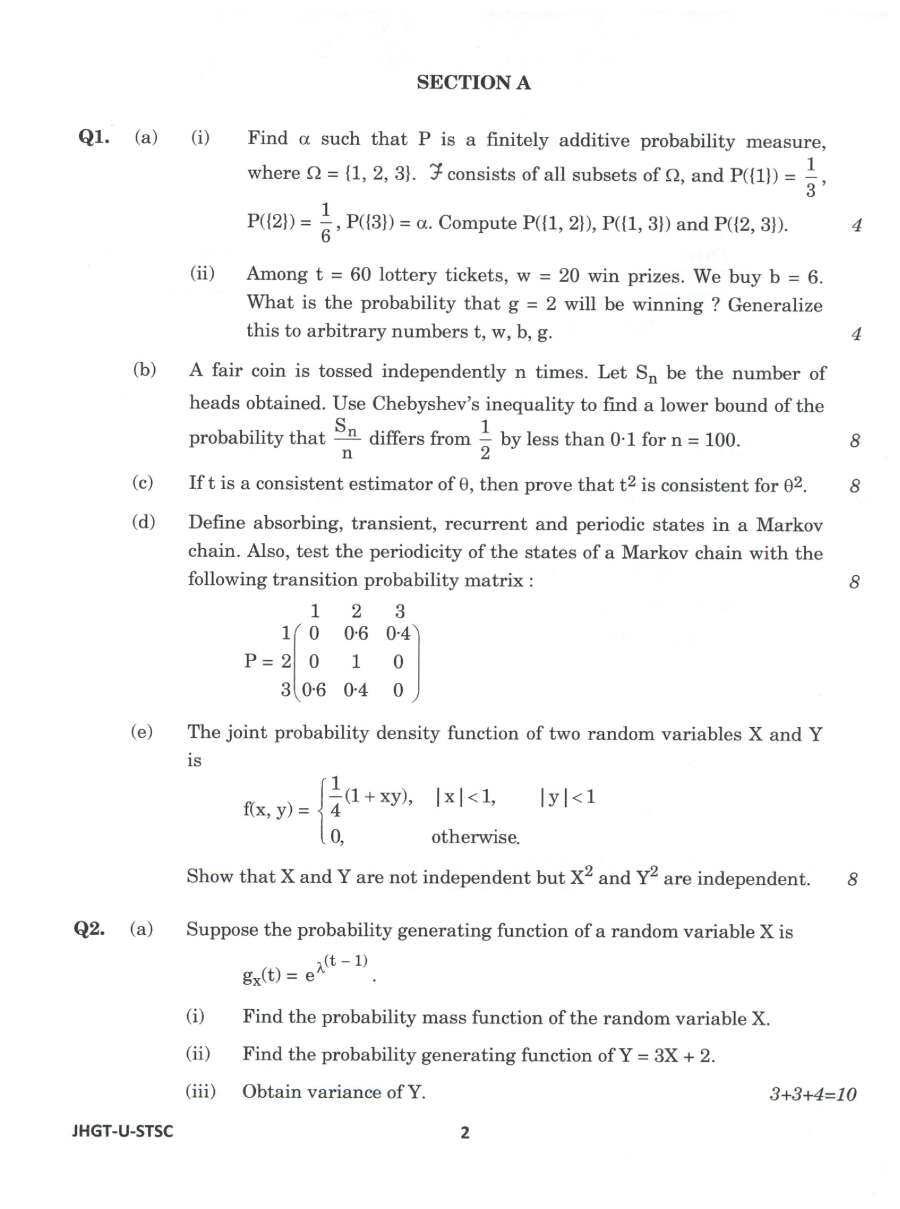
(a) (i) Find α such that P is a finitely additive probability measure, where \Omega = 1, 2, 3. \mathcalF consists of all subsets of \Omega, and P(\1\) = 1/3, P(\2\) = 1/6, P(\3\) = α. Compute P(\1, 2\), P(\1, 3\) and P(\2, 3\).
(a) (ii) Among t = 60 lottery tickets, w = 20 win prizes. We buy b = 6. What is the probability that g = 2 will be winning ? Generalize this to arbitrary numbers t, w, b, g.
(b) A fair coin is tossed independently n times. Let Sn be the number of heads obtained. Use Chebyshev's inequality to find a lower bound of the probability that (Sn)/(n) differs from 1/2 by less than 0.1 for n = 100.
(c) If t is a consistent estimator of θ, then prove that t2 is consistent for θ^2.
(d)
Define absorbing, transient, recurrent and periodic states in a Markov chain. Also, test the periodicity of the states of a Markov chain with the following transition probability matrix :
P = \beginbmatrix 0 & 0. 6 & 0. 4 \\ 0 & 1 & 0 \\ 0. 4 & 0 \endbmatrix.
(e)
The joint probability density function of two random variables X and Y is
f(x, y) = \begincases 1/4(1 + xy), & |x| < 1, \quad |y| < 1 \\ 0, & \textotherwise. \endcases
Show that X and Y are not independent but X2 and Y2 are independent.