Q1.
(a)
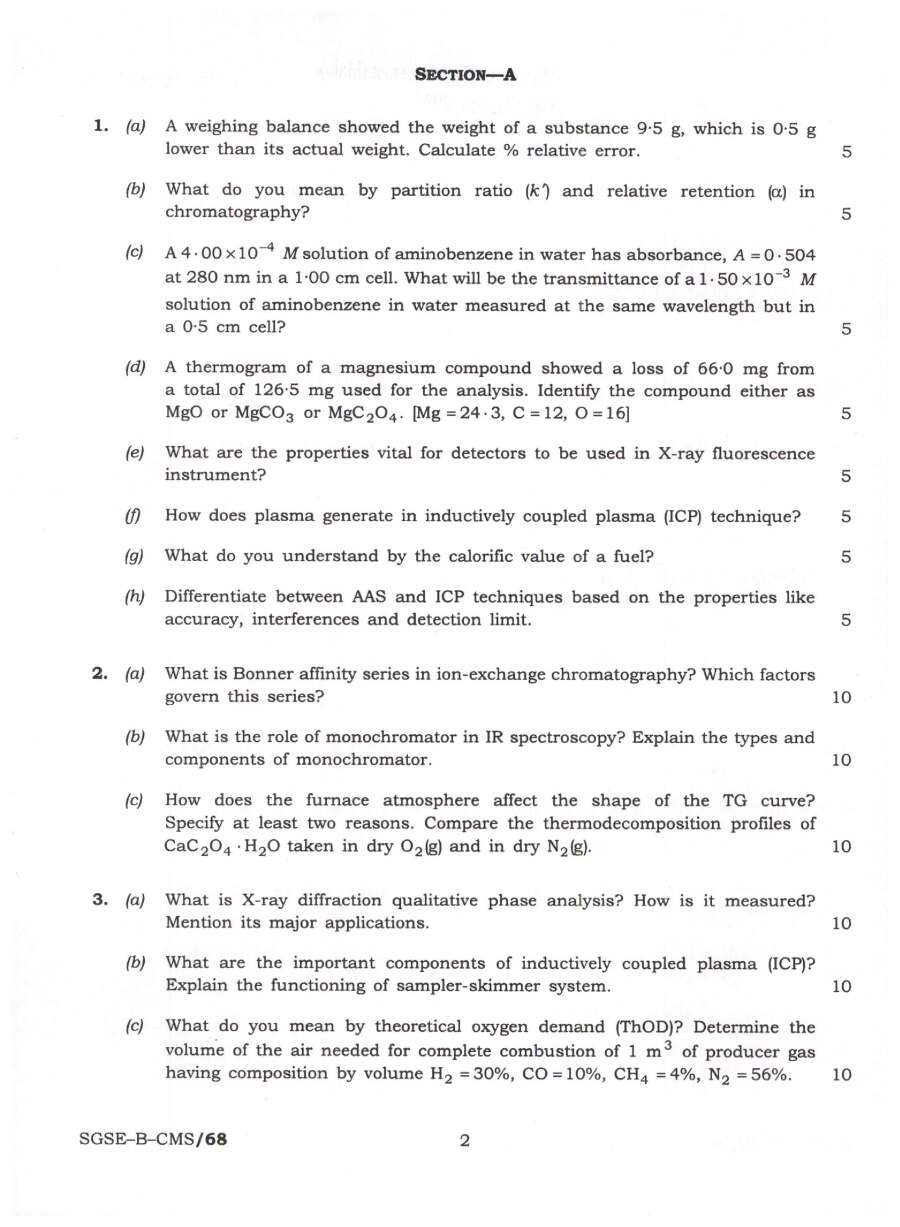
SECTION-A 1. A weighing balance showed the weight of a substance 9.5 g, which is 0.5 g lower than its actual weight. Calculate % relative error.
(b)
What do you mean by partition ratio (k') and relative retention (α) in chromatography?
(c)
A 4 \cdot 00 × 10 -4 M solution of aminobenzene in water has absorbance, A = 0 \cdot 504 at 280 nm in a 1.00 cm cell. What will be the transmittance of a 1.50 × 10⁻³ M solution of aminobenzene in water measured at the same wavelength but in a 0.5 cm cell?
(d)
A thermogram of a magnesium compound showed a loss of 66.0 mg from a total of 126.5 mg used for the analysis. Identify the compound either as MgO or MgCO 3 or MgC 2 O 4 . [Mg = 24.3, C = 12, O = 16]
(e)
What are the properties vital for detectors to be used in X-ray fluorescence instrument? (f) How does plasma generate in inductively coupled plasma (ICP) technique? What do you understand by the calorific value of a fuel? 5 q) (h) Differentiate between AAS and ICP techniques based on the properties like accuracy, interferences and detection limit.
Q1.
(a)
SECTION-A 1. A weighing balance showed the weight of a substance 9.5 g, which is 0.5 g lower than its actual weight. Calculate % relative error.
(b)
What do you mean by partition ratio (k') and relative retention (α) in chromatography?
(c)
A 4 \cdot 00 × 10 -4 M solution of aminobenzene in water has absorbance, A = 0 \cdot 504 at 280 nm in a 1.00 cm cell. What will be the transmittance of a 1.50 × 10⁻³ M solution of aminobenzene in water measured at the same wavelength but in a 0.5 cm cell?
(d)
A thermogram of a magnesium compound showed a loss of 66.0 mg from a total of 126.5 mg used for the analysis. Identify the compound either as MgO or MgCO 3 or MgC 2 O 4 . [Mg = 24.3, C = 12, O = 16]
(e)
What are the properties vital for detectors to be used in X-ray fluorescence instrument? (f) How does plasma generate in inductively coupled plasma (ICP) technique? What do you understand by the calorific value of a fuel? 5 q) (h) Differentiate between AAS and ICP techniques based on the properties like accuracy, interferences and detection limit.
Q2.
(a)
What is Bonner affinity series in ion-exchange chromatography? Which factors govern this series?
(b)
What is the role of monochromator in IR spectroscopy? Explain the types and components of monochromator.
(c)
How does the furnace atmosphere affect the shape of the TG curve? Specify at least two reasons. Compare the thermodecomposition profiles of CaC2O4 · H2O taken in dry O2(g) and in dry N2(g). 10 з. (a) What is X-ray diffraction qualitative phase analysis? How is it measured? Mention its major applications. What are the important components of inductively coupled plasma (ICP)? (b) Explain the functioning of sampler-skimmer system. What do you mean by theoretical oxygen demand (ThOD)? Determine the
(c) volume of the air needed for complete combustion of 1 \text m3 of producer gas having composition by volume H 2 = 30%, CO = 10%, CH 4 = 4%, N 2 = 56%. SGSE-B-CMS/68 \overlinea
Q2.
(a)
What is Bonner affinity series in ion-exchange chromatography? Which factors govern this series?
(b)
What is the role of monochromator in IR spectroscopy? Explain the types and components of monochromator.
(c)
How does the furnace atmosphere affect the shape of the TG curve? Specify at least two reasons. Compare the thermodecomposition profiles of CaC2O4 · H2O taken in dry O2(g) and in dry N2(g). 10 з. (a) What is X-ray diffraction qualitative phase analysis? How is it measured? Mention its major applications. What are the important components of inductively coupled plasma (ICP)? (b) Explain the functioning of sampler-skimmer system. What do you mean by theoretical oxygen demand (ThOD)? Determine the
(c) volume of the air needed for complete combustion of 1 \text m3 of producer gas having composition by volume H 2 = 30%, CO = 10%, CH 4 = 4%, N 2 = 56%. SGSE-B-CMS/68 \overlinea
Q3.
1.
(c) A 4.00 × 10^-4 M solution of aminobenzene in water has absorbance, A = 0.504 at 280 nm in a 1.00 cm cell. What will be the transmittance of a 1.50 × 10^-3 M solution of aminobenzene in water measured at the same wavelength but in a 0.5 cm cell?
Q4.
1. (d) A thermogram of a magnesium compound showed a loss of 66.0 mg from a total of 126.5 mg used for the analysis. Identify the compound either as MgO or MgCO3 or MgC2O4. [Mg = 24.3, C = 12, O = 16]
Q5.
1. (e) What are the properties vital for detectors to be used in X-ray fluorescence instrument?
Q6.
1. (f) How does plasma generate in inductively coupled plasma (ICP) technique?
Q7.
1. (g) What do you understand by the calorific value of a fuel?
Q8.
1. (h) Differentiate between AAS and ICP techniques based on the properties like accuracy, interferences and detection limit.
Q9.
2. (a) What is Bonner affinity series in ion-exchange chromatography? Which factors govern this series?
Q10.
2. (b) What is the role of monochromator in IR spectroscopy? Explain the types and components of monochromator.