Indian Forest Service 2025 Chemistry Paper I Question Paper PDF

Central Government Jobs Other Jobs 2025

  • Year 2025
  • Conducted By UPSC
  • Questions 8
  • Maximum Marks 200
  • Duration Three Hours
  • Languages English

Exam Details

Detail Information
Examination Indian Forest Service (Main) Examination
Year 2025
Conducting Body UPSC
Paper Chemistry Paper - I
Subject Chemistry
Duration Three Hours
Maximum Marks 200
Number of Questions 8
Question Type Mixed

This document contains the Chemistry Paper I for the Indian Forest Service (Main) Examination 2025, conducted by UPSC. The paper consists of 8 questions, with 5 to be attempted, including compulsory questions 1 and 5. It covers various topics in Chemistry, with questions carrying equal marks. Aspirants can use this paper to understand the exam structure, question complexity, and important concepts tested in the IFS Main examination. The paper is designed to assess a candidate's in-depth knowledge of Chemistry relevant to forestry.

Major Topics Covered

  • Chemistry
  • Bond Lengths
  • Nitrate Ion
  • Cubic Close-Packed Structure
  • Mixed Oxide
  • Tetrahedral Voids
  • Octahedral Voids
  • Gibbs Free Energy
  • Equilibrium Pressure
  • Standard Gibbs Energy of Formation
  • Schrödinger Equation
  • Hydrogen Atom
  • Spherical Polar Coordinates
  • Particle in a Box
  • Photon Emission
  • Frequency
  • Constants

Why This Paper is Important

  • Useful for Indian Forest Service (Main) Examination preparation
  • Helps understand the latest exam pattern
  • Useful for practice and self-assessment
  • Covers frequently asked General Studies topics
  • Helpful for analysing question trends

Related Resources

  • Indian Forest Service (Main) Examination 2024 Chemistry Paper I
  • Indian Forest Service (Main) Examination 2025 General Studies Paper I
  • UPSC Civil Services Exam 2025 Chemistry Optional Paper
  • Indian Forest Service (Main) Examination 2025 Chemistry Paper I Answer Key
  • Indian Forest Service (Main) Examination Chemistry Syllabus
  • UPSC Main Exam Chemistry Syllabus
  • Indian Forest Service (Main) Examination Pattern
  • UPSC Main Exam Pattern

Instructions

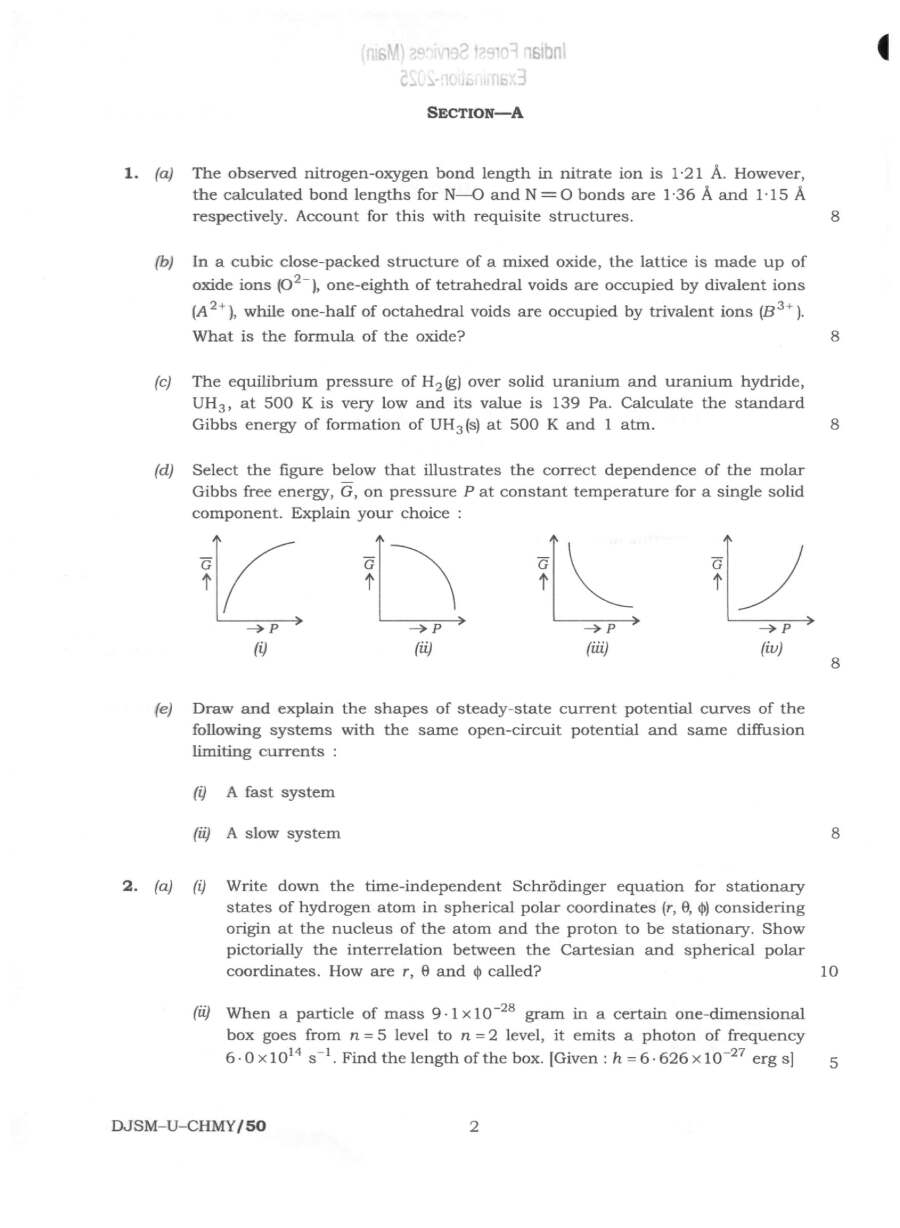
  • There are EIGHT questions in all, out of which FIVE are to be attempted.
  • Out of the remaining SIX questions, THREE are to be attempted selecting at least ONE question from each of the two Sections A and B.
  • Attempts of questions shall be counted in sequential order.
  • Unless struck off, attempt of a question shall be counted even if attempted partly.
  • Any page or portion of the page left blank in the Question-cum-Answer Booklet must be clearly struck off.
  • The number of marks carried by a question/part is indicated against it.
  • Unless otherwise mentioned, symbols and notations have their usual standard meanings.
  • Assume suitable data, if necessary, and indicate the same clearly.
  • Neat sketches may be drawn, wherever required.
  • Answers must be written in ENGLISH only.
  • Useful Constants: k_{\rm B} = 1.38 \times 10^{-23} J K-1 h = 6.626 \times 10^{-34} J s R = 8.314 J K-1 mol-1 \pi = 3.14 c=3\times10^8\, m s ^{-1} F = 96500 \text{ C mol}^{-1} N_A = 6.023 \times 10^{23} mol-1 1 atm = 101325 Pa m_e = 9.1 \times 10^{-31} kg

Questions (page 2)

Section A

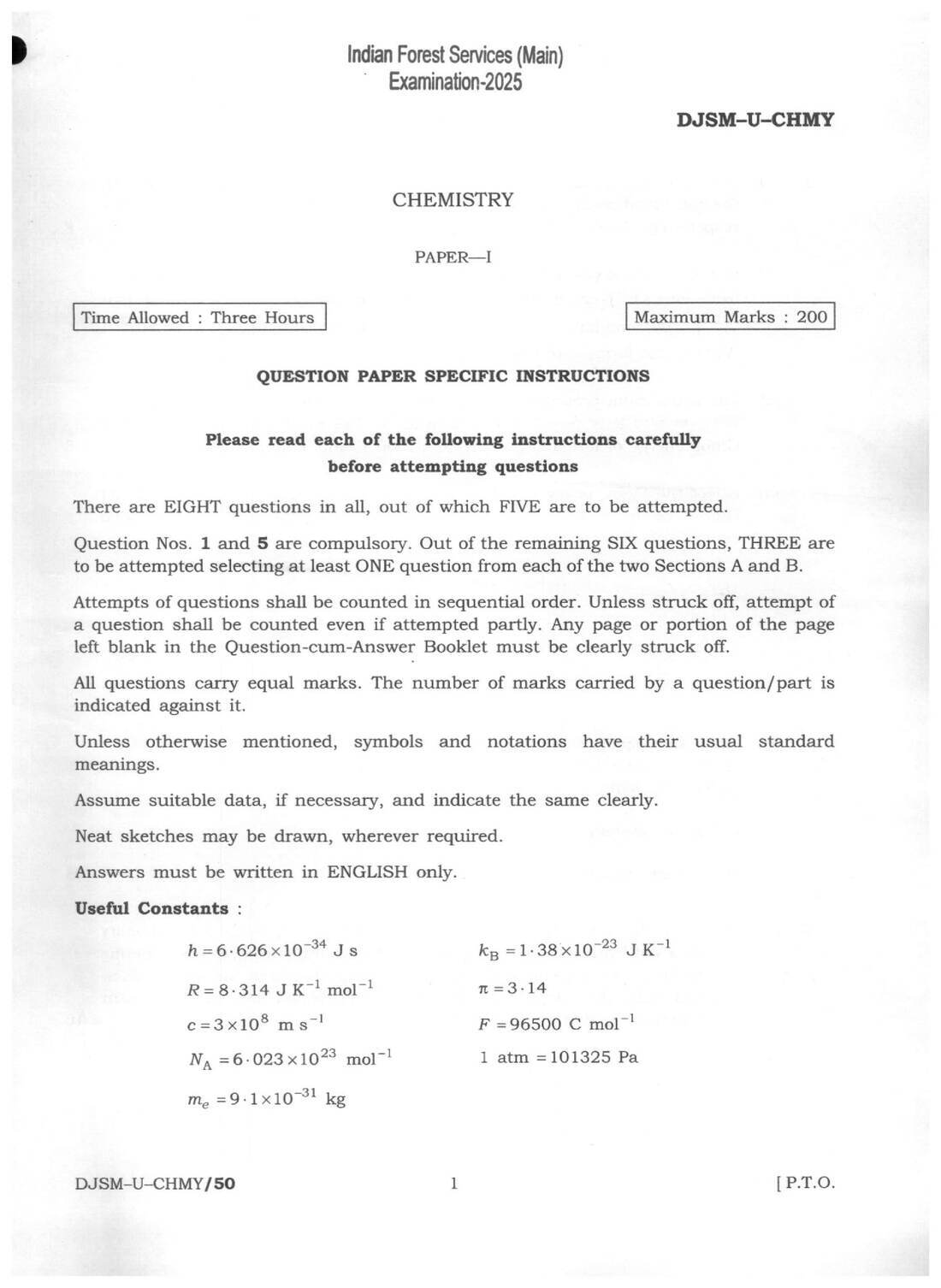
Q1. The observed nitrogen-oxygen bond length in nitrate ion is 1.21 Å. However, the calculated bond lengths for N—O and N = O bonds are 1.36 Å and 1.15 Å respectively. Account for this with requisite structures. In a cubic close-packed structure of a mixed oxide, the lattice is made up of oxide ions (O2-), one-eighth of tetrahedral voids are occupied by divalent ions (A2+), while one-half of octahedral voids are occupied by trivalent ions (B3+). What is the formula of the oxide? The equilibrium pressure of H2(g) over solid uranium and uranium hydride, UH3, at 500 K is very low and its value is 139 Pa. Calculate the standard Gibbs energy of formation of UH3(s) at 500 K and 1 atm. Select the figure below that illustrates the correct dependence of the molar Gibbs free energy, Ḡ, on pressure P at constant temperature for a single solid component. Explain your choice : Draw and explain the shapes of steady-state current potential curves of the following systems with the same open-circuit potential and same diffusion limiting currents:

(d) Select the figure below that illustrates the correct dependence of the molar Gibbs free energy, Ḡ, on pressure P at constant temperature for a single solid component. Explain your choice :

(d) (i)

(d) (ii)

(d) (iii)

(d) (iv)

(e) (i) A fast system

(e) (ii) A slow system
Section A

Q2. Write down the time-independent Schrödinger equation for stationary states of hydrogen atom in spherical polar coordinates (r, θ, φ) considering origin at the nucleus of the atom and the proton to be stationary. Show pictorially the interrelation between the Cartesian and spherical polar coordinates. How are r, θ and φ called? When a particle of mass 9.1 × 10⁻²⁸ gram in a certain one-dimensional box goes from n = 5 level to n = 2 level, it emits a photon of frequency 6.0 × 10¹⁴ s-1. Find the length of the box. [Given : h = 6.626 × 10⁻²⁷ erg s]

Question paper preview

Scanned pages 1–2 for reference. Download the official PDF for the full paper.

Page 1
Indian Forest Service (Main) Examination 2025 Chemistry Paper I page 1 instructions and useful constants scan PDF download
Page 2
Indian Forest Service (Main) Examination 2025 Chemistry Paper I page 1 instructions and useful constants scan PDF download

Free question paper download

Download question paper PDF

  • 2.1 MB
  • 8 pages
  • PDF format

Frequently asked questions

What is the name of the examination?

The examination is the Indian Forest Service (Main) Examination.

What is the year of this question paper?

This question paper is from the year 2025.

Which paper is this question paper for?

This is Chemistry Paper - I.

Who conducts the Indian Forest Service Examination?

The Indian Forest Service Examination is conducted by UPSC (Union Public Service Commission).

How many questions are there in total?

There are a total of EIGHT questions in this paper.

How many questions are compulsory?

Question Nos. 1 and 5 are compulsory.

← Back to Other Jobs papers