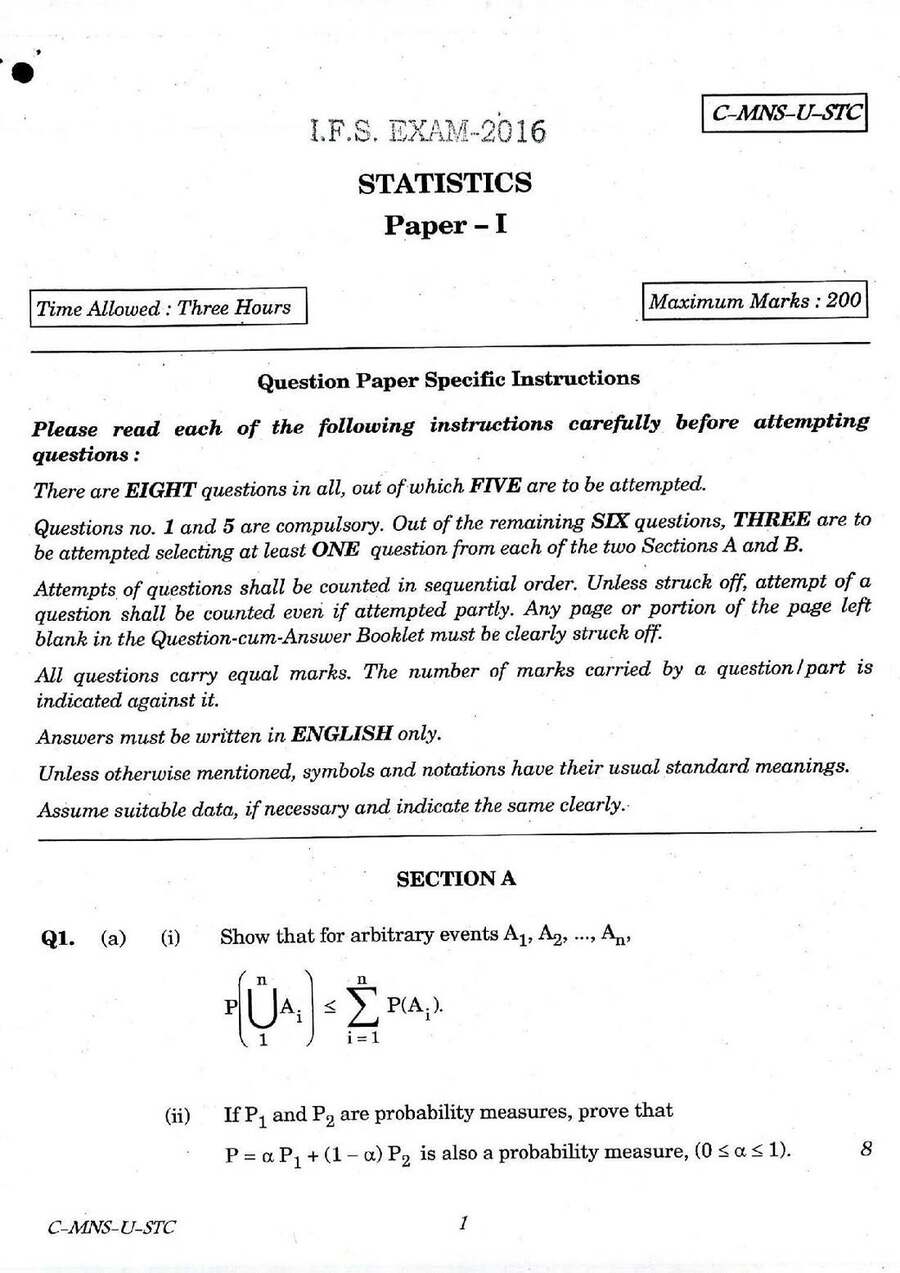
Q1.
(b)
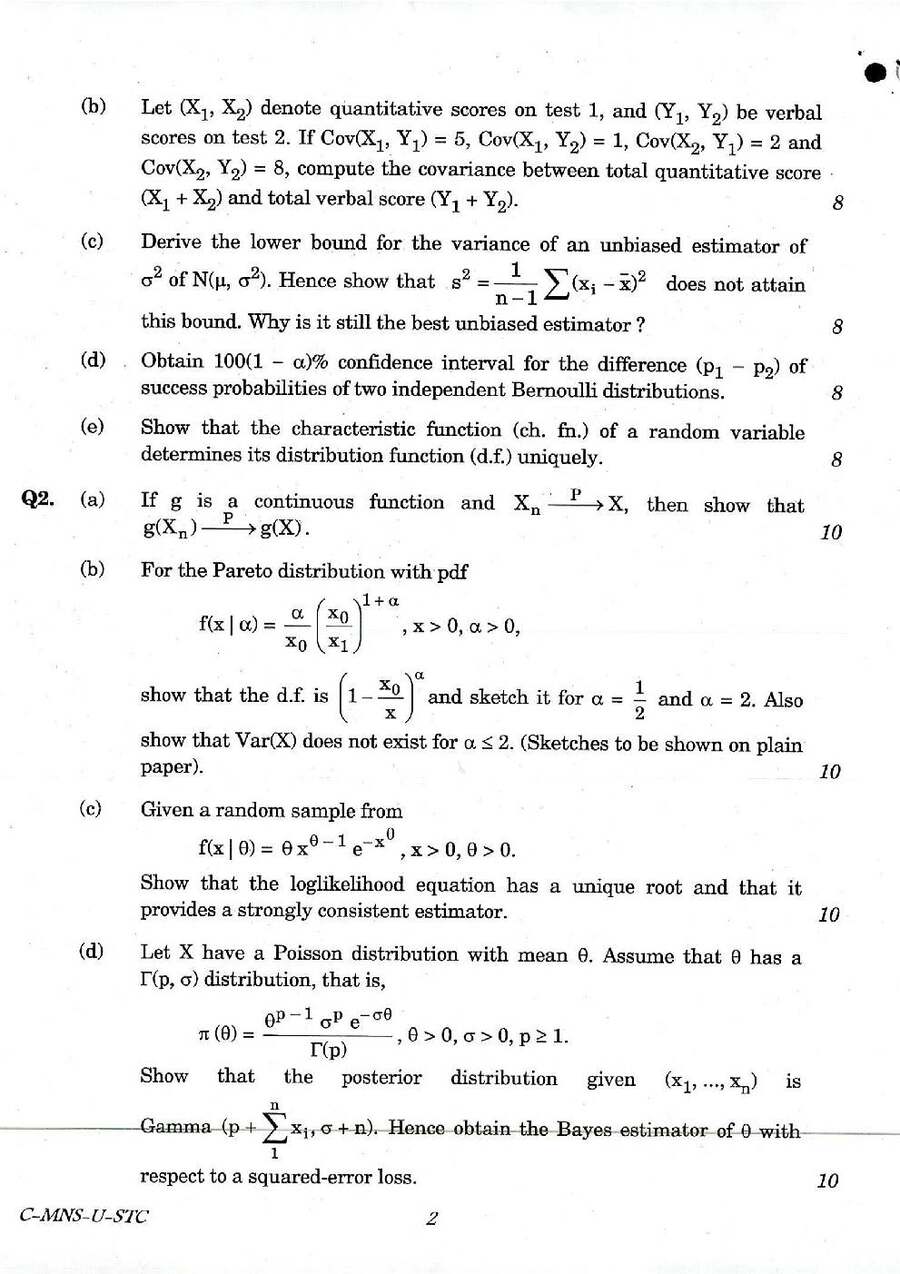
Let (X1, X2) denote quantitative scores on test 1, and (Y1, Y2) be verbal scores on test 2. If Cov(X1, Y1) = 5, Cov(X1, Y2) = 1, Cov(X2, Y1) = 2 and Cov(X2, Y2) = 8, compute the covariance between total quantitative score (X1 + X2) and total verbal score (Y1 + Y2).
(c)
Derive the lower bound for the variance of an unbiased estimator of sigma2 of N(mu, sigma2). Hence show that s2 = (1)/(n-1) sumi=1^n (xi - arx)2 does not attain this bound. Why is it still the best unbiased estimator?
(d)
Obtain 100(1 - α)% confidence interval for the difference (p1 - p2) of success probabilities of two independent Bernoulli distributions.
(e)
Show that the characteristic function (ch. fn.) of a random variable determines its distribution function (d.f.) uniquely.
Q2.
(a)
If g is a continuous function and Xn \xrightarrowP X, then show that g(Xn) \xrightarrowP g(X).
(b)
For the Pareto distribution with pdf f(x | α) = (α)/(x0) (x0)/(x) )1+α, x > 0, α > 0, show that the d.f. is 1-(x0)/(x))α and sketch it for α = 1/2 and α = 2. Also show that Var(X) does not exist for α leq 2. (Sketches to be shown on plain paper).
(c)
Given a random sample from f(x | θ) = θ xθ - 1 e^-xθ, x > 0, θ > 0. Show that the loglikelihood equation has a unique root and that it provides a strongly consistent estimator.
(d)
Let X have a Poisson distribution with mean θ. Assume that θ has a \Gamma(p, σ) distribution, that is, π(θ) = (θ^p-1\,σ^p,e^-σθ)/(\Gamma(p)),θ>0,σ>0,p≥1. Show that the posterior distribution given (x1, . . , xn) is Gamma (p + ∑i=1n xi, σ + n). Hence obtain the Bayes estimator of θ with respect to a squared-error loss.