IES ISS 2017 General Economics Paper I Question Paper PDF

Central Government Jobs Other Jobs 2017

  • Year 2017
  • Conducted By UPSC
  • Maximum Marks 200
  • Duration Three Hours
  • Languages English

Exam Details

Detail Information
Examination Indian Economic Service and Indian Statistical Service Examination
Year 2017
Conducting Body UPSC
Paper General Economics Paper - I
Subject Economics
Duration Three Hours
Maximum Marks 200
Question Type Mixed

This is the General Economics Paper - I from the Indian Economic Service and Indian Statistical Service Examination held in 2017, conducted by UPSC. The paper carried a maximum of 200 marks and was allocated three hours for completion. It is divided into three sections, with specific instructions on the number of questions to be attempted from each. This paper is crucial for aspirants aiming to qualify for these prestigious services, providing a clear understanding of the exam's scope and difficulty in economics.

Major Topics Covered

  • Cardinal Utility Analysis
  • Compensating Variation of Income
  • Cost Difference
  • Laws of Variable Proportions
  • Laws of Returns to Scale
  • Elasticity of Substitution
  • Fixed Coefficient Production Function
  • Cost Elasticity of Output
  • Average Cost Curve
  • Peak-Load Pricing
  • Third Degree Price Discrimination
  • Perfect Competition
  • Normal Profit
  • Supernormal Profit
  • Loss
  • Social Welfare
  • Private Welfare

Why This Paper is Important

  • Useful for Indian Economic Service and Indian Stati preparation
  • Helps understand the latest exam pattern
  • Useful for practice and self-assessment
  • Covers frequently asked General Studies topics
  • Helpful for analysing question trends

Related Resources

  • IES ISS 2017 General Economics Paper II
  • IES ISS 2017 Indian Statistics Paper I
  • IES ISS 2017 Indian Statistics Paper II
  • IES ISS 2017 General Economics Paper I Answer Key
  • IES ISS Exam Syllabus
  • General Economics Syllabus
  • IES ISS Exam Pattern
  • UPSC Exam Pattern

Instructions

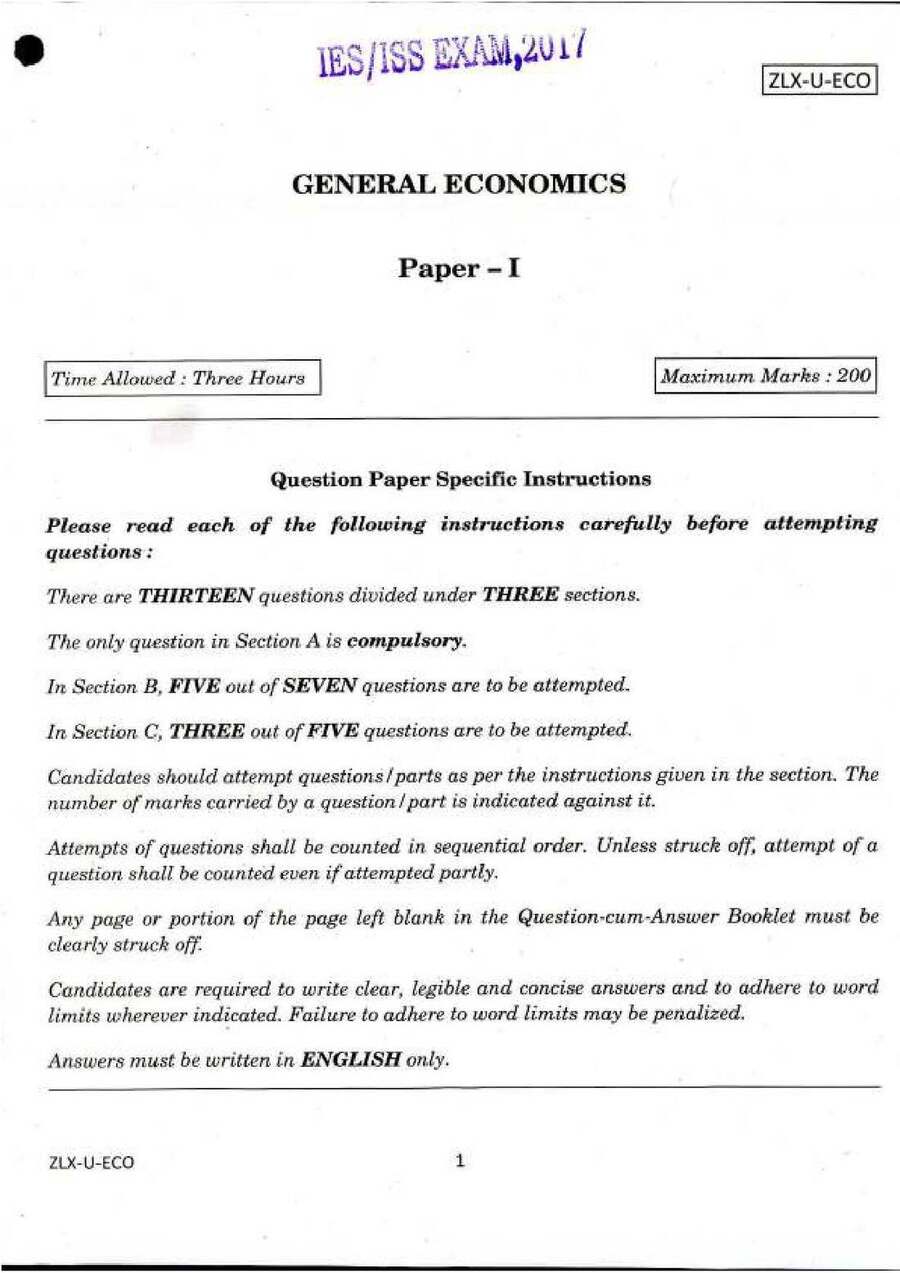
  • There are THIRTEEN questions divided under THREE sections.
  • The only question in Section A is compulsory.
  • In Section B, FIVE out of SEVEN questions are to be attempted.
  • In Section C, THREE out of FIVE questions are to be attempted.
  • Candidates should attempt questions/parts as per the instructions given in the section.
  • The number of marks carried by a question / part is indicated against it.
  • Attempts of questions shall be counted in sequential order.
  • Unless struck off, attempt of a question shall be counted even if attempted partly.
  • Any page or portion of the page left blank in the Question-cum-Answer Booklet must be clearly struck off.
  • Candidates are required to write clear, legible and concise answers and to adhere to word limits wherever indicated.
  • Failure to adhere to word limits may be penalized.
  • Answers must be written in ENGLISH only.

Questions (page 2)

Section A

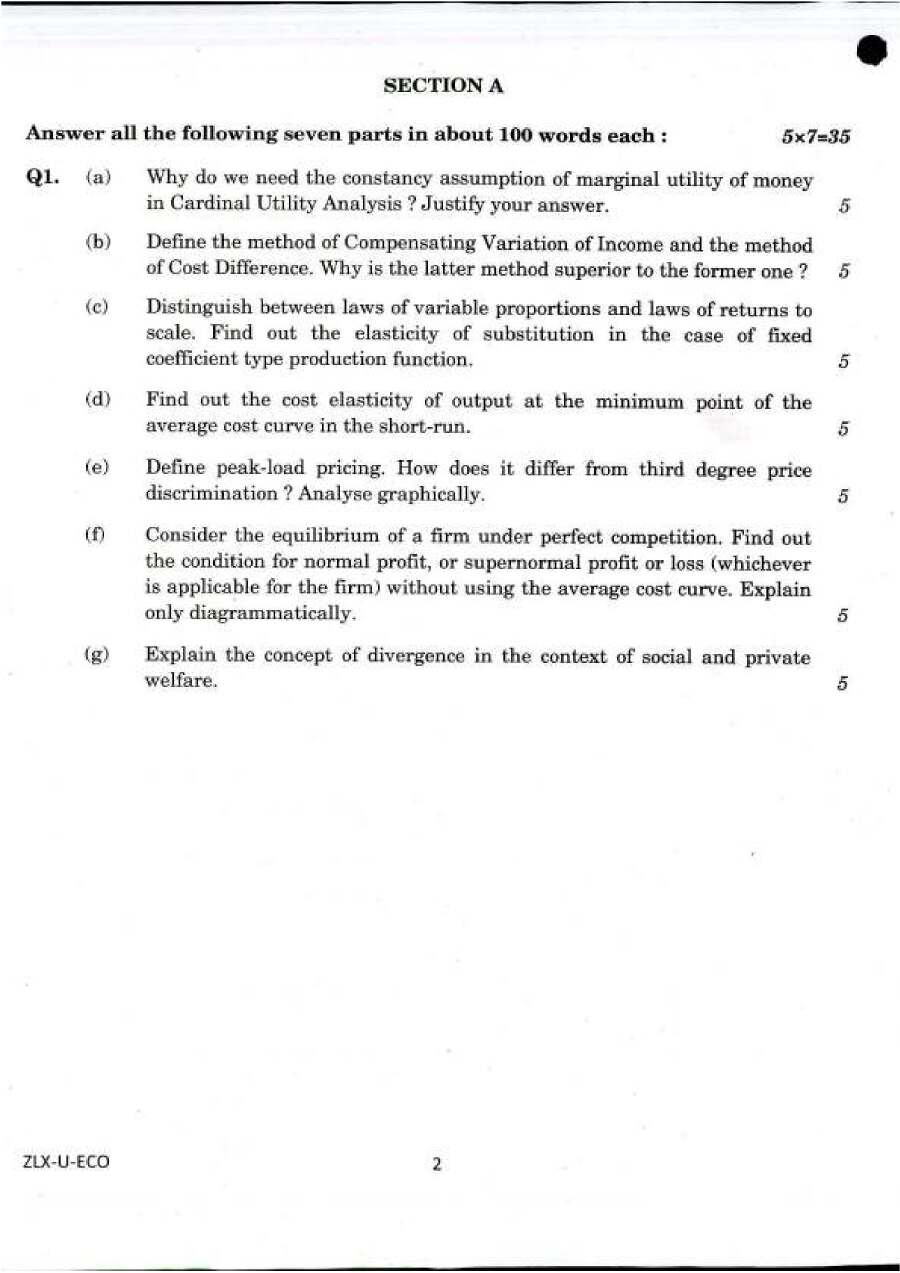
Q1. Answer all the following seven parts in about 100 words each :

(a) Why do we need the constancy assumption of marginal utility of money in Cardinal Utility Analysis ? Justify your answer.

(b) Define the method of Compensating Variation of Income and the method of Cost Difference. Why is the latter method superior to the former one?

(c) Distinguish between laws of variable proportions and laws of returns to scale. Find out the elasticity of substitution in the case of fixed coefficient type production function.

(d) Find out the cost elasticity of output at the minimum point of the average cost curve in the short-run.

(e) Define peak-load pricing. How does it differ from third degree price discrimination ? Analyse graphically.

(f) Consider the equilibrium of a firm under perfect competition. Find out the condition for normal profit, or supernormal profit or loss (whichever is applicable for the firm) without using the average cost curve. Explain only diagrammatically.

(g) Explain the concept of divergence in the context of social and private welfare.
Question paper preview

Scanned pages 1–2 for reference. Download the official PDF for the full paper.

Page 1
IES ISS 2017 General Economics Paper I question paper page 1 instructions scan PDF download UPSC
Page 2
IES ISS 2017 General Economics Paper I question paper page 1 instructions scan PDF download UPSC

Free question paper download

Download question paper PDF

  • 327 KB
  • 6 pages
  • PDF format

Frequently asked questions

What is the name of the exam?

The exam is the Indian Economic Service and Indian Statistical Service Examination.

Which year is this question paper from?

This question paper is from the year 2017.

Who conducts the IES/ISS Examination?

The examination is conducted by UPSC (Union Public Service Commission).

What is the subject of this paper?

The subject is General Economics, Paper - I.

What is the maximum marks for this paper?

The maximum marks for this paper are 200.

What is the time allowed to complete the paper?

The time allowed is Three Hours.

← Back to Other Jobs papers