Section A
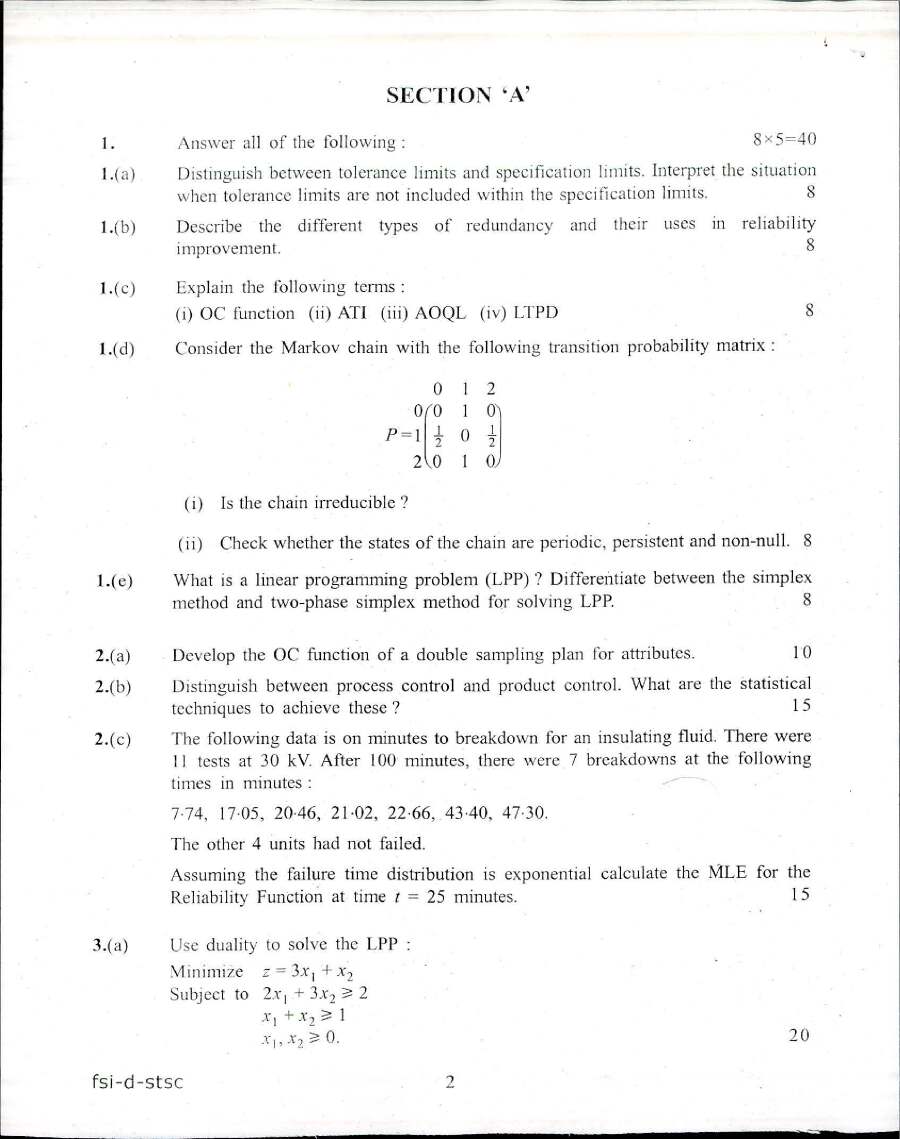
Q1. Answer all of the following: Distinguish between tolerance limits and specification limits. Interpret the situation 1.
(a) when tolerance limits are not included within the specification limits. 8 Describe the different types of redundancy and their uses in reliability 1.
(b) 8 improvement. Explain the following terms: 1.
(c) 8
(i) OC function (ii) ATI (iii) AOQL (iv) LTPD Consider the Markov chain with the following transition probability matrix : 1.
(d) P = \beginbmatrix 0 & 1 & 0 \\ 1/2 & 0 & 1/2 \\ 0 & 1 & 0 \endbmatrix Is the chain irreducible?
(i) (ii) Check whether the states of the chain are periodic, persistent and non-null. 8 What is a linear programming problem (LPP)? Differentiate between the simplex 1.
(e) method and two-phase simplex method for solving LPP. 8 Develop the OC function of a double sampling plan for attributes. 2.
(a) Distinguish between process control and product control. What are the statistical 2.
(b) techniques to achieve these? The following data is on minutes to breakdown for an insulating fluid. There were 2.
(c) 11 tests at 30 kV. After 100 minutes, there were 7 breakdowns at the following times in minutes : 7.74, 17.05, 20.46, 21.02, 22.66, 43.40, 47.30. The other 4 units had not failed. Assuming the failure time distribution is exponential calculate the MLE for the Reliability Function at time t = 25 minutes. Use duality to solve the LPP : 3
(a) Minimize z = 3x1 + x2 Subject to 2x1 + 3x2 ≥ 2 x1 + x2 ≥ 1 x1, x2 ≥ 0. fsi-d-stsc \overline2