Geophysics Paper I 2018 - Combined Geo-Scientist & Geologist Exam
- Year 2018
- Conducted By Combined Geo-Scientist and Geologist Examination
- Questions 10
- Maximum Marks 200
- Duration Three Hours Maximum Marks: 200
- Languages English & Hindi
Exam Details
| Detail | Information |
|---|---|
| Examination | Geophysics Paper I |
| Year | 2018 |
| Conducting Body | Combined Geo-Scientist and Geologist Examination |
| Paper | Geophysics |
| Subject | Geophysics |
| Duration | Three Hours Maximum Marks: 200 |
| Maximum Marks | 200 |
| Number of Questions | 10 |
| Question Type | Mixed |
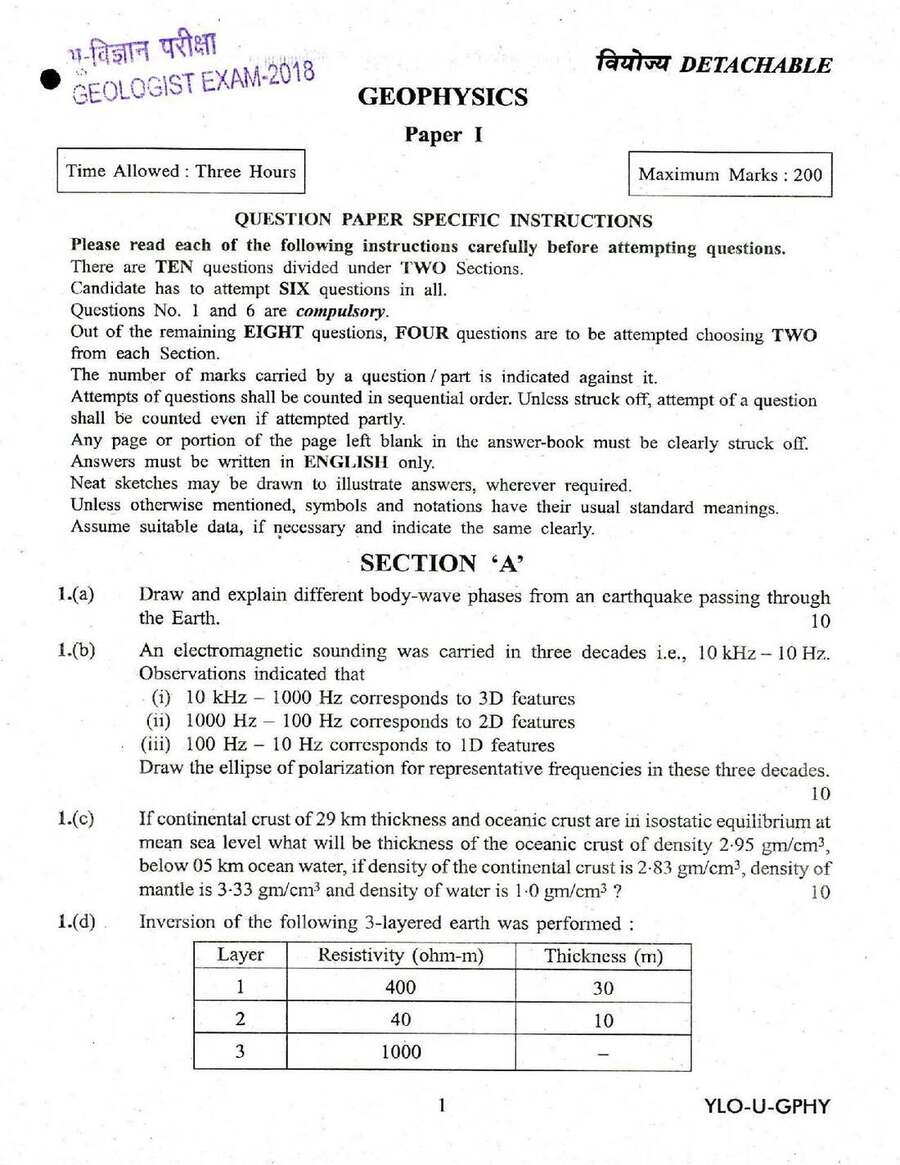
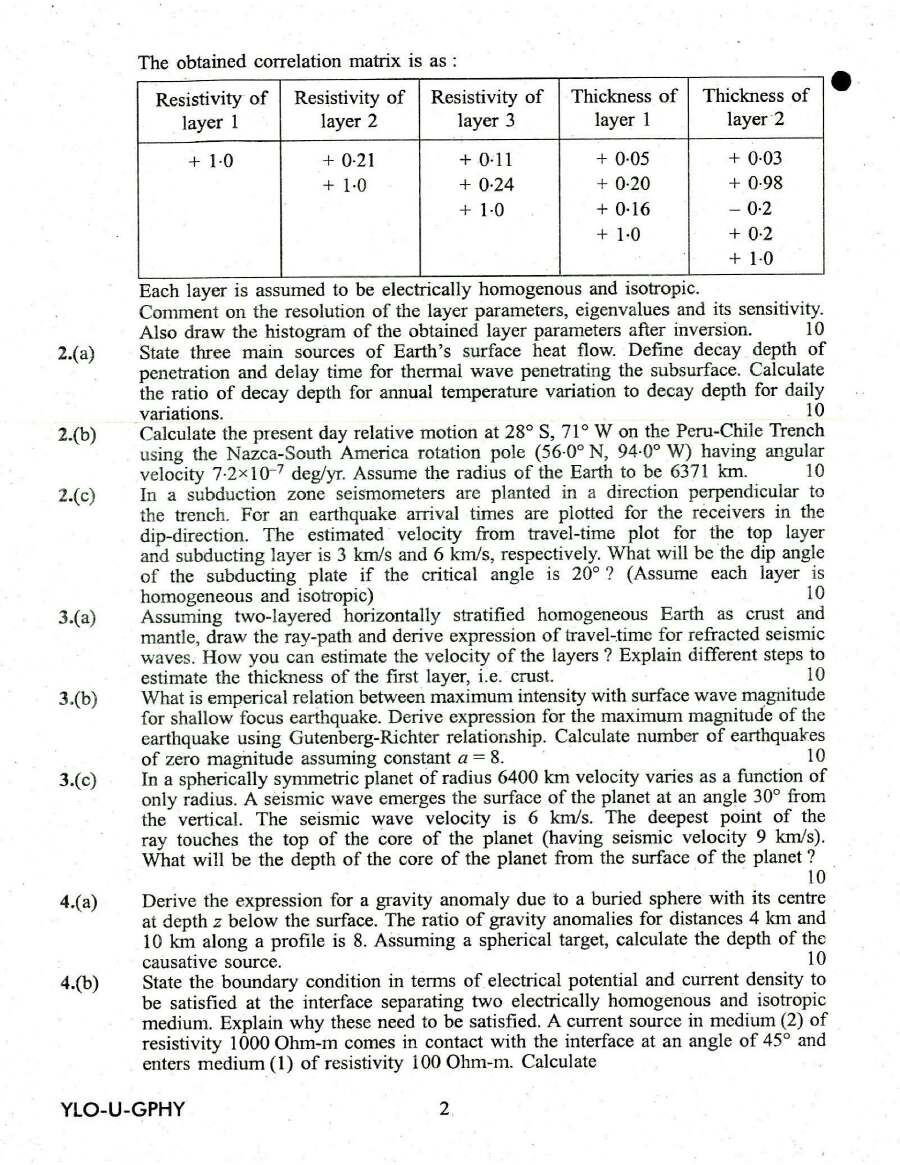
This dataset combines Page 1 and Page 2 OCR content for Geophysics Paper I from the Combined Geo-Scientist and Geologist Examination, 2018. Page 1 provides the exam header, instructions, and Section A questions 1(a)–(d). Page 2 contains the corrected objective-style content comprising questions 2(a)–2(c), 3(a), 3(c), and 4(a)–4(b). The repair workflow aligns two-column OCR, fixes broken words, restores line breaks, and preserves numbering. The metadata emphasizes the exam format, compulsory questions, and the general style of geophysics questions ranging from seismology and heat flow to gravity and electrical methods.
Major Topics Covered
- Body-wave seismology
- Polarization ellipse
- Isostasy and crustal structure
- Three-layer Earth models
- Electromagnetic sounding
- Electrical resistivity
- Heat flow and thermal diffusion
- Subduction zone seismology
- Ray tracing and travel-time
- Gutenberg-Richter relation
- Surface wave magnitude
- Gravity anomalies
- Boundary conditions in geophysics
- Two-layer Earth model
- Core-mantle interactions
- Planetary seismology
- Inversion techniques
- Depth estimation
- Subsidence and mantle densities
- Seismic velocities
Why This Paper is Important
- Useful for Geophysics Paper I preparation
- Helps understand the latest exam pattern
- Useful for practice and self-assessment
- Covers frequently asked General Studies topics
- Helpful for analysing question trends
Related Resources
- UPSC Combined Geo-Scientist 2019 Chemistry Paper II PDF
- Combined Geo-Scientist 2019 Chemistry Paper I Question Paper PDF
- Combined Geo-Scientist Geologist 2019 Geophysics Paper II UPSC PDF
- UPSC Combined Geo-Scientist Geologist 2019 Geophysics Paper I PDF
- Combined Geo-Scientist 2019 Geology Paper III Question Paper PDF
Instructions
- There are TEN questions divided under TWO Sections.
- Candidate has to attempt SIX questions in all.
- Out of the remaining EIGHT questions, FOUR questions are to be attempted choosing TWO from each Section.
- The number of marks carried by a question / part is indicated against it.
- Attempts of questions shall be counted in sequential order.
- Unless struck off, attempt of a question shall be counted even if attempted partly.
- Any page or portion of the page left blank in the answer-book must be clearly struck off.
- Answers must be written in ENGLISH only.
- Neat sketches may be drawn to illustrate answers, wherever required.
- Unless otherwise mentioned, symbols and notations have their usual standard meanings.
- Assume suitable data, if necessary and indicate the same clearly.
Questions (page 2)
Q1. The obtained correlation matrix is as : Thickness of Thickness of Resistivity of Resistivity of Resistivity of layer 1 layer 2 layer 3 layer 2 layer 1 + 0.03 +1.0 + 0.11 +0.05 + 0.21 +0.98 + 0.20 +0.24 +1.0 -0.2 +0.16 +1.0 + 0.2 +1.0 + 1.0 Each layer is assumed to be electrically homogenous and isotropic. Comment on the resolution of the layer parameters, eigenvalues and its sensitivity. Also draw the histogram of the obtained layer parameters after inversion. 10 State three main sources of Earth's surface heat flow. Define decay depth of
Q2.
(a) penetration and delay time for thermal wave penetrating the subsurface. Calculate the ratio of decay depth for annual temperature variation to decay depth for daily variations. Calculate the present day relative motion at 28° S, 71° W on the Peru-Chile Trench 2.
(b) using the Nazca-South America rotation pole (56.0° N, 94.0° W) having angular velocity 7.2 × 10⁻⁷ deg/yr. Assume the radius of the Earth to be 6371 km.
(c)
In a subduction zone seismometers are planted in a direction perpendicular to
2. the trench. For an earthquake arrival times are plotted for the receivers in the dip-direction. The estimated velocity from travel-time plot for the top layer and subducting layer is 3 km/s and 6 km/s, respectively. What will be the dip angle of the subducting plate if the critical angle is 20°? (Assume each layer is homogeneous and isotropic) Assuming two-layered horizontally stratified homogeneous Earth as crust and 3.(a) mantle, draw the ray-path and derive expression of travel-time for refracted seismic waves. How you can estimate the velocity of the layers ? Explain different steps to estimate the thickness of the first layer, i.e. crust. What is emperical relation between maximum intensity with surface wave magnitude 3
(6) for shallow focus earthquake. Derive expression for the maximum magnitude of the earthquake using Gutenberg-Richter relationship. Calculate number of earthquakes of zero magnitude assuming constant a = 8. In a spherically symmetric planet of radius 6400 km velocity varies as a function of
3. (c) only radius. A seismic wave emerges the surface of the planet at an angle 30° from the vertical. The seismic wave velocity is 6 km/s. The deepest point of the ray touches the top of the core of the planet (having seismic velocity 9 km/s). What will be the depth of the core of the planet from the surface of the planet? Derive the expression for a gravity anomaly due to a buried sphere with its centre 4.(a) at depth z below the surface. The ratio of gravity anomalies for distances 4 km and km along a profile is
8. Assuming a spherical target, calculate the depth of the causative source. State the boundary condition in terms of electrical potential and current density to 4.(b) be satisfied at the interface separating two electrically homogenous and isotropic medium. Explain why these need to be satisfied. A current source in medium
(2) of resistivity 1000 Ohm-m comes in contact with the interface at an angle of 45° and enters medium
(1) of resistivity 100 Ohm-m. Calculate YLO-U-GPHY 2\cdot
Q2.
(a) penetration and delay time for thermal wave penetrating the subsurface. Calculate the ratio of decay depth for annual temperature variation to decay depth for daily variations. Calculate the present day relative motion at 28° S, 71° W on the Peru-Chile Trench 2.
(b) using the Nazca-South America rotation pole (56.0° N, 94.0° W) having angular velocity 7.2 × 10⁻⁷ deg/yr. Assume the radius of the Earth to be 6371 km.
(c)
In a subduction zone seismometers are planted in a direction perpendicular to
2. the trench. For an earthquake arrival times are plotted for the receivers in the dip-direction. The estimated velocity from travel-time plot for the top layer and subducting layer is 3 km/s and 6 km/s, respectively. What will be the dip angle of the subducting plate if the critical angle is 20°? (Assume each layer is homogeneous and isotropic) Assuming two-layered horizontally stratified homogeneous Earth as crust and 3.(a) mantle, draw the ray-path and derive expression of travel-time for refracted seismic waves. How you can estimate the velocity of the layers ? Explain different steps to estimate the thickness of the first layer, i.e. crust. What is emperical relation between maximum intensity with surface wave magnitude 3
(6) for shallow focus earthquake. Derive expression for the maximum magnitude of the earthquake using Gutenberg-Richter relationship. Calculate number of earthquakes of zero magnitude assuming constant a = 8. In a spherically symmetric planet of radius 6400 km velocity varies as a function of
3. (c) only radius. A seismic wave emerges the surface of the planet at an angle 30° from the vertical. The seismic wave velocity is 6 km/s. The deepest point of the ray touches the top of the core of the planet (having seismic velocity 9 km/s). What will be the depth of the core of the planet from the surface of the planet? Derive the expression for a gravity anomaly due to a buried sphere with its centre 4.(a) at depth z below the surface. The ratio of gravity anomalies for distances 4 km and km along a profile is
8. Assuming a spherical target, calculate the depth of the causative source. State the boundary condition in terms of electrical potential and current density to 4.(b) be satisfied at the interface separating two electrically homogenous and isotropic medium. Explain why these need to be satisfied. A current source in medium
(2) of resistivity 1000 Ohm-m comes in contact with the interface at an angle of 45° and enters medium
(1) of resistivity 100 Ohm-m. Calculate YLO-U-GPHY 2\cdot
Q3.
1.
(c) Mean sea level what will be thickness of the oceanic crust of density 2.95 gm/cm^3, below 0.5 km ocean water, if density of the continental crust is 2.83 gm/cm^3, density of mantle is 3.33 gm/cm^3 and density of water is 1.0 gm/cm^3? (10 marks)
Q4. 1.(d) Inversion of the following 3-layered earth was performed: Resistivity (ohm-m) Layer Thickness (m) 1 400 30 40 2 10 3 1000. (10 marks)
Q5. 2.(a) State three main sources of Earth's surface heat flow. Define decay depth of penetration and delay time for thermal wave penetrating the subsurface. Calculate the ratio of decay depth for annual temperature variation to decay depth for daily variations. Calculate the present day relative motion at 28° S, 71° W on the Peru-Chile Trench. (10 marks)
Q6. 2.(b) Using the Nazca-South America rotation pole (56.0° N, 94.0° W) having angular velocity 7.2 × 10^{-7} deg/yr. Assume the radius of the Earth to be 6371 km. (10 marks)
Q7.
2.
(c) In a subduction zone seismometers are planted in a direction perpendicular to the trench. For an earthquake arrival times are plotted for the receivers in the dip-direction. The estimated velocity from travel-time plot for the top layer and subducting layer is 3 km/s and 6 km/s, respectively. What will be the dip angle of the subducting plate if the critical angle is 20°? (Assume each layer is 10 km homogeneous and isotropic). (10 marks)
Q8. 3.(a) In a two-layered horizontally stratified Earth as crust and mantle, draw the ray-path and derive expression of travel-time for refracted seismic waves. How you can estimate the velocity of the layers? Explain different steps to estimate the thickness of the first layer, i.e. crust. (10 marks)
Q9.
3.
(c) In a spherically symmetric planet of radius 6400 km velocity varies as a function of only radius. A seismic wave emerges the surface of the planet at an angle 30° from the vertical. The seismic wave velocity is 6 km/s. The deepest point of the ray touches the top of the core of the planet (having seismic velocity 9 km/s). What will be the depth of the core of the planet from the surface of the planet? (10 marks)
Q10. 4.(a) Derive the expression for a gravity anomaly due to a buried sphere with its centre at depth z below the surface. The ratio of gravity anomalies for distances 4 km and 10 km along a profile is 8. Assuming a spherical target, calculate the depth of the 10 causative source. (10 marks)
Question paper preview
Scanned pages 1–2 for reference. Download the official PDF for the full paper.
Free question paper download
Download question paper PDF
Your download starts in 10s
Preparing your question paper file…
Frequently asked questions
What is the full name of the exam in the header?
GEOLOGIST EXAM-2018 - Combined Geo-Scientist and Geologist Examination (Geophysics Paper I).
How many questions are in the paper and how many must be answered?
There are ten questions; six questions must be attempted.
Which questions are compulsory?
Questions No. 1 and 6 are compulsory.
In which language should answers be written?
Answers must be written in English only (as per paper instructions).
What is the time allowed and maximum marks?
Three hours; maximum marks 200.
Which section contains Q1(a)–Q1(d)?
Section A.