Indian Forest Service 2019 Geology Paper II Question Paper PDF
- Year 2019
- Conducted By UPSC
- Questions 8
- Maximum Marks 200
- Duration Three Hours
- Languages English
Exam Details
| Detail | Information |
|---|---|
| Examination | Indian Forest Service (Main) Examination |
| Year | 2019 |
| Conducting Body | UPSC |
| Paper | Geology Paper - II |
| Subject | Geology |
| Duration | Three Hours |
| Maximum Marks | 200 |
| Number of Questions | 8 |
| Question Type | Mixed |
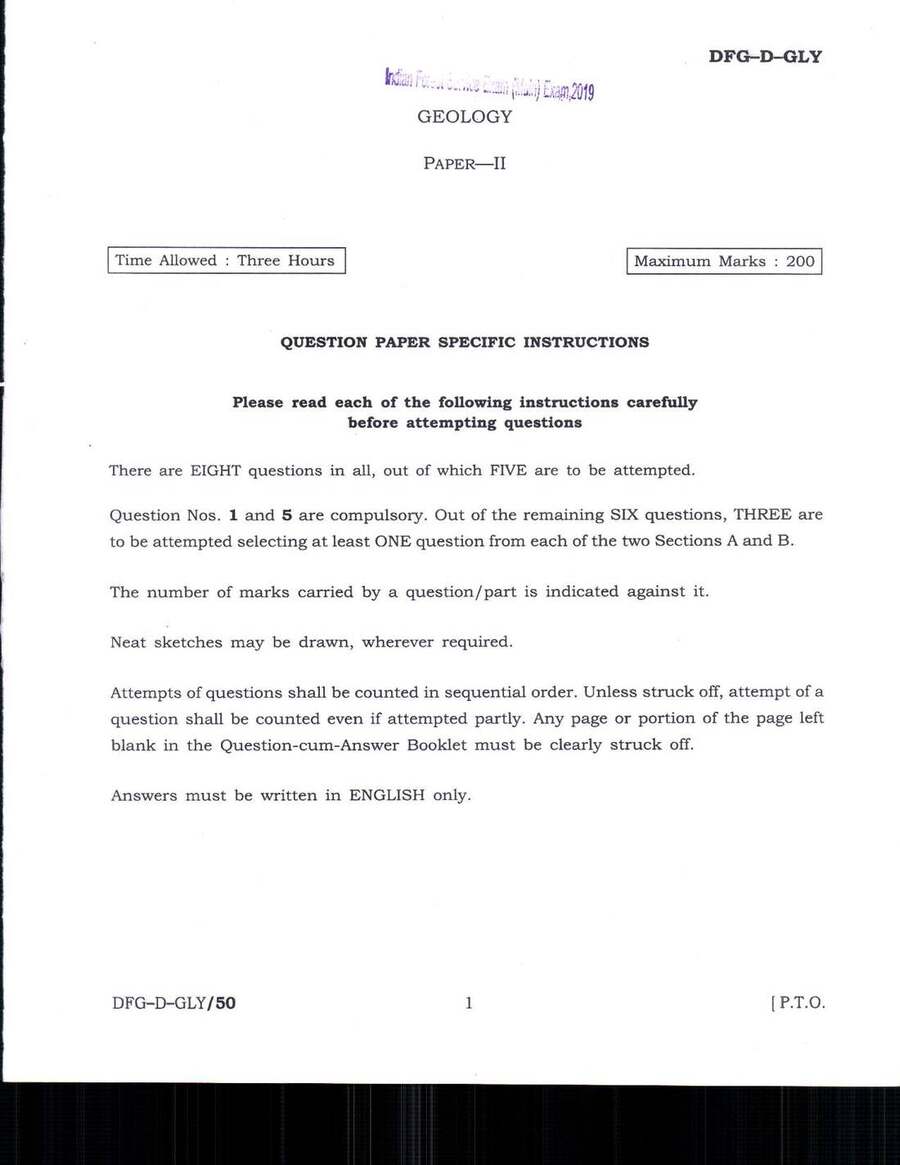
This is the official question paper for the Indian Forest Service (Main) Examination 2019, specifically for Geology Paper II. Conducted by UPSC, this paper tests candidates on advanced geological concepts over a duration of three hours, with a maximum of 200 marks. It comprises a mix of compulsory and optional questions, requiring detailed knowledge of various geological domains. Aspirants preparing for the IFS exam can use this paper to understand the question format, marking scheme, and the depth of knowledge expected in Geology.
Major Topics Covered
- Augite
- Hornblende
- Hypersthene
- Deccan Volcanic Province
- Sedimentary Rocks
- Anisotropic Minerals
- Interference Colours
- Granite
- Gabbro
- Syenite
- Charnockite
- Sedimentary Basins of India
- Hydrocarbon Prospects
- Cataclastic Metamorphism
- Cubic System
- Heavy Minerals
- Mineral Stability
- Magma Diversification
- Igneous Systems
- Mica Group of Minerals
- Conglomerate
- Shale
- Igneous Rocks
- Inosilicates
- Nesosilicates
Why This Paper is Important
- Useful for Indian Forest Service (Main) Examination preparation
- Helps understand the latest exam pattern
- Useful for practice and self-assessment
- Covers frequently asked General Studies topics
- Helpful for analysing question trends
Related Resources
- Indian Forest Service (Main) Examination 2018 Geology Paper II
- Indian Forest Service (Main) Examination 2020 Geology Paper II
- Geologists Examination 2019 Paper I
- Indian Forest Service 2019 Geology Paper II Answer Key
- Indian Forest Service Main Syllabus
- Geology Syllabus for Competitive Exams
- Indian Forest Service Main Exam Pattern
- UPSC Exam Pattern
Instructions
- There are EIGHT questions in all, out of which FIVE are to be attempted.
- Out of the remaining SIX questions, THREE are to be attempted selecting at least ONE question from each of the two Sections A and B.
- The number of marks carried by a question/part is indicated against it.
- Neat sketches may be drawn, wherever required.
- Attempts of questions shall be counted in sequential order.
- Unless struck off, attempt of a question shall be counted even if attempted partly.
- Any page or portion of the page left blank in the Question-cum-Answer Booklet must be clearly struck off.
- Answers must be written in ENGLISH only.
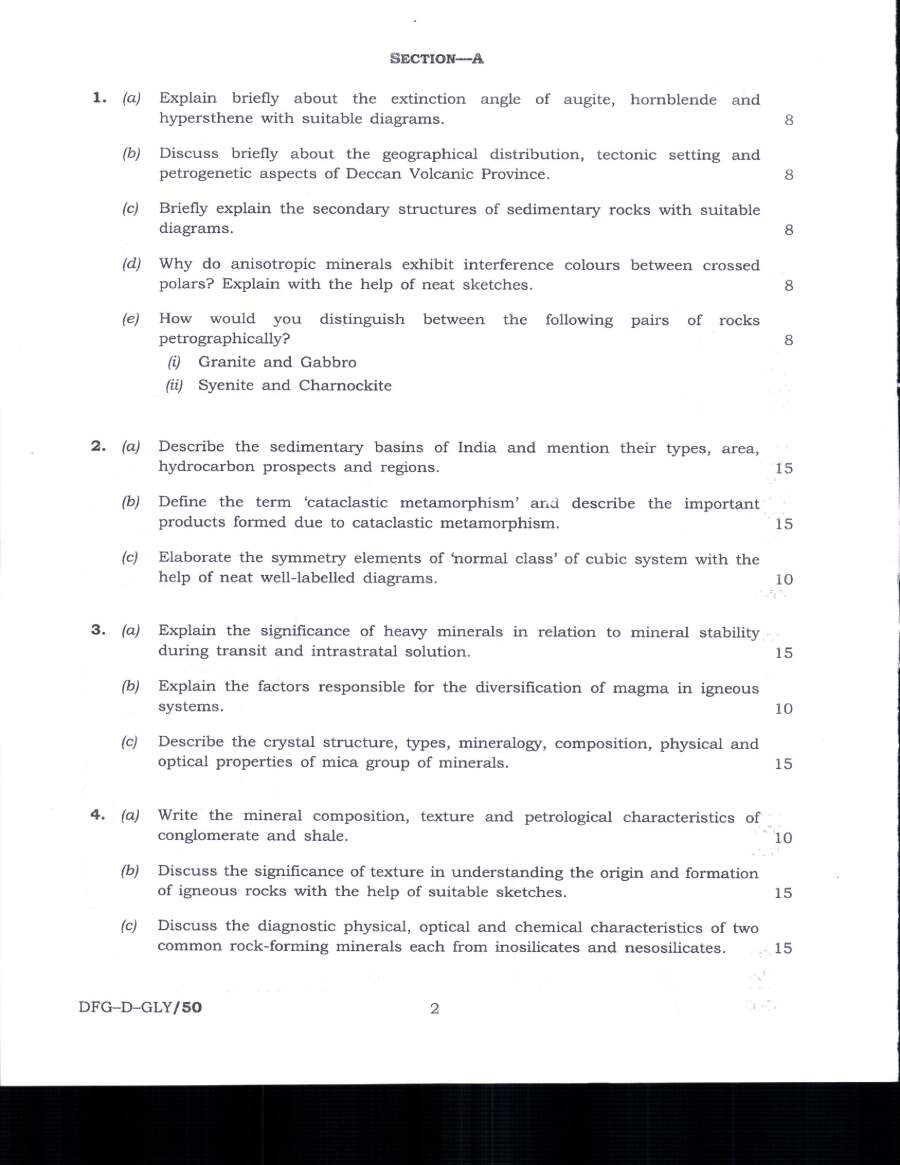
Questions (page 2)
Q2. (a) Describe the sedimentary basins of India and mention their types, area, r p hydrocarbon prospects and regions.
Q3. (a) Explain the significance of heavy minerals in relation to mineral stability during transit and intrastratal solution.
Q4. (a) Write the mineral composition, texture and petrological characteristics of conglomerate and shale.
Question paper preview
Scanned pages 1–2 for reference. Download the official PDF for the full paper.
Free question paper download
Download question paper PDF
Your download starts in 10s
Preparing your question paper file…
Frequently asked questions
What is the name of the exam for which this question paper is intended?
This question paper is for the Indian Forest Service (Main) Examination.
Which year is this Indian Forest Service question paper from?
This question paper is from the year 2019.
Who conducts the Indian Forest Service Examination?
The Indian Forest Service Examination is conducted by UPSC (Union Public Service Commission).
What is the subject of this specific question paper?
The subject of this question paper is Geology, specifically Paper II.
What is the maximum marks for Geology Paper II?
The maximum marks for Geology Paper II is 200.
What is the time duration allowed for this paper?
The time allowed for this paper is Three Hours.