UPSC Combined Geo-Scientist 2020 Geophysics Paper III PDF

Central Government Jobs Other Jobs 2020

  • Year 2020
  • Conducted By UPSC
  • Maximum Marks 200
  • Duration Three Hours
  • Languages English

Exam Details

Detail Information
Examination Combined Geo-Scientist (Main) Examination
Year 2020
Conducting Body UPSC
Paper Geophysics Paper - III
Subject Geophysics
Duration Three Hours
Maximum Marks 200
Question Type Mixed

This is the official question paper for the UPSC Combined Geo-Scientist (Main) Examination 2020, specifically for Geophysics Paper - III. The paper is designed to test candidates' in-depth knowledge in Geophysics, carrying a maximum of 200 marks and allowing a duration of three hours for completion. It comprises a mix of compulsory and optional questions divided into two sections, requiring candidates to attempt a total of six questions. This paper is a crucial resource for aspirants preparing for the Combined Geo-Scientist examination, providing insights into the exam's structure, question complexity, and subject coverage.

Major Topics Covered

  • Scintillation counters
  • FIR low-pass filter
  • Shipboard operations
  • Eötvös correction
  • Hydrophone
  • Aquifer properties
  • Hydraulic conductivity
  • Mapping cameras
  • Focal length lenses
  • Digital camera sensor
  • Angular field of view
  • Cross-correlation of signals

Why This Paper is Important

  • Useful for Combined Geo-Scientist (Main) Examinatio preparation
  • Helps understand the latest exam pattern
  • Useful for practice and self-assessment
  • Covers frequently asked General Studies topics
  • Helpful for analysing question trends

Related Resources

  • Combined Geo-Scientist (Main) Examination 2021 Geophysics Paper III
  • Combined Geo-Scientist (Main) Examination 2019 Geophysics Paper III
  • UPSC Geologist Examination Previous Year Papers
  • Combined Geo-Scientist 2020 Geophysics Paper III Answer Key
  • UPSC Geophysics Paper III Solutions 2020
  • Combined Geo-Scientist Main Syllabus Geophysics
  • UPSC Geophysics Syllabus
  • Combined Geo-Scientist Main Exam Pattern

Instructions

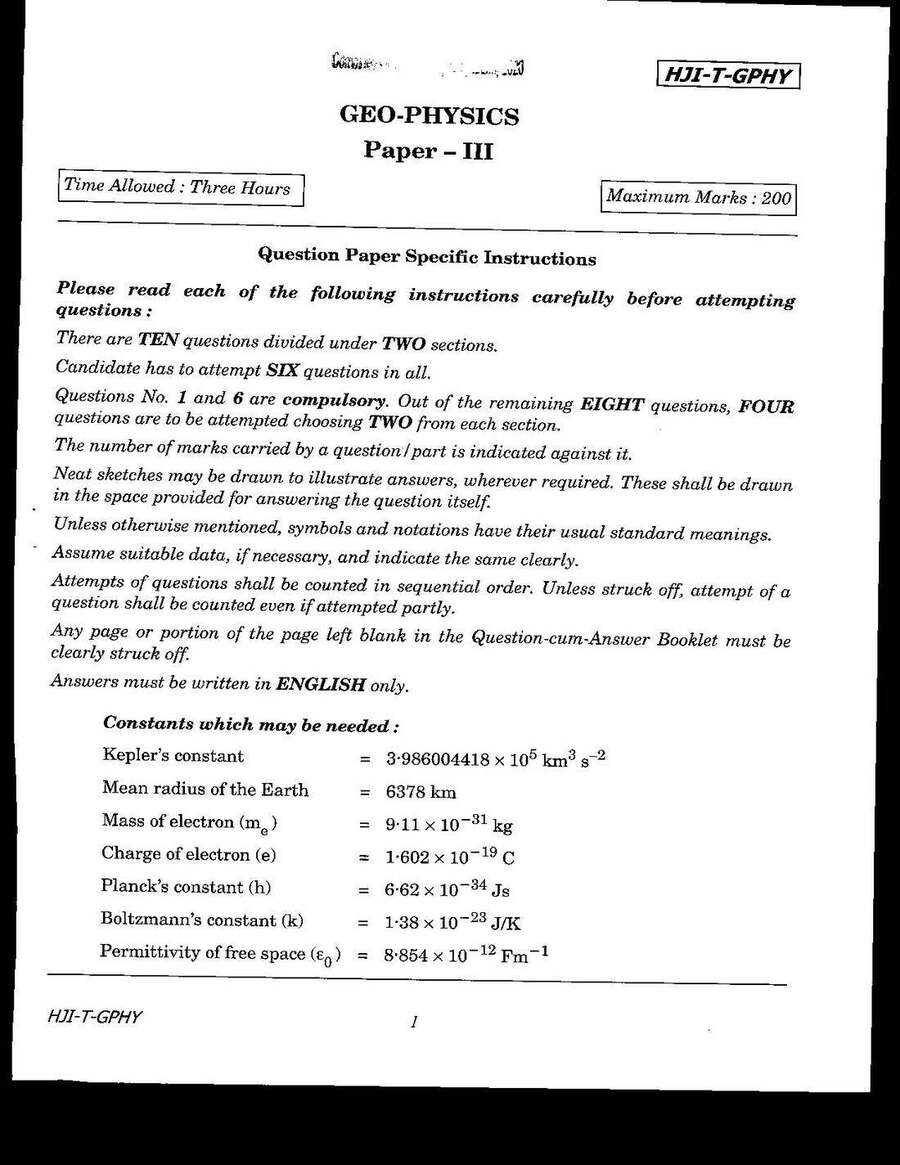
  • There are TEN questions divided under TWO sections.
  • Candidate has to attempt SIX questions in all.
  • Out of the remaining EIGHT questions, FOUR questions are to be attempted choosing TWO from each section.
  • The number of marks carried by a question/part is indicated against it.
  • Neat sketches may be drawn to illustrate answers, wherever required.
  • These shall be drawn in the space provided for answering the question itself.
  • Unless otherwise mentioned, symbols and notations have their usual standard meanings.
  • Assume suitable data, if necessary, and indicate the same clearly.
  • Attempts of questions shall be counted in sequential order.
  • Unless struck off, attempt of a question shall be counted even if attempted partly.
  • Any page or portion of the page left blank in the Question-cum-Answer Booklet must be clearly struck off.
  • Answers must be written in ENGLISH only.

Questions (page 2)

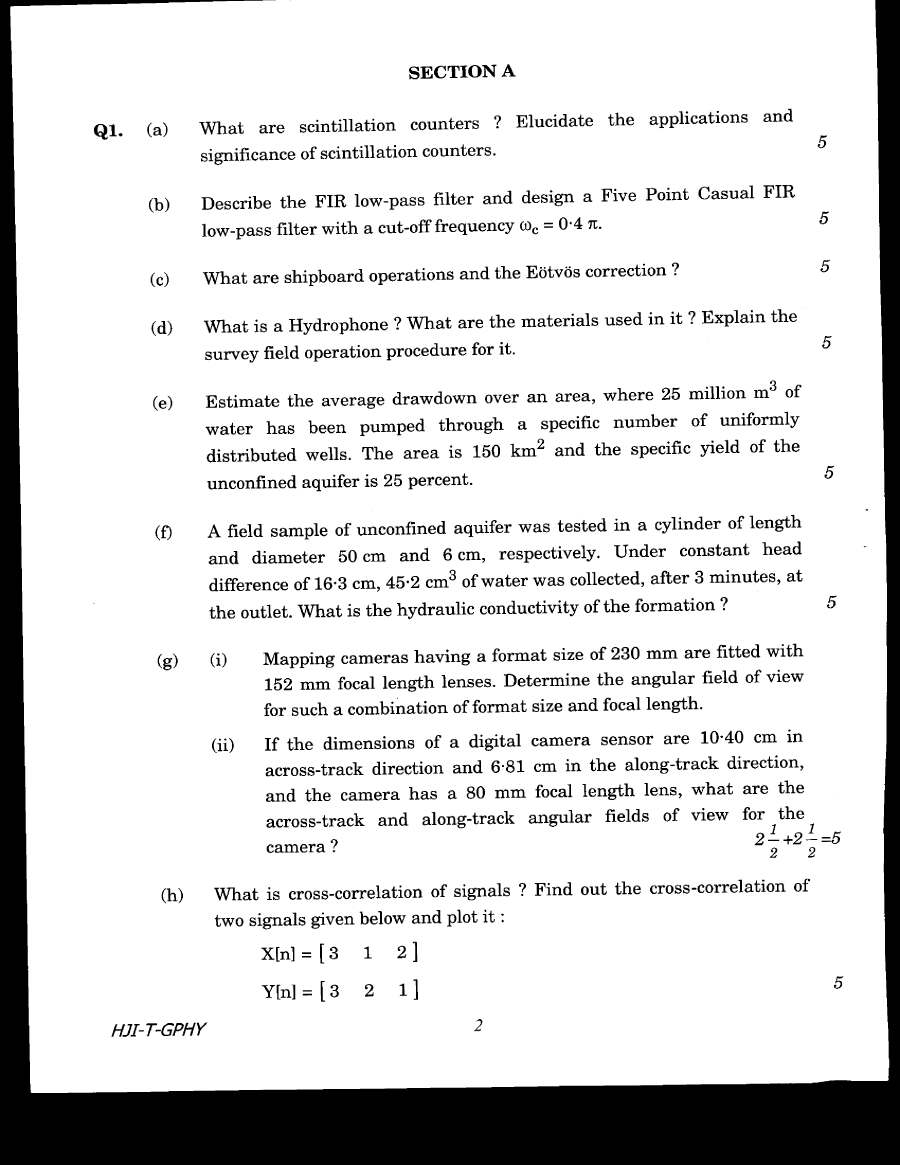
Section A

Q1.

(a) What are scintillation counters ? Elucidate the applications and significance of scintillation counters.

(b) Describe the FIR low-pass filter and design a Five Point Casual FIR low-pass filter with a cut-off frequency ω_c = 0.4 π.

(c) What are shipboard operations and the Eötvös correction?

(d) What is a Hydrophone ? What are the materials used in it ? Explain the survey field operation procedure for it.

(e) Estimate the average drawdown over an area, where 25 million m3 of water has been pumped through a specific number of uniformly distributed wells. The area is 150 km2 and the specific yield of the unconfined aquifer is 25 percent.

(f) A field sample of unconfined aquifer was tested in a cylinder of length and diameter 50 cm and 6 cm, respectively. Under constant head difference of 16.3 cm, 45.2 cm3 of water was collected, after 3 minutes, at the outlet. What is the hydraulic conductivity of the formation?

(g) Mapping cameras having a format size of 230 mm are fitted with 152 mm focal length lenses. Determine the angular field of view for such a combination of format size and focal length.
If the dimensions of a digital camera sensor are 10.40 cm in across-track direction and 6.81 cm in the along-track direction, and the camera has a 80 mm focal length lens, what are the across-track and along-track angular fields of view for the camera?

(h) What is cross-correlation of signals ? Find out the cross-correlation of two signals given below and plot it:
X[n] = \beginbmatrix 3 & 1 & 2 \endbmatrix
Y[n] = [3 \ 2 \ 1]
Question paper preview

Scanned pages 1–2 for reference. Download the official PDF for the full paper.

Page 1
UPSC Combined Geo-Scientist Main 2020 Geophysics Paper III question paper page 1 instructions scan PDF download
Page 2
UPSC Combined Geo-Scientist Main 2020 Geophysics Paper III question paper page 1 instructions scan PDF download

Free question paper download

Download question paper PDF

  • 245 KB
  • 8 pages
  • PDF format

Frequently asked questions

What is the name of the examination?

The examination is the Combined Geo-Scientist (Main) Examination.

Which paper is this question paper for?

This question paper is for Geophysics Paper - III.

What is the conducting body for this examination?

The examination is conducted by UPSC (Union Public Service Commission).

What is the maximum marks for Geophysics Paper - III?

The maximum marks for Geophysics Paper - III is 200.

What is the time allowed to complete the paper?

The time allowed to complete the paper is Three Hours.

In which year was this paper conducted?

This paper was conducted in the year 2020.

← Back to Other Jobs papers