Section A
Q1.
(a)
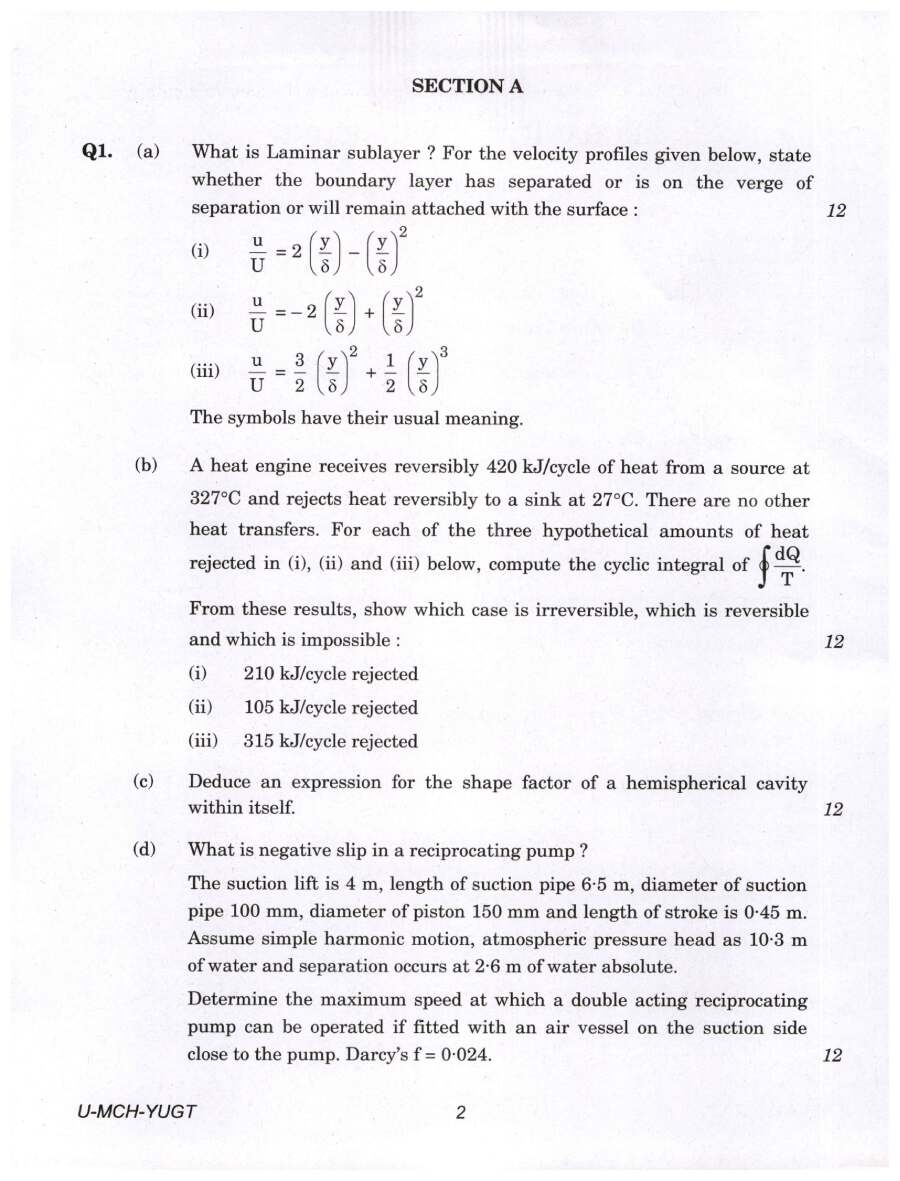
What is Laminar sublayer? For the velocity profiles given below, state whether the boundary layer has separated or is on the verge of separation or will remain attached with the surface :
(i) (u)/(U) = 2(y)/(δ)) - (y)/(δ))2
(ii) (u)/(U) = -2(y)/(δ)) + (y)/(δ))2
(iii) (u)/(U) = (3/2) (y)/(δ))2 + 1/2 (y)/(δ))3
The symbols have their usual meaning.
(b)
A heat engine receives reversibly 420 kJ/cycle of heat from a source at 327°C and rejects heat reversibly to a sink at 27°C. There are no other heat transfers. For each of the three hypothetical amounts of heat rejected in (i), (ii) and (iii) below, compute the cyclic integral of ∮ (dQ)/(T).
From these results, show which case is irreversible, which is reversible and which is impossible :
(i) 210 kJ/cycle rejected
(ii) 105 kJ/cycle rejected
(iii) 315 kJ/cycle rejected
(c) Deduce an expression for the shape factor of a hemispherical cavity within itself.
(d) What is negative slip in a reciprocating pump? The suction lift is 4 \text m, length of suction pipe 6.5 \text m, diameter of suction pipe 100 mm, diameter of piston 150 mm and length of stroke is 0.45 m. Assume simple harmonic motion, atmospheric pressure head as 10.3 m of water and separation occurs at 2.6 m of water absolute. Determine the maximum speed at which a double acting reciprocating pump can be operated if fitted with an air vessel on the suction side close to the pump. Darcy's f = 0.024.