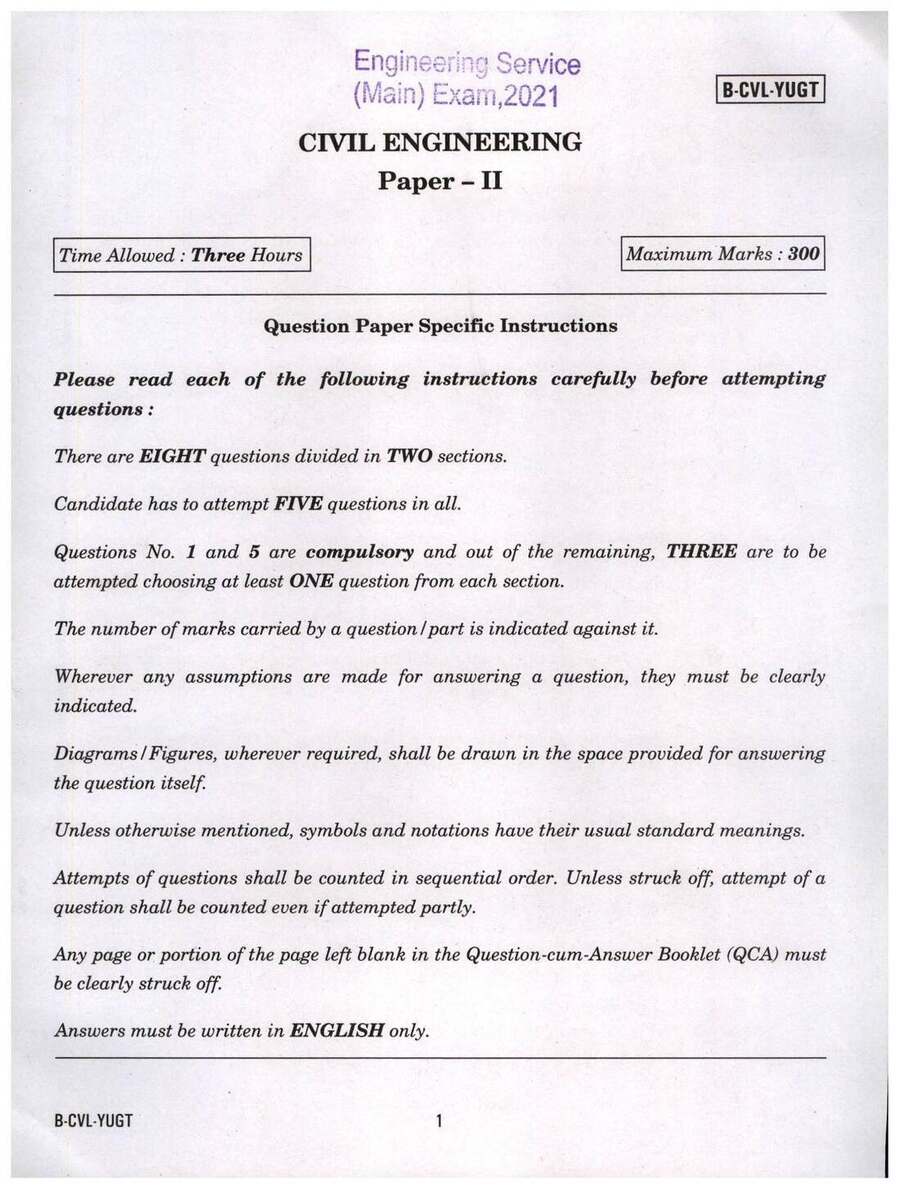
Engineering Service Main 2021 Civil Engineering Paper II PDF

Central Government Jobs Engineer 2021

  • Year 2021
  • Conducted By UPSC
  • Maximum Marks 300
  • Duration Three Hours
  • Languages English

Exam Details

Detail Information
Examination Engineering Service (Main) Examination
Year 2021
Conducting Body UPSC
Paper CIVIL ENGINEERING Paper - II
Subject Civil Engineering
Duration Three Hours
Maximum Marks 300
Question Type Mixed

This is the question paper for the Engineering Service (Main) Examination, 2021, specifically for Civil Engineering Paper II, conducted by UPSC. The paper carries a maximum of 300 marks and is to be completed within three hours. It consists of eight questions divided into two sections, requiring candidates to attempt five questions in total, with compulsory questions and choices within sections. This paper is crucial for aspirants aiming for engineering roles in government services, providing a direct look at the types of problems and knowledge assessed.

Major Topics Covered

  • Fluid Mechanics
  • Hydraulics
  • Environmental Engineering
  • Hydrostatic Force
  • Weir Design
  • Noise Pollution
  • Wastewater Treatment
  • BOD Calculation
  • River Flow Dynamics

Why This Paper is Important

  • Useful for Engineering Service (Main) Examination preparation
  • Helps understand the latest exam pattern
  • Useful for practice and self-assessment
  • Covers frequently asked General Studies topics
  • Helpful for analysing question trends

Related Resources

  • Engineering Service (Main) Examination, 2021 - Civil Engineering Paper - I
  • Engineering Service (Main) Examination, 2020 - Civil Engineering Paper - II
  • Engineering Service (Main) Examination, 2022 - Civil Engineering Paper - II
  • ESE 2021 Civil Engineering Paper II Answer Key
  • ESE Civil Engineering Syllabus
  • Civil Engineering Mains Syllabus
  • ESE Exam Pattern
  • Engineering Service Mains Exam Pattern

Instructions

  • There are EIGHT questions divided in TWO sections.
  • Candidate has to attempt FIVE questions in all.
  • Questions No. 1 and 5 are compulsory and out of the remaining, THREE are to be attempted choosing at least ONE question from each section.
  • The number of marks carried by a question / part is indicated against it.
  • Wherever any assumptions are made for answering a question, they must be clearly indicated.
  • Diagrams/Figures, wherever required, shall be drawn in the space provided for answering the question itself.
  • Unless otherwise mentioned, symbols and notations have their usual standard meanings.
  • Attempts of questions shall be counted in sequential order.
  • Unless struck off, attempt of a question shall be counted even if attempted partly.
  • Any page or portion of the page left blank in the Question-cum-Answer Booklet (QCA) must be clearly struck off.
  • Answers must be written in ENGLISH only.

Questions (page 2)

Section A

Q1.

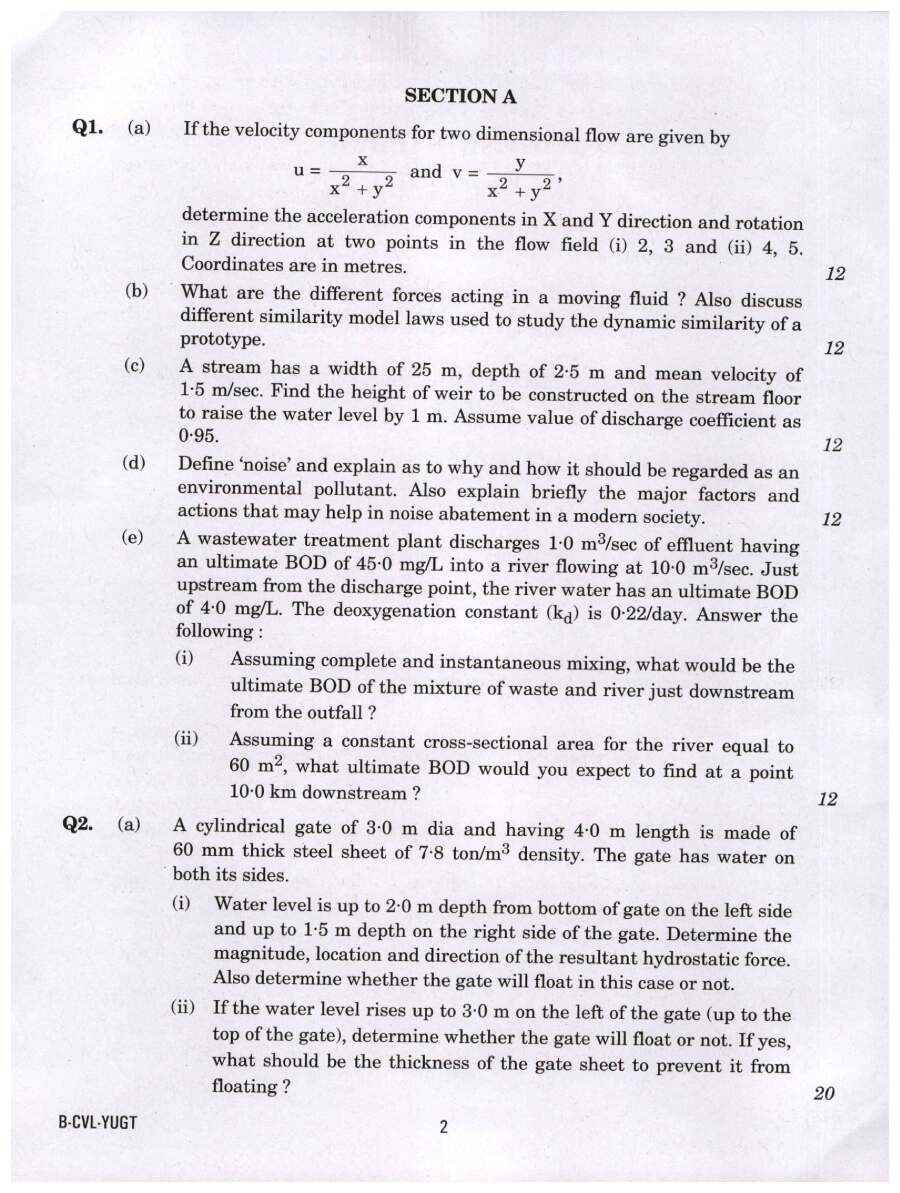
(a) If the velocity components for two dimensional flow are given by u = (x)/(x2 + y2) and v = (y)/(x2 + y2), determine the acceleration components in X and Y direction and rotation in Z direction at two points in the flow field (i) 2, 3 and (ii) 4, 5. Coordinates are in metres.

(b) What are the different forces acting in a moving fluid ? Also discuss different similarity model laws used to study the dynamic similarity of a prototype.

(c) A stream has a width of 25 m, depth of 2.5 m and mean velocity of 1.5 m/sec. Find the height of weir to be constructed on the stream floor to raise the water level by 1 m. Assume value of discharge coefficient as 0.95.

(d) Define 'noise' and explain as to why and how it should be regarded as an environmental pollutant. Also explain briefly the major factors and actions that may help in noise abatement in a modern society.

(e) A wastewater treatment plant discharges 1.0 \text m3/\textsec of effluent having an ultimate BOD of 45.0 mg/L into a river flowing at 10.0 m3/sec. Just upstream from the discharge point, the river water has an ultimate BOD of 4.0 mg/L. The deoxygenation constant (kd) is 0.22/day. Answer the following: (i) Assuming complete and instantaneous mixing, what would be the ultimate BOD of the mixture of waste and river just downstream from the outfall? Assuming a constant cross-sectional area for the river equal to (ii) 60 m2, what ultimate BOD would you expect to find at a point 10.0 km downstream?
Section A

Q2.

(a) A cylindrical gate of 3.0 m dia and having 4.0 m length is made of 60 mm thick steel sheet of 7.8 ton/m^3 density. The gate has water on both its sides. Water level is up to 2.0 m depth from bottom of gate on the left side (i) and up to 1.5 m depth on the right side of the gate. Determine the magnitude, location and direction of the resultant hydrostatic force. Also determine whether the gate will float in this case or not. If the water level rises up to 3.0 m on the left of the gate (up to the (ii) top of the gate), determine whether the gate will float or not. If yes, what should be the thickness of the gate sheet to prevent it from floating?

Question paper preview

Scanned pages 1–2 for reference. Download the official PDF for the full paper.

Page 1
UPSC Engineering Service (Main) Examination 2021 Civil Engineering Paper II question paper page 1 scan, showing exam details and instructions for candidates. PDF download.
Page 2
UPSC Engineering Service (Main) Examination 2021 Civil Engineering Paper II question paper page 1 scan, showing exam details and instructions for candidates. PDF download.

Free question paper download

Download question paper PDF

  • 5.8 MB
  • 9 pages
  • PDF format

Frequently asked questions

What is the full name of the examination?

The full name of the examination is the Engineering Service (Main) Examination.

Which year is this question paper for?

This question paper is for the Engineering Service (Main) Examination, 2021.

Who conducts the Engineering Service Examination?

The Engineering Service Examination is conducted by UPSC (Union Public Service Commission).

What is the subject of this paper?

This paper is for Civil Engineering, specifically Paper II.

What is the maximum marks for this paper?

The maximum marks for this paper are 300.

What is the time allowed to complete the paper?

The time allowed to complete the paper is Three Hours.

← Back to Engineer papers