Section A
Q1.
(a)
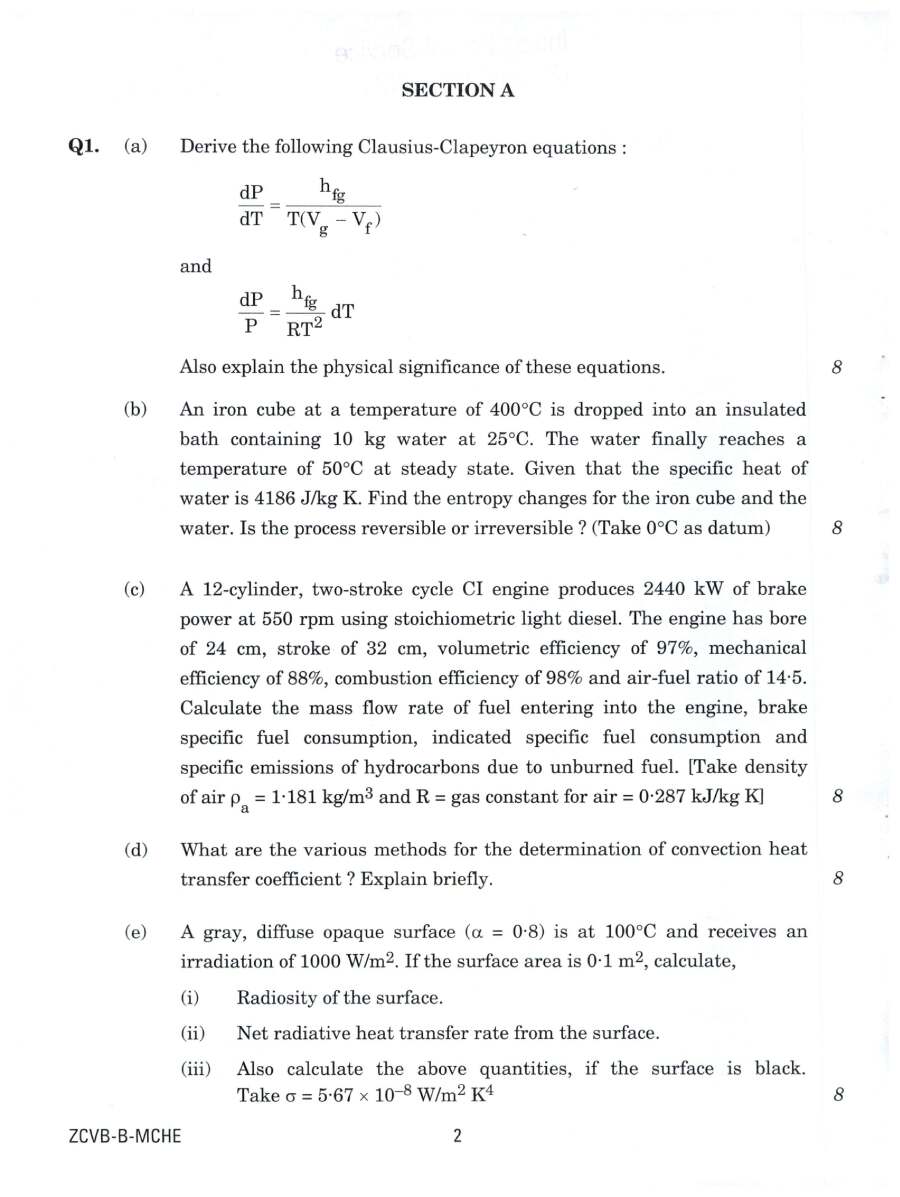
Derive the following Clausius-Clapeyron equations :
(dP)/(dT) = (hfg)/(T(Vg - Vf)) and (dP)/(P) = (hfg)/(RT2) dT
Also explain the physical significance of these equations.
(b) An iron cube at a temperature of 400\circC is dropped into an insulated bath containing 10 kg water at 25\circC. The water finally reaches a temperature of 50\circC at steady state. Given that the specific heat of water is 4186 J/kg K. Find the entropy changes for the iron cube and the water. Is the process reversible or irreversible ? (Take 0\circC as datum)
(c) A 12-cylinder, two-stroke cycle CI engine produces 2440 kW of brake power at 550 rpm using stoichiometric light diesel. The engine has bore of 24 cm, stroke of 32 cm, volumetric efficiency of 97%, mechanical efficiency of 88%, combustion efficiency of 98% and air-fuel ratio of 14.5. Calculate the mass flow rate of fuel entering into the engine, brake specific fuel consumption, indicated specific fuel consumption and specific emissions of hydrocarbons due to unburned fuel. [Take density of air \rho\rm a = 1.181 kg/m3 and R = gas constant for air = 0.287 kJ/kg K]
(d) What are the various methods for the determination of convection heat transfer coefficient? Explain briefly.
(e)
A gray, diffuse opaque surface (α = 0.8) is at 100\circC and receives an irradiation of 1000 W/m2. If the surface area is 0.1 m2, calculate,
(i) Radiosity of the surface.
(ii) Net radiative heat transfer rate from the surface.
(iii) Also calculate the above quantities, if the surface is black.
(iv) Take σ = 5.67 × 10⁻⁸ W/m2 K4