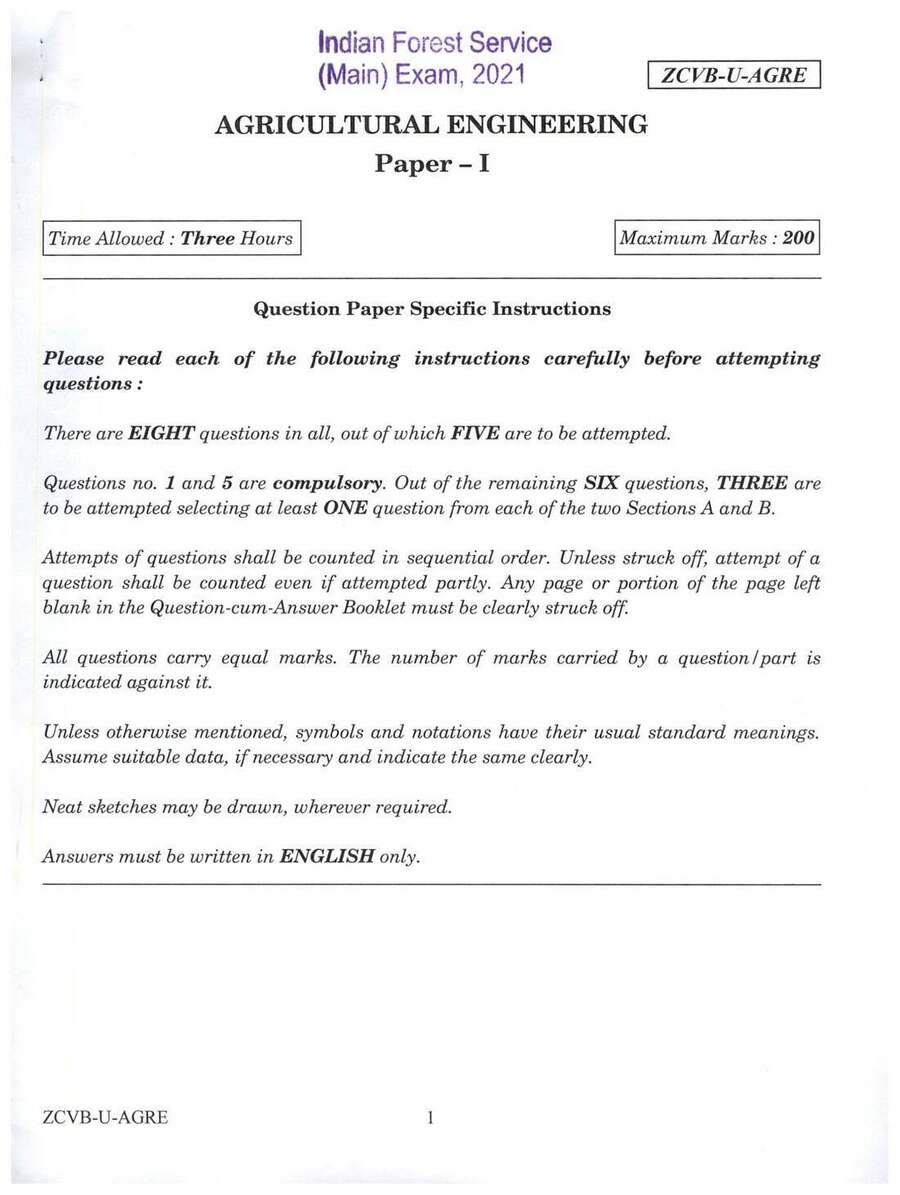
Indian Forest Service 2021 Agricultural Engineering Paper I PDF

Central Government Jobs Engineer 2021

  • Year 2021
  • Conducted By UPSC
  • Questions 8
  • Maximum Marks 200
  • Duration Three Hours
  • Languages English

Exam Details

Detail Information
Examination Indian Forest Service (Main) Examination
Year 2021
Conducting Body UPSC
Paper Agricultural Engineering Paper - I
Subject Agricultural Engineering
Duration Three Hours
Maximum Marks 200
Number of Questions 8
Question Type Mixed

This is the question paper for the Indian Forest Service (Main) Examination 2021, specifically Paper I for Agricultural Engineering. Conducted by UPSC, this paper carries a maximum of 200 marks and candidates are allowed three hours to complete it. It is a crucial resource for aspirants preparing for the IFS Main exam, offering insights into the types of questions, marking scheme, and important topics covered in Agricultural Engineering.

Major Topics Covered

  • Soil and Water Conservation
  • GIS and Remote Sensing
  • Hydrology
  • Erosion Control
  • Watershed Management
  • Spillway Design
  • Forest Management

Why This Paper is Important

  • Useful for Indian Forest Service (Main) Examination preparation
  • Helps understand the latest exam pattern
  • Useful for practice and self-assessment
  • Covers frequently asked General Studies topics
  • Helpful for analysing question trends

Related Resources

  • Indian Forest Service (Main) Examination 2021 Agricultural Engineering Paper II
  • Indian Forest Service (Main) Examination 2020 Agricultural Engineering Paper I
  • Engineering Services Examination 2021 Agricultural Engineering Paper I
  • Indian Forest Service (Main) Examination 2021 Agricultural Engineering Paper I Answer Key
  • Indian Forest Service (Main) Examination Syllabus
  • Agricultural Engineering Syllabus for UPSC Exams
  • Indian Forest Service (Main) Examination Pattern
  • UPSC Exam Pattern for Engineering Services

Instructions

  • There are EIGHT questions in all, out of which FIVE are to be attempted.
  • Out of the remaining SIX questions, THREE are to be attempted selecting at least ONE question from each of the two Sections A and B.
  • Attempts of questions shall be counted in sequential order.
  • Unless struck off, attempt of a question shall be counted even if attempted partly.
  • Any page or portion of the page left blank in the Question-cum-Answer Booklet must be clearly struck off.
  • The number of marks carried by a question/part is indicated against it.
  • Unless otherwise mentioned, symbols and notations have their usual standard meanings.
  • Assume suitable data, if necessary and indicate the same clearly.
  • Neat sketches may be drawn, wherever required.
  • Answers must be written in ENGLISH only.

Questions (page 2)

Section A

Q1.

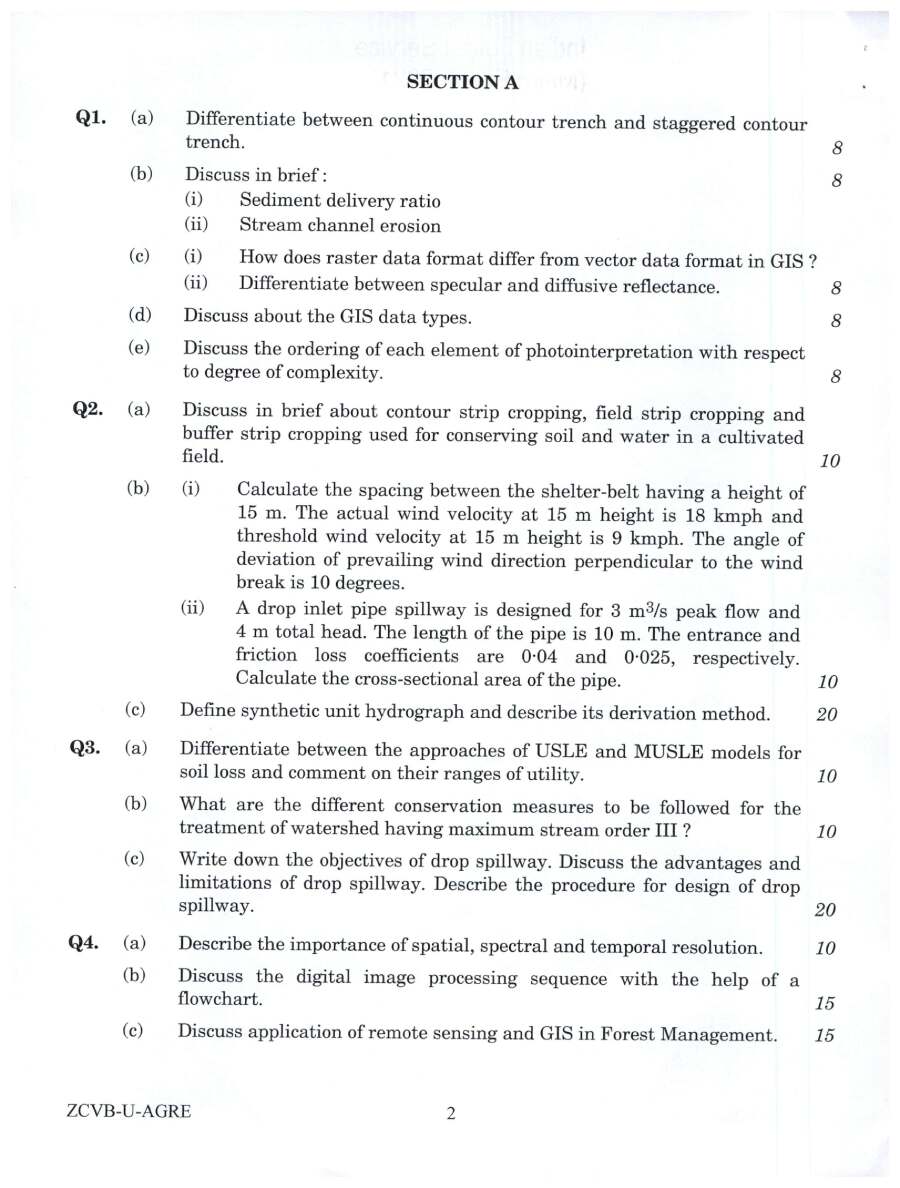
(a) Differentiate between continuous contour trench and staggered contour trench.

(b) Discuss in brief:
(i) Sediment delivery ratio
(ii) Stream channel erosion

(c) (i) How does raster data format differ from vector data format in GIS ?
(ii) Differentiate between specular and diffusive reflectance.

(d) Discuss about the GIS data types.

(e) Discuss the ordering of each element of photointerpretation with respect to degree of complexity.
Section A

Q2.

(a) Discuss in brief about contour strip cropping, field strip cropping and buffer strip cropping used for conserving soil and water in a cultivated field.

(b) (i) Calculate the spacing between the shelter-belt having a height of 15 m. The actual wind velocity at 15 m height is 18 kmph and threshold wind velocity at 15 m height is 9 kmph. The angle of deviation of prevailing wind direction perpendicular to the wind break is 10 degrees.
(ii) A drop inlet pipe spillway is designed for 3 m3/s peak flow and 4 m total head. The length of the pipe is 10 m. The entrance and friction loss coefficients are 0.04 and 0.025, respectively. Calculate the cross-sectional area of the pipe.

(c) Define synthetic unit hydrograph and describe its derivation method.

Section A

Q3.

(a) Differentiate between the approaches of USLE and MUSLE models for soil loss and comment on their ranges of utility.

(b) What are the different conservation measures to be followed for the treatment of watershed having maximum stream order III?

(c) Write down the objectives of drop spillway. Discuss the advantages and limitations of drop spillway. Describe the procedure for design of drop spillway.

Section A

Q4.

(a) Describe the importance of spatial, spectral and temporal resolution.

(b) Discuss the digital image processing sequence with the help of a flowchart.

(c) Discuss application of remote sensing and GIS in Forest Management.

Question paper preview

Scanned pages 1–2 for reference. Download the official PDF for the full paper.

Page 1
Indian Forest Service Main 2021 Agricultural Engineering Paper I page 1 instructions scan PDF download UPSC IFS exam paper
Page 2
Indian Forest Service Main 2021 Agricultural Engineering Paper I page 1 instructions scan PDF download UPSC IFS exam paper

Free question paper download

Download question paper PDF

  • 1.5 MB
  • 4 pages
  • PDF format

Frequently asked questions

What is the name of the exam?

The exam is the Indian Forest Service (Main) Examination.

What is the year of this question paper?

This question paper is from the year 2021.

Which paper is this?

This is Agricultural Engineering Paper - I.

Who conducts the Indian Forest Service examination?

The Indian Forest Service examination is conducted by UPSC (Union Public Service Commission).

What is the maximum marks for this paper?

The maximum marks for this paper are 200.

How much time is allowed for this paper?

Three hours are allowed for this paper.

← Back to Engineer papers