Indian Forest Service 2022 Mechanical Engineering Paper II PDF

Central Government Jobs Engineer 2022

  • Year 2022
  • Conducted By UPSC
  • Questions 8
  • Maximum Marks 200
  • Duration Three Hours
  • Languages English

Exam Details

Detail Information
Examination Indian Forest Service (Main) Examination
Year 2022
Conducting Body UPSC
Paper Mechanical Engineering Paper - II
Subject Mechanical Engineering
Duration Three Hours
Maximum Marks 200
Number of Questions 8
Question Type Mixed

This is the official question paper for the Indian Forest Service (Main) Examination 2022, Paper II for Mechanical Engineering. Conducted by UPSC, this paper carries a maximum of 200 marks and is allocated a time of three hours. It is designed to assess the in-depth knowledge of candidates in Mechanical Engineering subjects. Aspirants preparing for the IFS exam can use this paper to understand the question format, difficulty level, and important topics covered, aiding in their focused study and revision.

Major Topics Covered

  • Thermodynamics
  • Heat Transfer
  • Fluid Mechanics
  • Engines
  • Non-dimensional numbers
  • Emissivity
  • SI Units

Why This Paper is Important

  • Useful for Indian Forest Service (Main) Examination preparation
  • Helps understand the latest exam pattern
  • Useful for practice and self-assessment
  • Covers frequently asked General Studies topics
  • Helpful for analysing question trends

Related Resources

  • Indian Forest Service (Main) Examination 2022 Mechanical Engineering Paper - I
  • Indian Forest Service (Main) Examination 2021 Mechanical Engineering Paper - II
  • Engineering Services Examination 2022 Mechanical Engineering Paper - II
  • Indian Forest Service (Main) Examination 2022 Mechanical Engineering Paper - II Answer Key
  • Indian Forest Service (Main) Examination Syllabus
  • Mechanical Engineering Syllabus for Competitive Exams
  • Indian Forest Service (Main) Examination Pattern
  • UPSC Exam Pattern for Engineers

Instructions

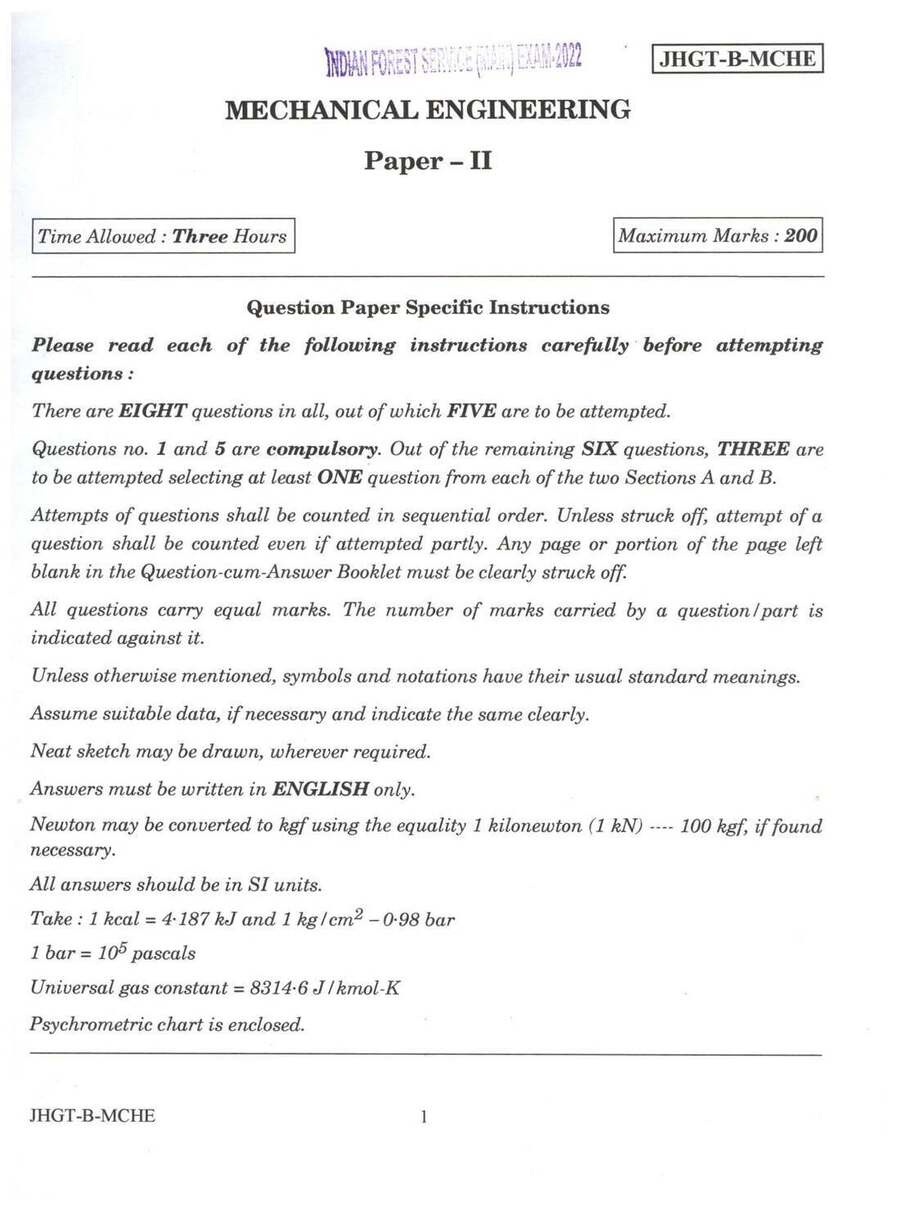
  • There are EIGHT questions in all, out of which FIVE are to be attempted.
  • Out of the remaining SIX questions, THREE are to be attempted selecting at least \overline{ONE} question from each of the two Sections A and B.
  • Attempts of questions shall be counted in sequential order.
  • Unless struck off, attempt of a question shall be counted even if attempted partly.
  • Any page or portion of the page left blank in the Question-cum-Answer Booklet must be clearly struck off.
  • The number of marks carried by a question/part is indicated against it.
  • Unless otherwise mentioned, symbols and notations have their usual standard meanings.
  • Assume suitable data, if necessary and indicate the same clearly.
  • Neat sketch may be drawn, wherever required.
  • Answers must be written in ENGLISH only.
  • Newton may be converted to kgf using the equality 1 kilonewton (1 \text{ kN}) ---- 100 kgf, if found necessary.
  • Take: 1 kcal = 4.187 kJ and 1 kg/cm2 - 0.98 bar 1 bar = 10^5 pascals Universal gas constant = 8314.6 J/kmol-K Psychrometric chart is enclosed.

Questions (page 2)

Section A

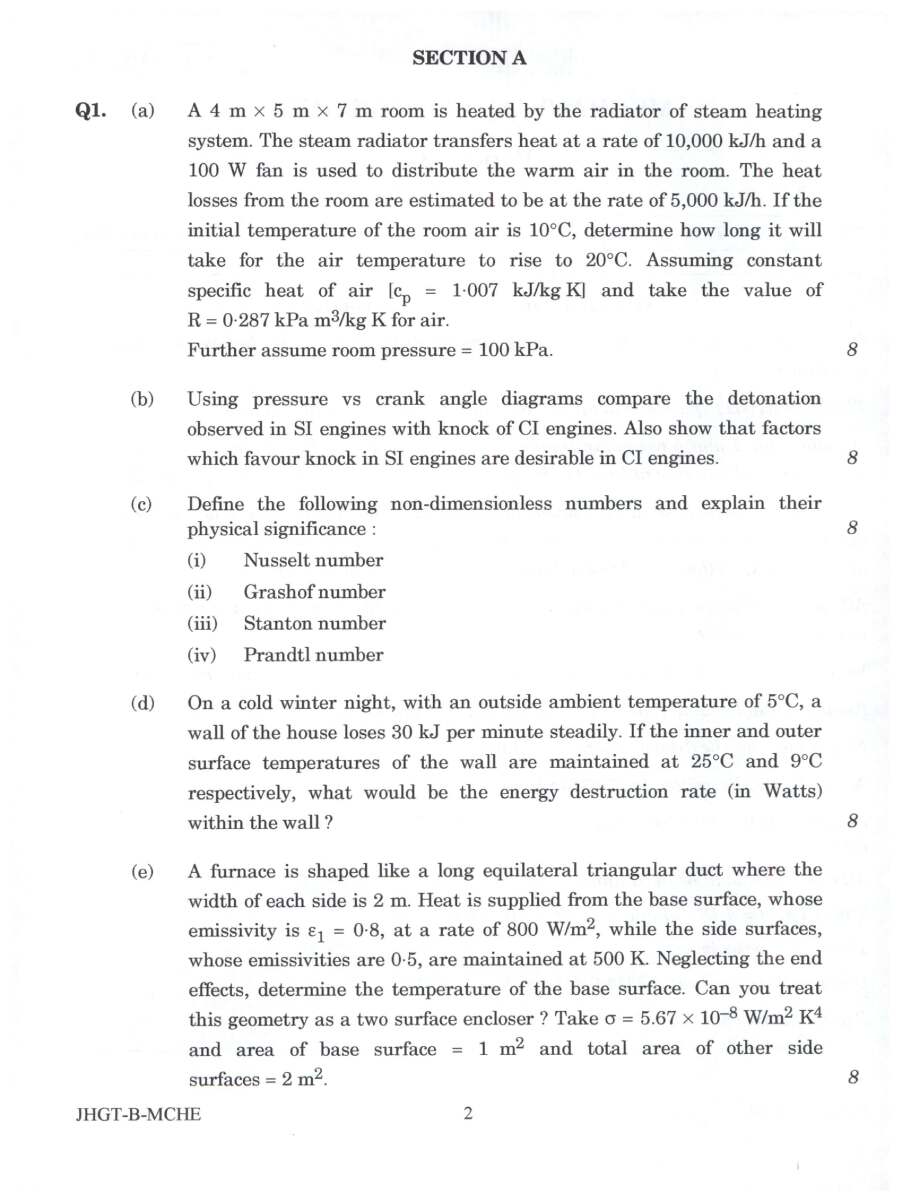
Q1.

(a) A 4 m × 5 m × 7 m room is heated by the radiator of steam heating system. The steam radiator transfers heat at a rate of 10,000 kJ/h and a 100 W fan is used to distribute the warm air in the room. The heat losses from the room are estimated to be at the rate of 5,000 kJ/h. If the initial temperature of the room air is 10°C, determine how long it will take for the air temperature to rise to 20°C. Assuming constant specific heat of air [cp = 1.007 \text kJ/kg K] and take the value of R = 0.287 kPa m3/kg K for air. Further assume room pressure = 100 kPa.

(b) Using pressure vs crank angle diagrams compare the detonation observed in SI engines with knock of CI engines. Also show that factors which favour knock in SI engines are desirable in CI engines.

(c) Define the following non-dimensionless numbers and explain their physical significance :
(i) Nusselt number
(ii) Grashof number
(iii) Stanton number
(iv) Prandtl number

(d) On a cold winter night, with an outside ambient temperature of 5°C, a wall of the house loses 30 kJ per minute steadily. If the inner and outer surface temperatures of the wall are maintained at 25°C and 9°C respectively, what would be the energy destruction rate (in Watts) within the wall?

(e) A furnace is shaped like a long equilateral triangular duct where the width of each side is 2 m. Heat is supplied from the base surface, whose emissivity is \varepsilon1 = 0.8, at a rate of 800 W/m2, while the side surfaces, whose emissivities are 0.5, are maintained at 500 K. Neglecting the end effects, determine the temperature of the base surface. Can you treat this geometry as a two surface encloser? Take σ = 5.67 × 10⁻⁸ W/m2 K4 and area of base surface = 1 m2 and total area of other side surfaces = 2 m2.
Question paper preview

Scanned pages 1–2 for reference. Download the official PDF for the full paper.

Page 1
Indian Forest Service 2022 Mechanical Engineering Paper II question paper page 1 instructions scan PDF download UPSC IFS Main
Page 2
Indian Forest Service 2022 Mechanical Engineering Paper II question paper page 1 instructions scan PDF download UPSC IFS Main

Free question paper download

Download question paper PDF

  • 4.7 MB
  • 12 pages
  • PDF format

Frequently asked questions

What is the name of the examination?

The examination is the Indian Forest Service (Main) Examination.

What is the year of this question paper?

This question paper is from the year 2022.

Which paper is this?

This is Mechanical Engineering Paper – II.

Who conducts the Indian Forest Service Examination?

The examination is conducted by UPSC (Union Public Service Commission).

What is the maximum marks for this paper?

The maximum marks for this paper are 200.

What is the time allowed for this paper?

The time allowed for this paper is Three Hours.

← Back to Engineer papers