Agricultural Engineering Paper I (2022) – IFS Main Exam

Central Government Jobs Engineer 2022

  • Year 2022
  • Conducted By Indian Forest Service
  • Questions 8
  • Maximum Marks 200
  • Duration Three Hours
  • Languages English

Exam Details

Detail Information
Examination Indian Forest Service (Main) Examination
Year 2022
Conducting Body Indian Forest Service
Paper Agricultural Engineering
Subject Agricultural Engineering
Duration Three Hours
Maximum Marks 200
Number of Questions 8
Question Type Descriptive / Subjective

This entry covers Agricultural Engineering Paper I from the Indian Forest Service Main Examination, 2022. The paper carries 200 marks and three hours. It comprises eight questions; Questions 1 and 5 are compulsory, and five more must be attempted with at least one from each of the two Sections A and B. Page 2 presents Section A with Q1–Q3 and subparts addressing topics in watershed development, sand dunes, rainfall estimation by isohyetal methods, LANDSAT image processing, and remote sensing in archaeology. Q2 advances to soil conservation farming, unit hydrographs, contour bunds, and check dam planning, while Q3 focuses on the design procedure for check dams and plane method details in land levelling. The OCR repairs provide the corrected stems for these descriptive questions, suitable for study and SEO indexing.

Major Topics Covered

  • Indian Forest Service
  • Agricultural Engineering
  • Watershed development
  • Guidelines and principles
  • Sand dunes and stabilization
  • Isohyetal method
  • Rainfall estimation
  • LANDSAT
  • Remote sensing
  • Archaeological applications of imagery
  • Soil conservation farming
  • Land use capability classification
  • Unit hydrograph
  • Hydrology
  • Contour bunds
  • Soil infilration
  • Check dams
  • Planning and design of water structures
  • Plane method of land levelling
  • Centroid and plane slope concepts

Why This Paper is Important

  • Useful for Indian Forest Service (Main) Examination preparation
  • Helps understand the latest exam pattern
  • Useful for practice and self-assessment
  • Covers frequently asked General Studies topics
  • Helpful for analysing question trends

Related Resources

Instructions

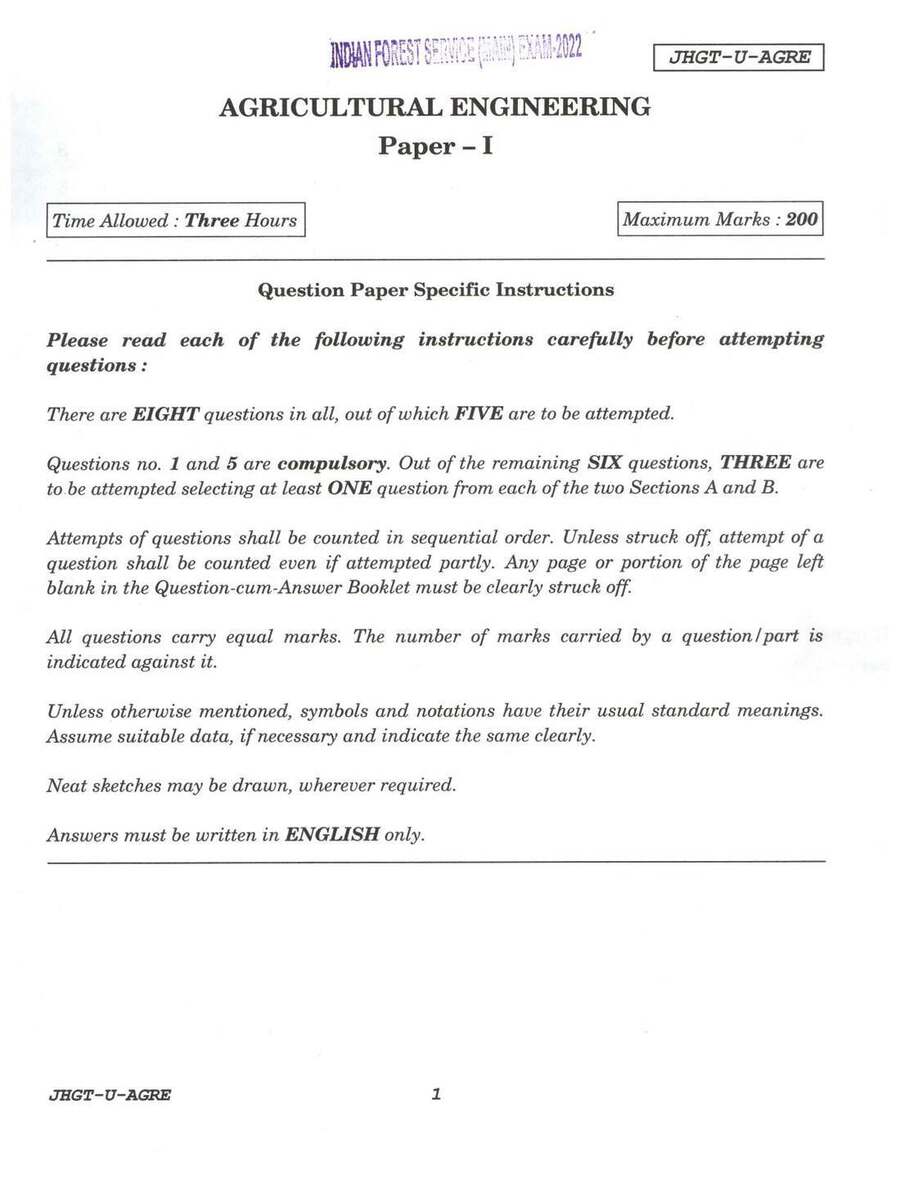
  • There are EIGHT questions in all, out of which FIVE are to be attempted.
  • Out of the remaining SIX questions, THREE are to be attempted selecting at least \overline{ONE} question from each of the two Sections A and B.
  • Attempts of questions shall be counted in sequential order.
  • Unless struck off, attempt of a question shall be counted even if attempted partly.
  • Any page or portion of the page left blank in the Question-cum-Answer Booklet must be clearly struck off.
  • The number of marks carried by a question/part is indicated against it.
  • Unless otherwise mentioned, symbols and notations have their usual standard meanings.
  • Assume suitable data, if necessary and indicate the same clearly.
  • Neat sketches may be drawn, wherever required.
  • Answers must be written in ENGLISH only.

Questions (page 2)

Q0.

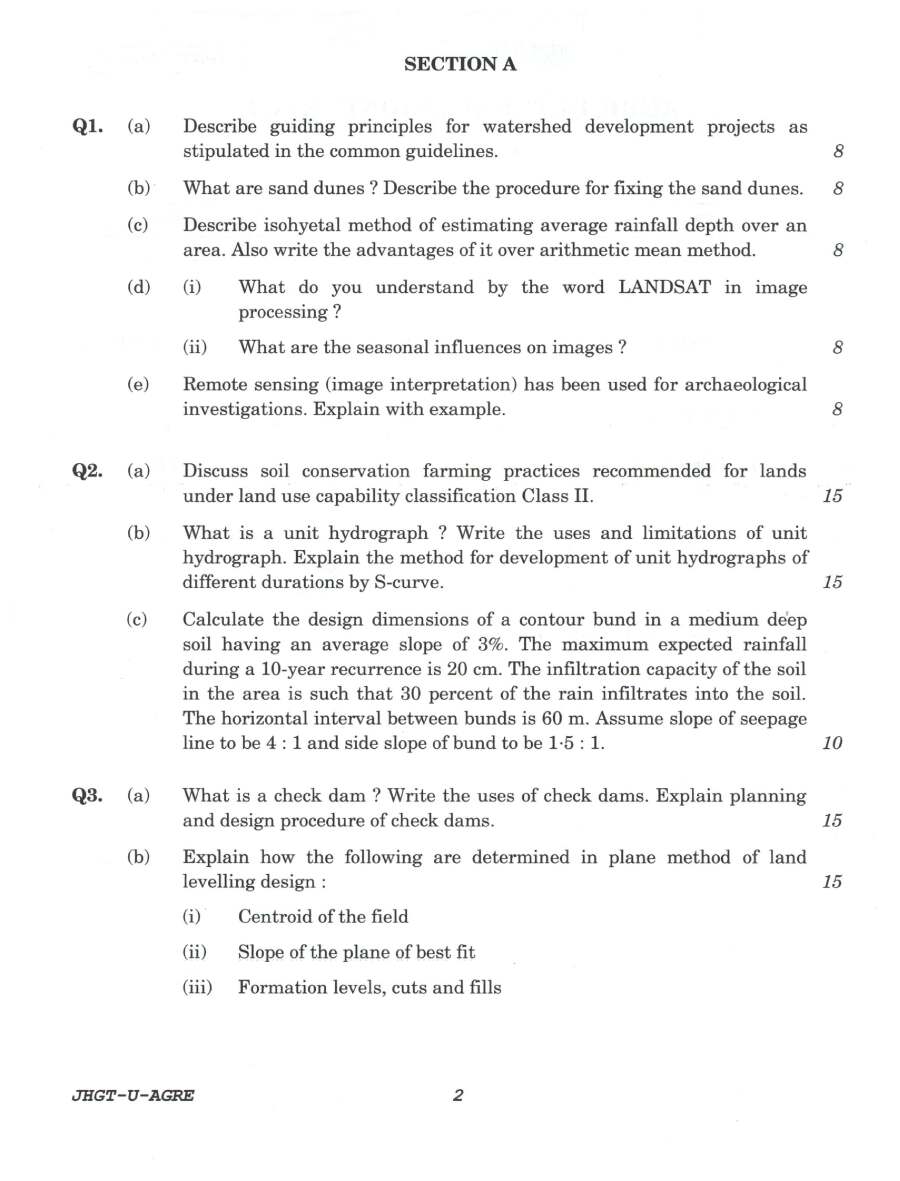
(a) Describe guiding principles for watershed development projects as stipulated in the common guidelines.

(b) What are sand dunes? Describe the procedure for fixing the sand dunes.

(c) Describe isohyetal method of estimating average rainfall depth over an area. Also write the advantages of it over arithmetic mean method.

(d) What do you understand by the word LANDSAT in image processing?
(i) processing?
(ii) What are the seasonal influences on images?

(e) Remote sensing (image interpretation) has been used for archaeological investigations. Explain with example.
Q0.

(a) Discuss soil conservation farming practices recommended for lands under land use capability classification Class II.

(b) What is a unit hydrograph? Write the uses and limitations of unit hydrograph. Explain the method for development of unit hydrographs of different durations by S-curve.

(c) Calculate the design dimensions of a contour bund in a medium deep soil having an average slope of 3%. The maximum expected rainfall during a 10-year recurrence is cm. The infiltration capacity of the soil in the area is such that 30 percent of the rain infiltrates into the soil. The horizontal interval between bunds is 60 m. Assume slope of seepage line to be 4:1 and side slope of bund to be 1.5:1.

(d) What is a check dam? Write the uses of check dams. Explain planning

Q0.

(a) design procedure of check dams.

(b) Explain how the following are determined in plane method of land levelling design :
(i) Centroid of the field
(ii) Slope of the plane of best fit
(iii) Formation levels, cuts and fills

Question paper preview

Scanned pages 1–2 for reference. Download the official PDF for the full paper.

Page 1
Agricultural Engineering Paper I (2022) – IFS Main Exam — page 1 instructions scan PDF download
Page 2
Agricultural Engineering Paper I (2022) – IFS Main Exam — page 1 instructions scan PDF download

Free question paper download

Download question paper PDF

  • 1.4 MB
  • 4 pages
  • PDF format

Frequently asked questions

Where can I download the Indian Forest Service (Main) Examination question paper PDF?

Use the Download PDF button on this page to save the official Indian Forest Service (Main) Examination (2022) Agricultural Engineering paper hosted on QuizCurrent.

Who conducts the Indian Forest Service (Main) Examination?

The Indian Forest Service (Main) Examination is conducted by Indian Forest Service. This portal reproduces the scanned question paper for practice and revision.

Does this page include exam instructions and questions?

Yes. Page 1 instructions and page 2 questions are extracted from the official PDF OCR so you can read them without downloading.

How many questions are on this paper?

The paper lists 8 questions as per the official booklet.

← Back to Engineer papers