Civil Engineering Paper II (2023) - ES Preliminary

Central Government Jobs Engineer 2023

  • Year 2023
  • Conducted By UPSC
  • Questions 150
  • Maximum Marks 300
  • Duration Three Hours
  • Languages English

Exam Details

Detail Information
Examination Civil Engineering Paper II
Year 2023
Conducting Body UPSC
Paper CIVIL ENGINEERING
Subject Civil Engineering
Duration Three Hours
Maximum Marks 300
Number of Questions 150

This entry consolidates Page 1 and the repaired Page 2 OCR for Civil Engineering Paper II (2023) of the Engineering Services Preliminary exam. Page 1 provides the examination header, time, maximum marks, and explicit instructions (including penalties for wrong answers and answer-sheet procedures). Page 2 presents objective questions in a two-column MCQ layout, including tore-apart stems such as Terzaghi-based foundation concepts, bearing capacity relations via SPT/CPT, and geosynthetics nomenclature and properties. The repair process fixes broken words, restores line breaks, and splits merged items to yield discrete question objects. The combined data supports SEO fields, metadata, and a robust FAQ for both pages.

Major Topics Covered

  • Geotechnical engineering
  • Bearing capacity
  • Terzaghi foundation theory
  • Shallow foundations
  • Soil mechanics
  • SPT
  • CPT
  • Geosynthetics
  • Geotextiles
  • Geogrids
  • Geonets
  • Geogrouts
  • Geosynthetics nomenclature
  • Soil properties
  • Earthworks
  • Pavement engineering
  • Ground improvement
  • Foundation design
  • Subgrade
  • Construction quality

Why This Paper is Important

  • Useful for Civil Engineering Paper II preparation
  • Helps understand the latest exam pattern
  • Useful for practice and self-assessment
  • Covers frequently asked General Studies topics
  • Helpful for analysing question trends

Related Resources

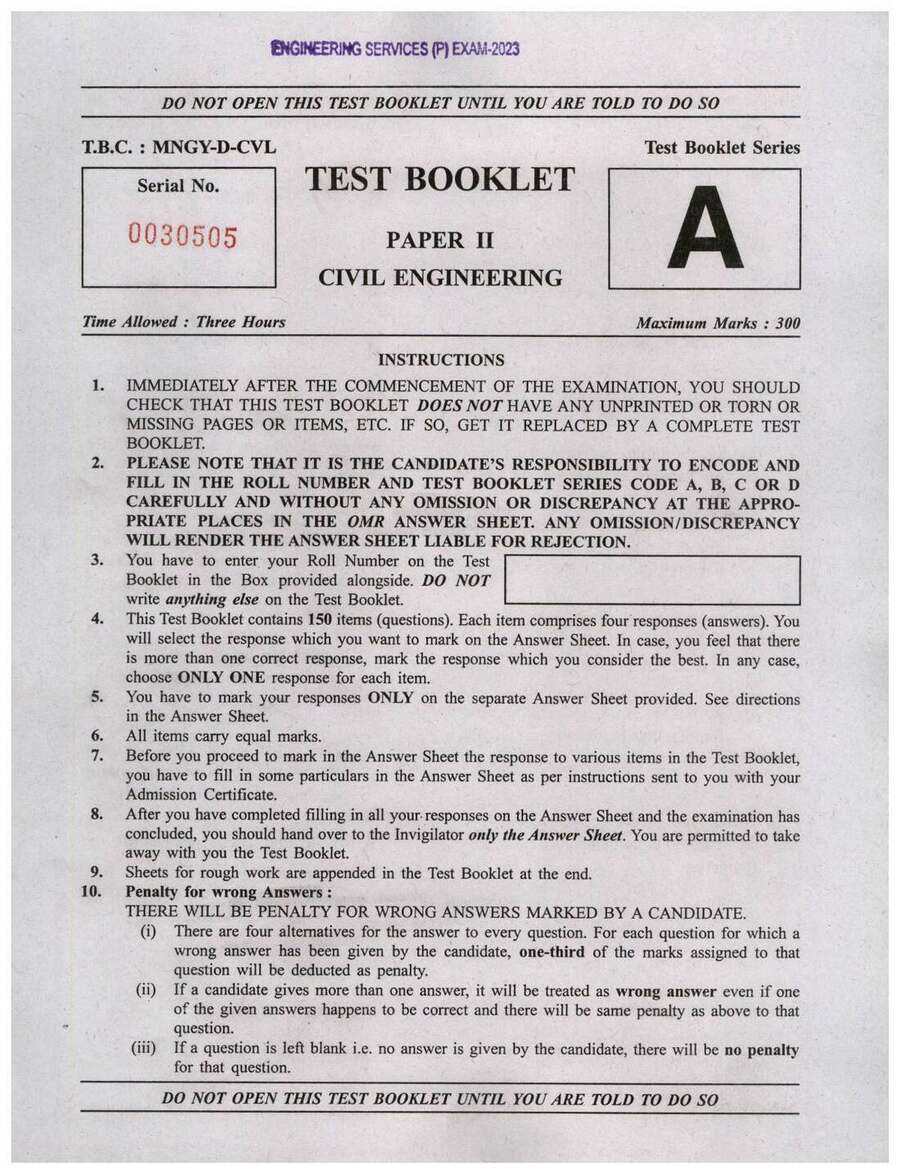
Instructions

  • CHECK THAT THIS TEST BOOKLET DOES NOT HAVE ANY UNPRINTED OR TORN OR MISSING PAGES OR ITEMS, ETC.
  • IF SO, GET IT REPLACED BY A COMPLETE TEST BOOKLET.
  • PLEASE NOTE THAT IT IS THE CANDIDATE'S RESPONSIBILITY TO ENCODE AND
  • FILL IN THE ROLL NUMBER AND TEST BOOKLET SERIES CODE A, B, C OR D CAREFULLY AND WITHOUT ANY OMISSION OR DISCREPANCY AT THE APPRO- PRIATE PLACES IN THE OMR ANSWER SHEET.
  • ANY OMISSION/DISCREPANCY WILL RENDER THE ANSWER SHEET LIABLE FOR REJECTION.
  • You have to enter your Roll Number on the Test
  • DO NOT write anything else on the Test Booklet.
  • This Test Booklet contains 150 items (questions).
  • Each item comprises four responses (answers).
  • will select the response which you want to mark on the Answer Sheet.
  • In case, you feel that there is more than one correct response, mark the response which you consider the best.
  • In any case, choose ONLY ONE response for each item.
  • You have to mark your responses ONLY on the separate Answer Sheet provided.
  • Before you proceed to mark in the Answer Sheet the response to various items in the Test Booklet,
  • you have to fill in some particulars in the Answer Sheet as per instructions sent to you with your Admission Certificate.
  • After you have completed filling in all your responses on the Answer Sheet and the examination has
  • concluded, you should hand over to the Invigilator only the Answer Sheet.
  • You are permitted to take away with you the Test Booklet.
  • Sheets for rough work are appended in the Test Booklet at the end.
  • THERE WILL BE PENALTY FOR WRONG ANSWERS MARKED BY A CANDIDATE.
  • There are four alternatives for the answer to every question.
  • For each question for which a (i) wrong answer has been given by the candidate, one-third of the marks assigned to that question will be deducted as penalty.
  • If a candidate gives more than one answer, it will be treated as wrong answer even if one (i) of the given answers happens to be correct and there will be same penalty as above to that question.
  • If a question is left blank i.e. no answer is given by the candidate, there will be no penalty (iii) for that question.
  • DO NOT OPEN THIS TEST BOOKLET UNTIL YOU ARE TOLD TO DO SO

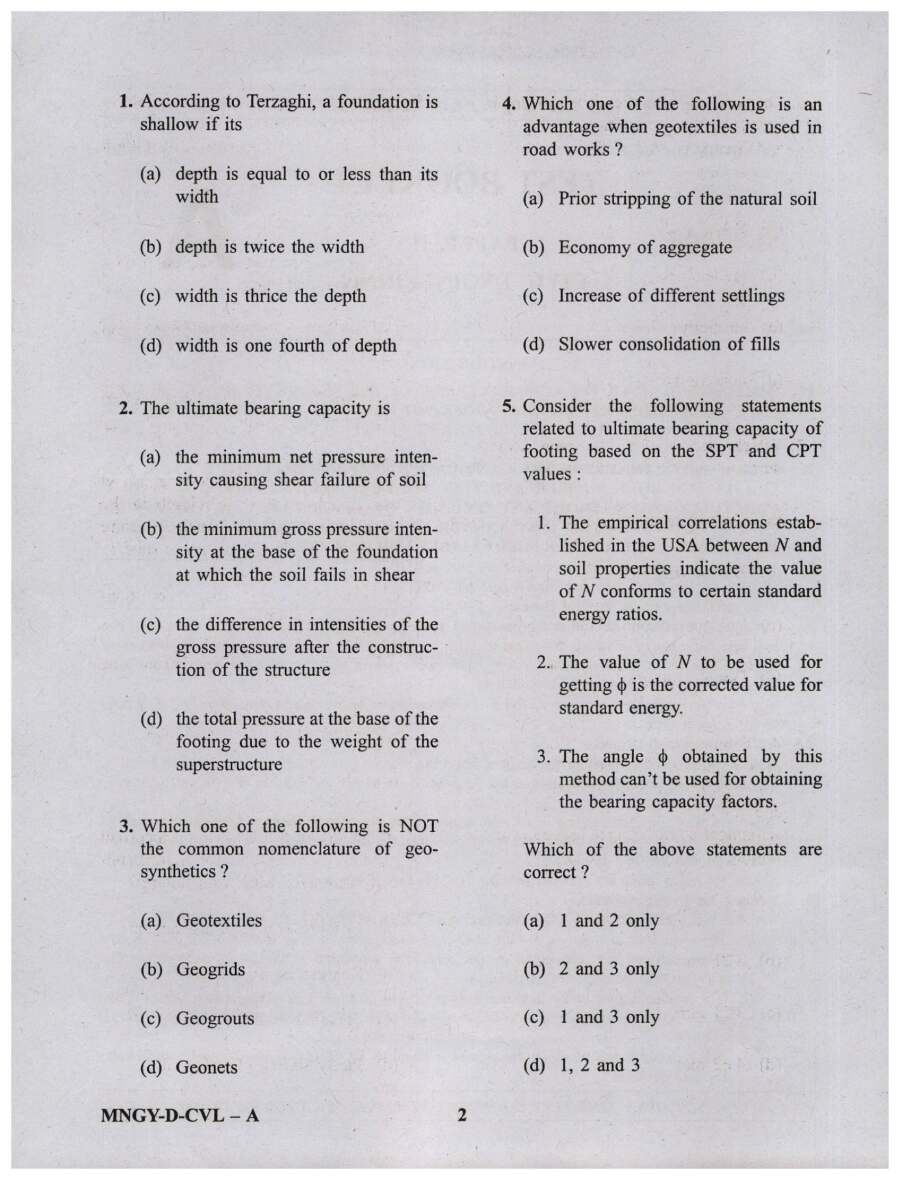
Questions (page 2)

Q1.

  • (a) According to Terzaghi, a foundation is 4. Which one of the following is an shallow if its advantage when geotextiles is used in road works? depth is equal to or less than its width (a) Prior stripping of the natural soil
  • (b) Economy of aggregate (b) depth is twice the width
  • (c) width is thrice the depth
    (c) Increase of different settlings
  • (d) Slower consolidation of fills (d) width is one fourth of depth 5. Consider the following statements
Q2.

  • (a) The ultimate bearing capacity is related to ultimate bearing capacity of footing based on the SPT and CPT the minimum net pressure inten- values : sity causing shear failure of soil 1. The empirical correlations estab-
  • (b) the minimum gross pressure inten- lished in the USA between N and sity at the base of the foundation soil properties indicate the value at which the soil fails in shear of N conforms to certain standard energy ratios.
  • (c) the difference in intensities of the gross pressure after the construc- 2. The value of N to be used for tion of the structure getting \phi is the corrected value for standard energy.
  • (d) the total pressure at the base of the footing due to the weight of the
    3. The angle \phi obtained by this superstructure method can't be used for obtaining the bearing capacity factors.
    3. Which one of the following is NOT the common nomenclature of geo- Which of the above statements are synthetics? correct? (a) Geotextiles (a) 1 and 2 only (b) 2 and 3 only (b) Geogrids
    (c) 1 and 3 only
    (c) Geogrouts (d) 1, 2 and 3 (d) Geonets \mathbbR (b) MNGY-D-CVL - A \overline{\mathbfc}

Q3. The angle φ obtained by this superstructure method can't be used for obtaining the bearing capacity factors.

Q3. Which of the following is NOT the common nomenclature of geo-synthetics?

  • (a) Geotextiles
  • (b) Geogrids
  • (c) Geogrouts
  • (d) Geonets

Q3. Which of the above statements are synthetics?

  • (a) 1 and 2 only
  • (b) 2 and 3 only
  • (c) 1 and 3 only
  • (d) 1, 2 and 3

Q4. Which one of the following is an advantage if geotextiles is used in road works?

  • (a) depth is equal to or less than its width
  • (b) Economy of aggregate
  • (c) width is thrice the depth
  • (d) Slower consolidation of fills

Question paper preview

Scanned pages 1–2 for reference. Download the official PDF for the full paper.

Page 1
Civil Engineering Paper II (2023) - ES Preliminary — page 1 instructions scan PDF download
Page 2
Civil Engineering Paper II (2023) - ES Preliminary — page 1 instructions scan PDF download

Free question paper download

Download question paper PDF

  • 20.9 MB
  • 32 pages
  • PDF format

Frequently asked questions

What is the time allowed for the paper?

Three hours.

What is the maximum marks for the paper?

300 marks.

How many questions are in the test booklet?

150 questions.

What is the penalty for wrong answers?

One-third of the marks assigned to that question.

If a question is left blank, is there a penalty?

No penalty.

Where should roll number be entered?

On the Answer Sheet.

← Back to Engineer papers