Section A
Q1.
(a)
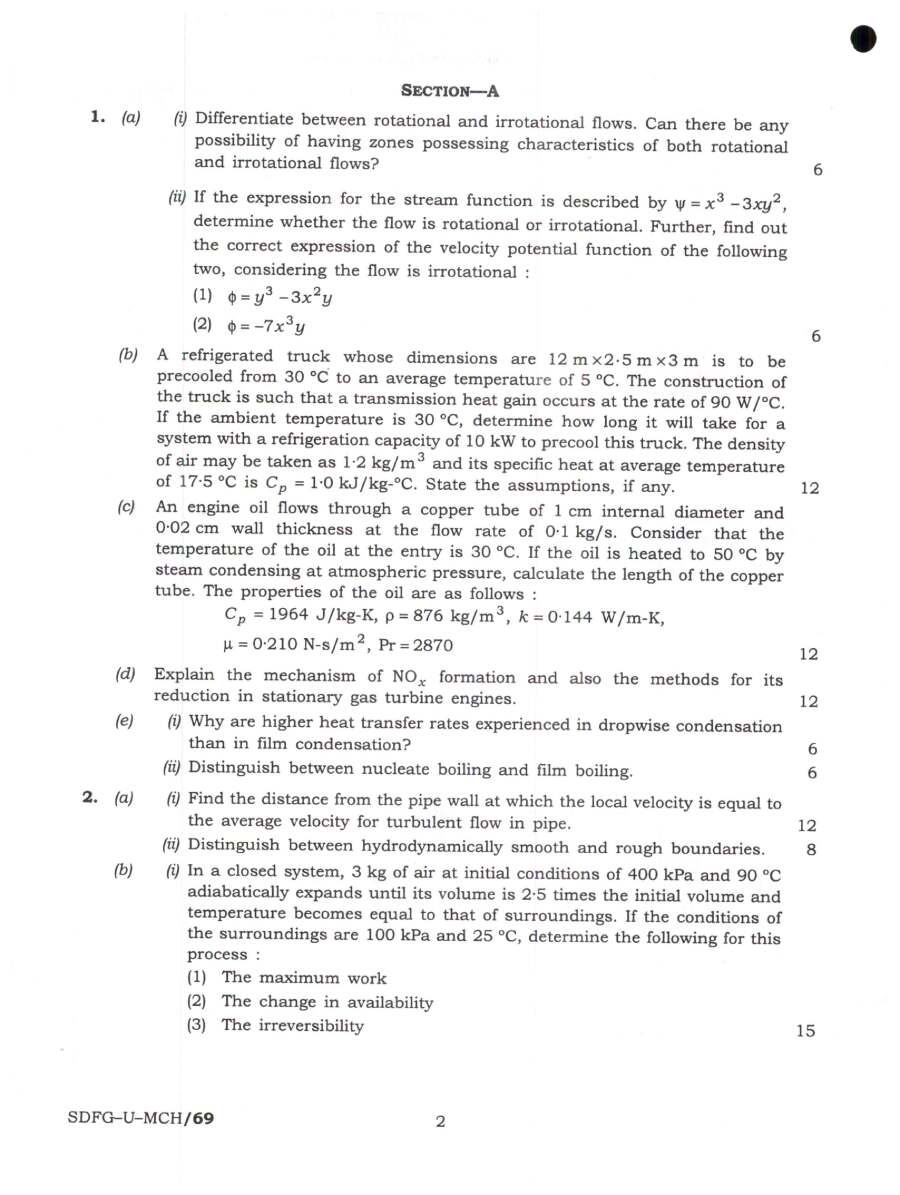
(i) Differentiate between rotational and irrotational flows. Can there be any possibility of having zones possessing characteristics of both rotational and irrotational flows?
(ii) If the expression for the stream function is described by \psi = x3 - 3xy2, determine whether the flow is rotational or irrotational. Further, find out the correct expression of the velocity potential function of the following two, considering the flow is irrotational :
(1) \phi = y3 - 3x2y
(2) \phi = -7x3y
(b) A refrigerated truck whose dimensions are 12 \text m × 2.5 \text m × 3 \text m is to be precooled from 30 °C to an average temperature of 5 °C. The construction of the truck is such that a transmission heat gain occurs at the rate of 90 W/\circC. If the ambient temperature is 30 °C, determine how long it will take for a system with a refrigeration capacity of 10 kW to precool this truck. The density of air may be taken as 1.2 kg/m3 and its specific heat at average temperature of 17.5 °C is Cp = 1.0 \text kJ/kg-°C. State the assumptions, if any.
(c) An engine oil flows through a copper tube of 1 cm internal diameter and 0.02 cm wall thickness at the flow rate of 0.1 kg/s. Consider that the temperature of the oil at the entry is 30 °C. If the oil is heated to 50 °C by steam condensing at atmospheric pressure, calculate the length of the copper tube. The properties of the oil are as follows : Cp = 1964 \text J/kg-K, \rho = 876 \text kg/m^3, k = 0.144 \text W/m-K, μ = 0.210 \text N-s/m^2, Pr = 2870
(d) Explain the mechanism of NOx formation and also the methods for its reduction in stationary gas turbine engines.
(e)
(i) Why are higher heat transfer rates experienced in dropwise condensation than in film condensation?
(ii) Distinguish between nucleate boiling and film boiling.