UPSC Civil Engineering Paper-I 2023 Section A (MCQ)
- Year 2023
- Conducted By Union Public Service Commission (UPSC)
- Questions 8
- Maximum Marks 300
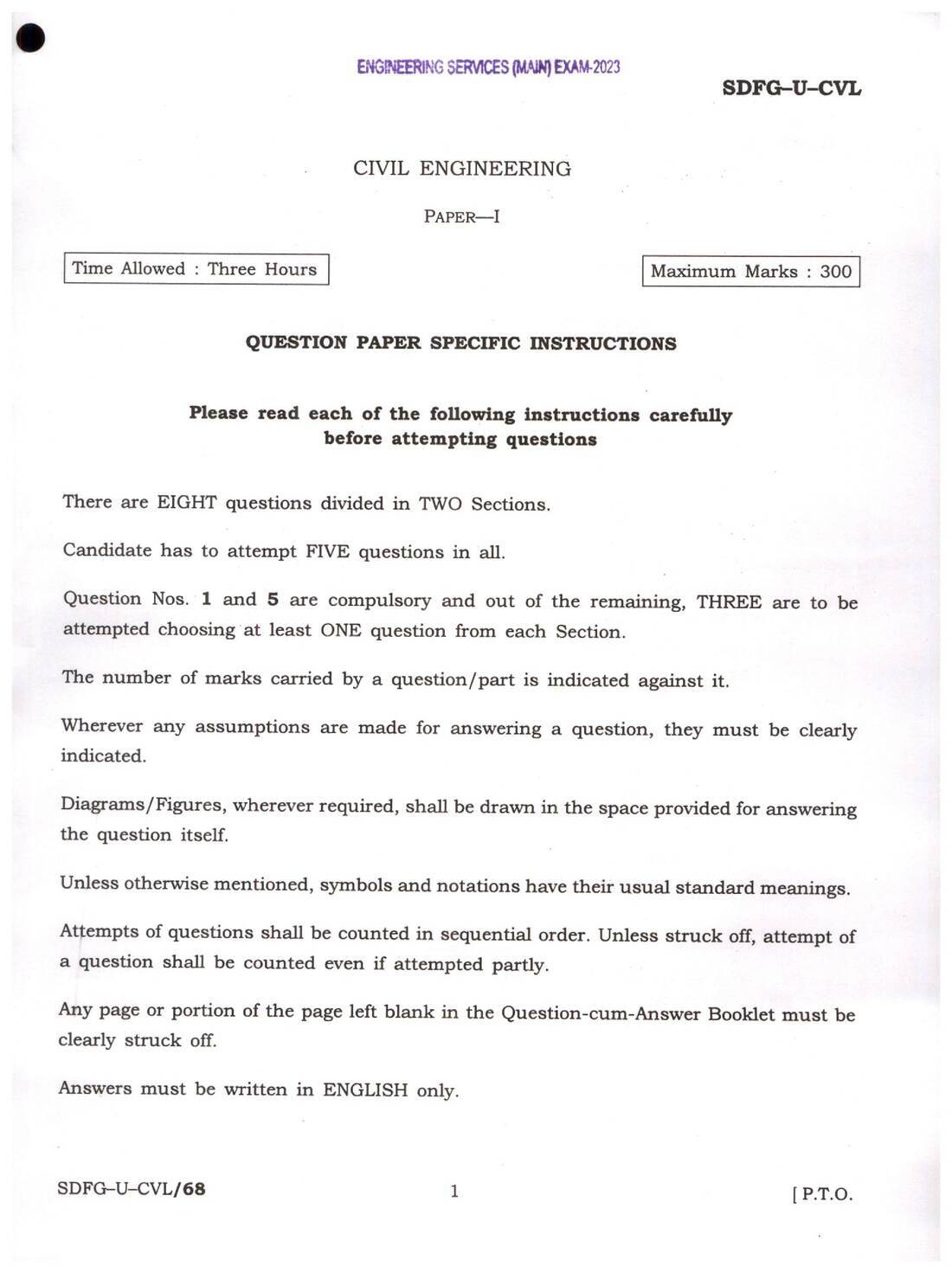
- Duration Three Hours Maximum Marks: 300 Question Paper Specific Instructions Please Read Each Of The Following Instructions Carefully Before Attempting Questions There Are Eight Questions Divided In Two Sections. Candidate Has To Attempt Five Questions In All. Question Nos. 1 And 5 Are Compulsory And Out Of The Remaining, Three Are To Be Attempted Choosing At Least One Question From Each Section. The Number Of Marks Carried By A Question/part Is Indicated Against It. Wherever Any Assumptions Are Made For Answering A Question, They Must Be Clearly Indicated. Diagrams/figures, Wherever Required, Shall Be Drawn In The Space Provided For Answering The Question Itself. Unless Otherwise Mentioned, Symbols And Notations Have Their Usual Standard Meanings. Attempts Of Questions Shall Be Counted In Sequential Order. Unless Struck Off, Attempt Of A Question Shall Be Counted Even If Attempted Partly. Any Page Or Portion Of The Page Left Blank In The Question-cum-answer Booklet Must Be Clearly Struck Off. Answers Must Be Written In English Only. Sdfg-u-cvl/68 1
- Languages English
Exam Details
| Detail | Information |
|---|---|
| Examination | Engineering Services (Main) Exam |
| Year | 2023 |
| Conducting Body | Union Public Service Commission (UPSC) |
| Paper | Civil Engineering Paper-I |
| Subject | Civil Engineering |
| Duration | Three Hours Maximum Marks: 300 Question Paper Specific Instructions Please Read Each Of The Following Instructions Carefully Before Attempting Questions There Are Eight Questions Divided In Two Sections. Candidate Has To Attempt Five Questions In All. Question Nos. 1 And 5 Are Compulsory And Out Of The Remaining, Three Are To Be Attempted Choosing At Least One Question From Each Section. The Number Of Marks Carried By A Question/part Is Indicated Against It. Wherever Any Assumptions Are Made For Answering A Question, They Must Be Clearly Indicated. Diagrams/figures, Wherever Required, Shall Be Drawn In The Space Provided For Answering The Question Itself. Unless Otherwise Mentioned, Symbols And Notations Have Their Usual Standard Meanings. Attempts Of Questions Shall Be Counted In Sequential Order. Unless Struck Off, Attempt Of A Question Shall Be Counted Even If Attempted Partly. Any Page Or Portion Of The Page Left Blank In The Question-cum-answer Booklet Must Be Clearly Struck Off. Answers Must Be Written In English Only. Sdfg-u-cvl/68 1 |
| Maximum Marks | 300 |
| Number of Questions | 8 |
| Question Type | Objective (MCQ) |
This JSON aggregates Page 1 and Page 2 OCR for UPSC Engineering Services (Main) Civil Engineering Paper-I 2023. Page 1 provides the exam header, duration, maximum marks, language, and general instructions. Page 2 (Section-A) contains repaired OCR for MCQ stems covering glazing types for clay products, efflorescence in bricks, prestressed concrete considerations, helically reinforced circular columns, rafter joint bolts design, tensile test material properties, gap-graded aggregates, and PPC versus OPC. The objective_questions_preview section enumerates eight questions (with subparts split where applicable), ready for SEO and metadata enrichment. The FAQ, topics, and keywords are inferred from the stems to support search optimization.
Major Topics Covered
- glazing types in clay products
- efflorescence in bricks
- prestressed concrete
- high tensile steel
- high strength concrete
- helically reinforced circular columns
- lateral ties in columns
- gusset joint bolting
- Bolts design in steel joints
- E250 grade steel
- K_b and γ_mb factors
- limit state design
- Poisson's ratio
- modulus of elasticity
- modulus of rigidity
- bulk modulus
- gap-graded aggregate
- PPC vs OPC
- cement ingredients
Why This Paper is Important
- Useful for Engineering Services (Main) Exam preparation
- Helps understand the latest exam pattern
- Useful for practice and self-assessment
- Covers frequently asked General Studies topics
- Helpful for analysing question trends
Related Resources
- Engineering Services Examination 2016 Electronics & Telecommunication Paper II PDF
- UPSC Engineering Services 2016 Electronics & Telecommunication Paper-I PDF
- Engineering Services Exam 2016 Electrical Engineering Paper II PDF
- UPSC Engineering Services Exam 2016 Electrical Engineering Paper I PDF
- Engineering Services Examination 2016 Mechanical Engineering Paper-II PDF
Instructions
- There are EIGHT questions divided in TWO Sections.
- Candidate has to attempt FIVE questions in all.
- Question Nos. 1 and 5 are compulsory and out of the remaining, THREE are to be attempted choosing at least ONE question from each Section.
- The number of marks carried by a question/part is indicated against it.
- Wherever any assumptions are made for answering a question, they must be clearly indicated.
- Diagrams/Figures, wherever required, shall be drawn in the space provided for answering the question itself.
- Unless otherwise mentioned, symbols and notations have their usual standard meanings.
- Attempts of questions shall be counted in sequential order.
- Unless struck off, attempt of a question shall be counted even if attempted partly.
- Any page or portion of the page left blank in the Question-cum-Answer Booklet must be clearly struck off.
- Answers must be written in ENGLISH only.
Questions (page 2)
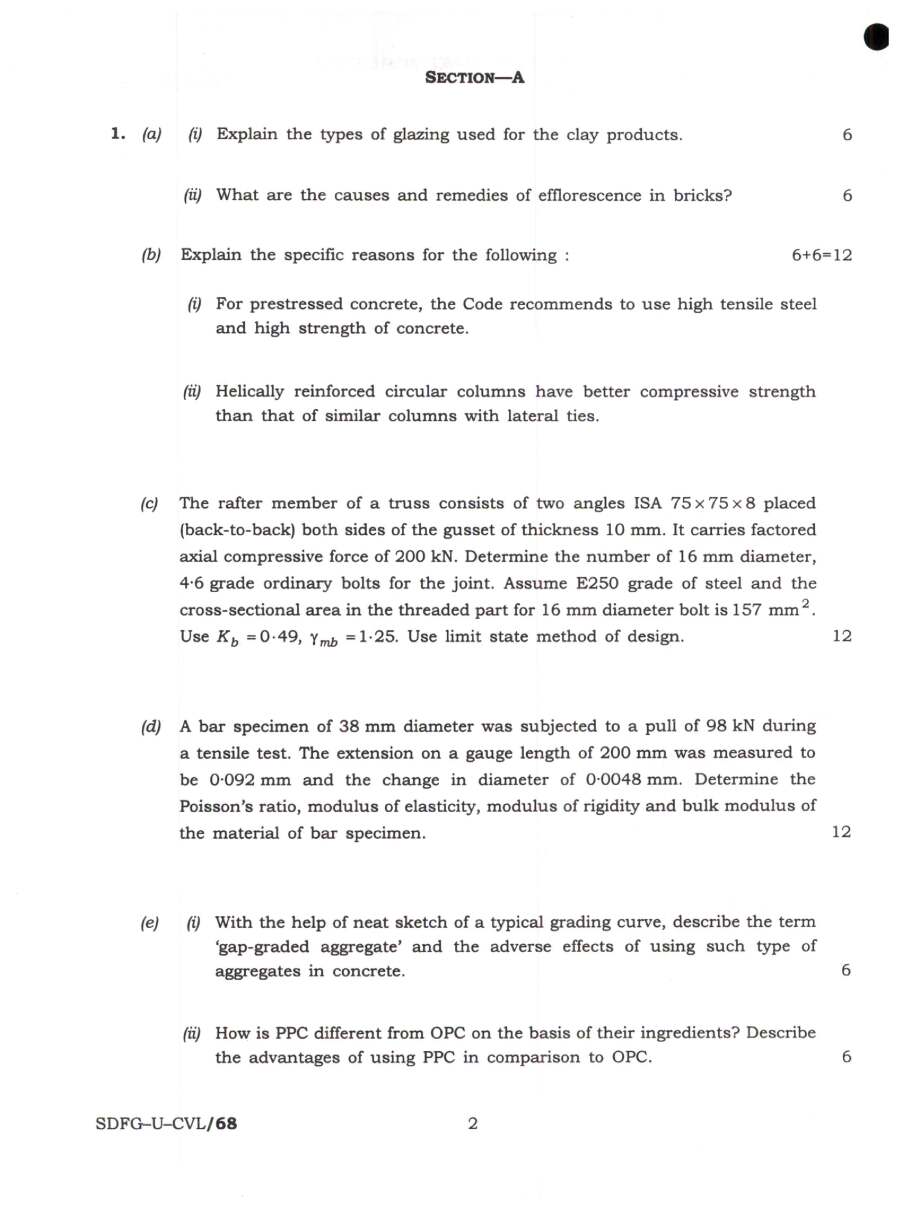
Q2. What are the causes and remedies of efflorescence in bricks? (6 marks)
Q3.
Explain the specific reasons for the following:
(i) For prestressed concrete, the Code recommends to use high tensile steel and high strength of concrete. (6 marks)
Q4.
Explain the specific reasons for the following:
(ii) Helically reinforced circular columns have better compressive strength than that of similar columns with lateral ties. (6 marks)
Q5. The rafter member of a truss consists of two angles ISA 75×75×8 placed back-to-back on both sides of the gusset of thickness 10 mm. It carries factored axial compressive force of 200 kN. Determine the number of 16 mm diameter, 4.6 grade ordinary bolts for the joint. Assume E250 grade of steel and the cross-sectional area in the threaded part for 16 mm diameter bolt is 157 mm2. Use Kb = 0.49, γ_mb = 1.25. Use limit state method of design. (12 marks)
Q6. A bar specimen of 38 mm diameter was subjected to a pull of 98 kN during a tensile test. The extension on a gauge length of 200 mm was measured to be 0.092 mm and the change in diameter of 0.0048 mm. Determine the Poisson's ratio, modulus of elasticity, modulus of rigidity and bulk modulus of the material of bar specimen. (12 marks)
Q7. With the help of neat sketch of a typical grading curve, describe the term 'gap-graded aggregate' and the adverse effects of using such type of aggregates in concrete. (6 marks)
Q8. How is PPC different from OPC on the basis of their ingredients? Describe the advantages of using PPC in comparison to OPC. (6 marks)
Question paper preview
Scanned pages 1–2 for reference. Download the official PDF for the full paper.
Free question paper download
Download question paper PDF
Your download starts in 10s
Preparing your question paper file…
Frequently asked questions
What is the full exam name and year?
Engineering Services (Main) Exam, UPSC, 2023.
Which paper is this?
Civil Engineering Paper-I.
How many questions are in this paper and how many must you attempt?
There are eight questions; five must be attempted in total.
Which questions are compulsory?
Questions 1 and 5 are compulsory.
In which language must answers be written?
Answers must be written in English.
What topics are covered in Section-A (Page 2) in this OCR repair?
Glazing types, efflorescence in bricks, prestressed concrete, helically reinforced circular columns, bolted joint design, tensile test properties, gap-graded aggregate, PPC vs OPC.