Engineering Services 2023 Civil Engineering Paper II Question Paper PDF

Central Government Jobs Engineer 2023

  • Year 2023
  • Conducted By UPSC
  • Questions 8
  • Maximum Marks 300
  • Duration Three Hours
  • Languages English

Exam Details

Detail Information
Examination Engineering Services (Main) Examination
Year 2023
Conducting Body UPSC
Paper Civil Engineering Paper – II
Subject Civil Engineering
Duration Three Hours
Maximum Marks 300
Number of Questions 8
Question Type Mixed

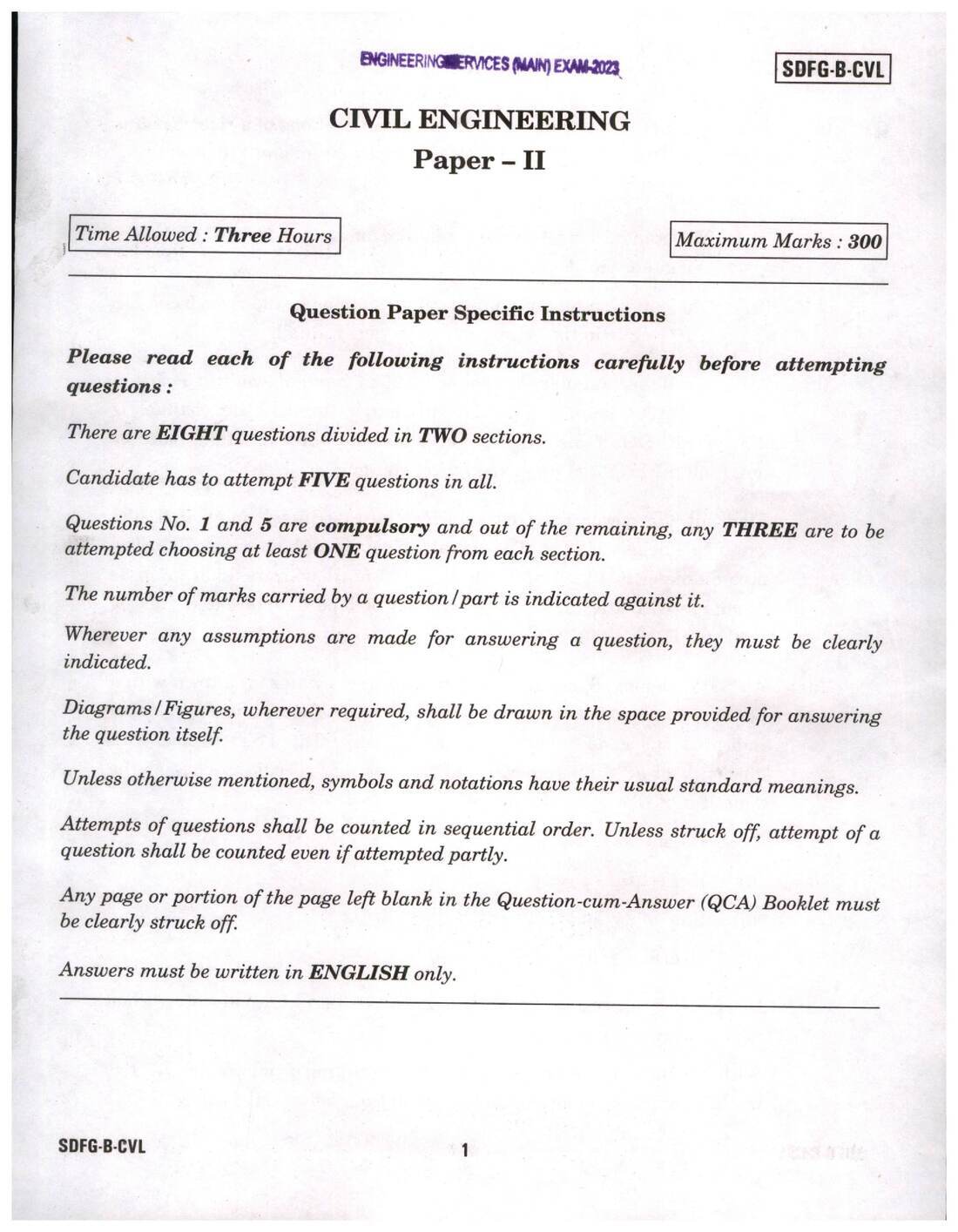
This is the official question paper for the Engineering Services (Main) Examination 2023, specifically for Civil Engineering Paper II. Conducted by UPSC, this paper carries a maximum of 300 marks and candidates are allowed three hours to complete it. It is a crucial resource for aspirants preparing for the ESE exam, offering insights into the types of questions, difficulty level, and important topics covered in Civil Engineering. Analyzing this paper can help candidates strategize their preparation and identify areas for improvement.

Major Topics Covered

  • Hydrology and Water Resources Engineering
  • Open Channel Flow
  • Fluid Mechanics
  • Pumps
  • Water Treatment
  • Wastewater Engineering
  • Environmental Engineering

Why This Paper is Important

  • Useful for Engineering Services (Main) Examination preparation
  • Helps understand the latest exam pattern
  • Useful for practice and self-assessment
  • Covers frequently asked General Studies topics
  • Helpful for analysing question trends

Related Resources

  • Engineering Services (Main) Examination 2022 Civil Engineering Paper II
  • Engineering Services (Main) Examination 2021 Civil Engineering Paper II
  • Engineering Services (Preliminary) Examination 2023 Civil Engineering Paper I
  • ESE 2023 Civil Engineering Paper II Answer Key
  • UPSC Engineering Services 2023 Civil Engineering Solutions
  • ESE Civil Engineering Syllabus
  • UPSC Engineering Services Exam Syllabus
  • ESE Exam Pattern

Instructions

  • There are EIGHT questions divided in TWO sections.
  • Candidate has to attempt FIVE questions in all.
  • Questions No. 1 and 5 are compulsory and out of the remaining, any THREE are to be attempted choosing at least ONE question from each section.
  • The number of marks carried by a question / part is indicated against it.
  • Wherever any assumptions are made for answering a question, they must be clearly indicated.
  • Diagrams/Figures, wherever required, shall be drawn in the space provided for answering the question itself.
  • Unless otherwise mentioned, symbols and notations have their usual standard meanings.
  • Attempts of questions shall be counted in sequential order.
  • Unless struck off, attempt of a question shall be counted even if attempted partly.
  • Any page or portion of the page left blank in the Question-cum-Answer (QCA) Booklet must be clearly struck off.
  • Answers must be written in ENGLISH only.

Questions (page 2)

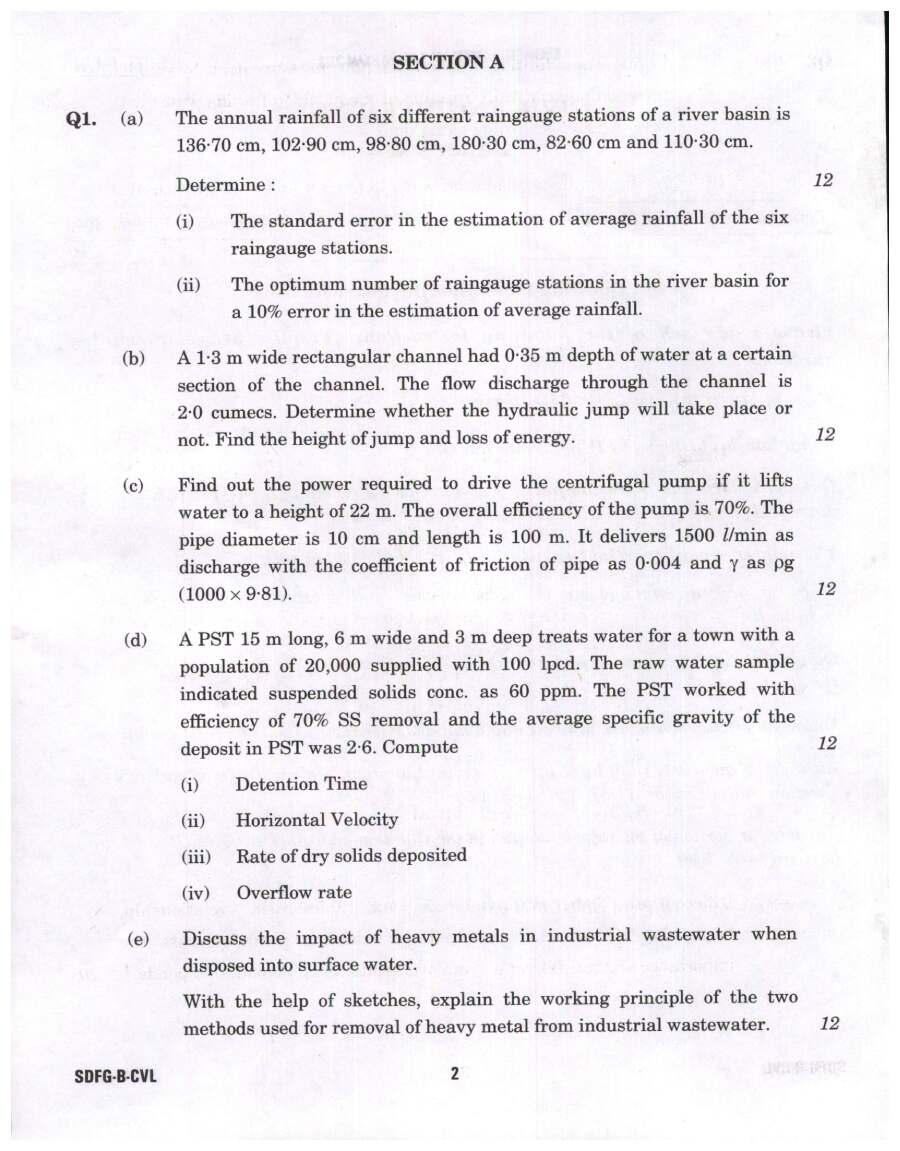
Section A

Q1.

(a) The annual rainfall of six different raingauge stations of a river basin is 136.70 cm, 102.90 cm, 98.80 cm, 180.30 cm, 82.60 cm and 110.30 cm.
Determine :
(i) The standard error in the estimation of average rainfall of the six raingauge stations.
(ii) The optimum number of raingauge stations in the river basin for a 10% error in the estimation of average rainfall.

(b) A 1.3 m wide rectangular channel had 0.35 m depth of water at a certain section of the channel. The flow discharge through the channel is 2.0 cumecs. Determine whether the hydraulic jump will take place or not. Find the height of jump and loss of energy.

(c) Find out the power required to drive the centrifugal pump if it lifts water to a height of 22 m. The overall efficiency of the pump is 70%. The pipe diameter is 10 cm and length is 100 m. It delivers 1500 l/min as discharge with the coefficient of friction of pipe as 0.004 and gamma as
ho g (1000 imes 9.81).

(d) A PST 15 m long, 6 m wide and 3 m deep treats water for a town with a population of 20,000 supplied with 100 lpcd. The raw water sample indicated suspended solids conc. as 60 ppm. The PST worked with efficiency of 70% SS removal and the average specific gravity of the deposit in PST was 2. Compute
(i) Detention Time
(ii) Horizontal Velocity
(iii) Rate of dry solids deposited
(iv) Overflow rate.

(e) Discuss the impact of heavy metals in industrial wastewater when disposed into surface water. With the help of sketches, explain the working principle of the two methods used for removal of heavy metal from industrial wastewater.
Question paper preview

Scanned pages 1–2 for reference. Download the official PDF for the full paper.

Page 1
Engineering Services Main Exam 2023 Civil Engineering Paper II question paper page 1 instructions scan PDF download UPSC ESE
Page 2
Engineering Services Main Exam 2023 Civil Engineering Paper II question paper page 1 instructions scan PDF download UPSC ESE

Free question paper download

Download question paper PDF

  • 5.4 MB
  • 10 pages
  • PDF format

Frequently asked questions

What is the name of the exam?

The exam is the Engineering Services (Main) Examination.

Which year is this question paper for?

This question paper is for the year 2023.

Who conducts the Engineering Services Examination?

The Union Public Service Commission (UPSC) conducts the Engineering Services Examination.

What is the subject of this paper?

This paper is for Civil Engineering.

What is the paper code?

The paper code is SDFG-B-CVL.

What is the maximum marks for this paper?

The maximum marks for this paper are 300.

← Back to Engineer papers