Indian Forest Service 2025 Mechanical Engineering Paper I Question Paper PDF

Central Government Jobs Engineer 2025

  • Year 2025
  • Conducted By UPSC
  • Questions 8
  • Maximum Marks 200
  • Duration Three Hours
  • Languages English

Exam Details

Detail Information
Examination Indian Forest Service (Main) Examination
Year 2025
Conducting Body UPSC
Paper Mechanical Engineering Paper - I
Subject Mechanical Engineering
Duration Three Hours
Maximum Marks 200
Number of Questions 8
Question Type Mixed

This is the Mechanical Engineering Paper I for the Indian Forest Service (Main) Examination 2025, conducted by UPSC. The paper contains 8 questions, of which 5 are to be attempted, with compulsory questions and sectional choices. It is designed to assess candidates' in-depth knowledge of Mechanical Engineering principles relevant to forestry and environmental management. Aspirants can use this question paper to understand the exam pattern, question types, and marking scheme, aiding in their preparation strategy for the IFS Main exam.

Major Topics Covered

  • Mechanical Engineering
  • Mechanisms
  • Gears
  • Stress Analysis
  • Mohr Circle
  • Crystal Systems
  • Material Science
  • Composite Materials

Why This Paper is Important

  • Useful for Indian Forest Service (Main) Examination preparation
  • Helps understand the latest exam pattern
  • Useful for practice and self-assessment
  • Covers frequently asked General Studies topics
  • Helpful for analysing question trends

Related Resources

  • Indian Forest Service (Main) Examination 2024 Mechanical Engineering Paper I
  • Indian Forest Service (Main) Examination 2025 Mechanical Engineering Paper II
  • Engineering Services Examination 2025 Mechanical Engineering Paper I
  • Indian Forest Service (Main) Examination 2025 Mechanical Engineering Paper I Answer Key
  • Indian Forest Service (Main) Examination Mechanical Engineering Syllabus
  • UPSC Mechanical Engineering Syllabus
  • Indian Forest Service (Main) Examination Pattern
  • UPSC Exam Pattern

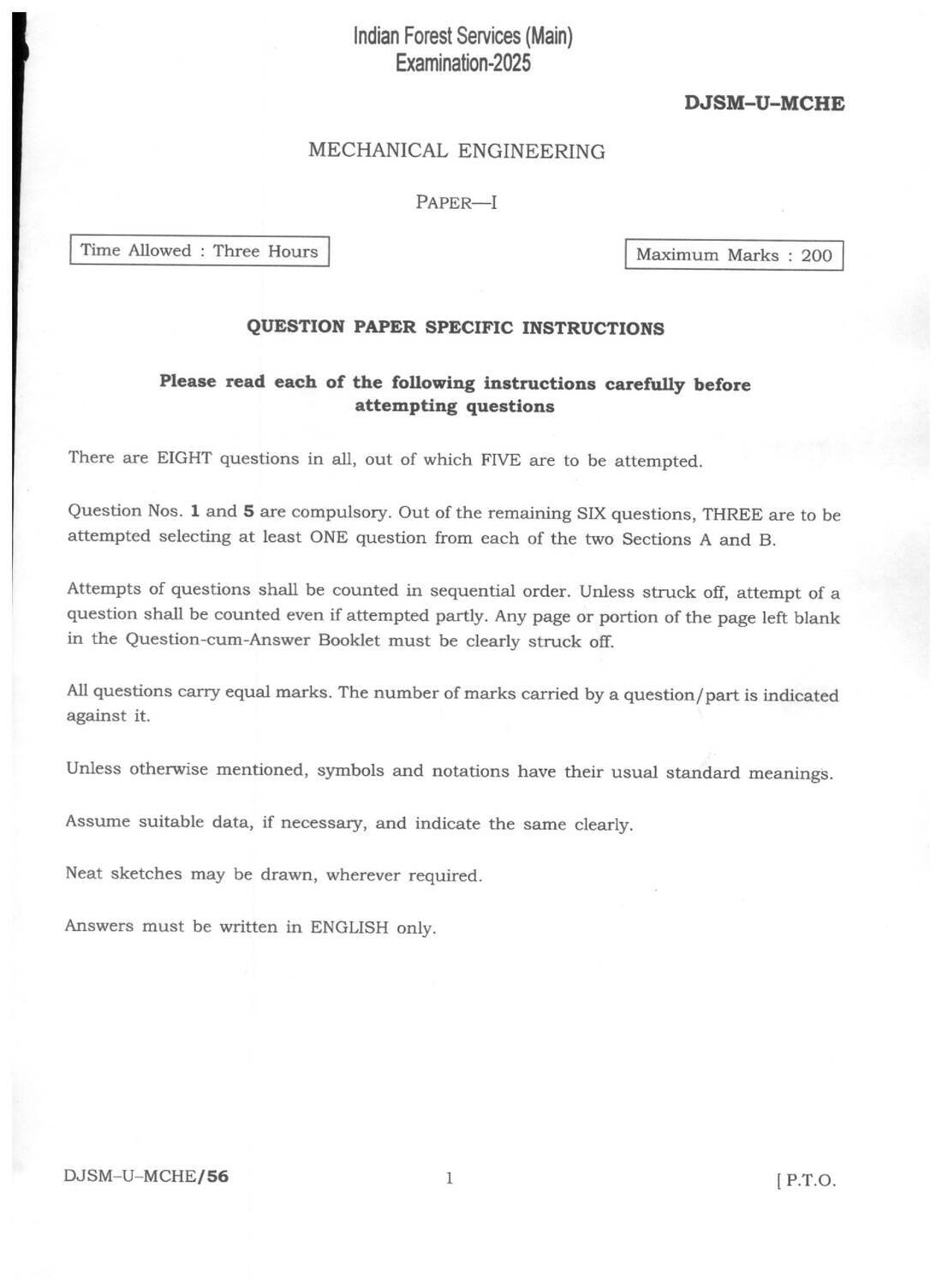
Instructions

  • There are EIGHT questions in all, out of which FIVE are to be attempted.
  • Out of the remaining SIX questions, THREE are to be attempted selecting at least ONE question from each of the two Sections A and B.
  • Attempts of questions shall be counted in sequential order.
  • Unless struck off, attempt of a question shall be counted even if attempted partly.
  • Any page or portion of the page left blank in the Question-cum-Answer Booklet must be clearly struck off.
  • The number of marks carried by a question/part is indicated against it.
  • Unless otherwise mentioned, symbols and notations have their usual standard meanings.
  • Assume suitable data, if necessary, and indicate the same clearly.
  • Neat sketches may be drawn, wherever required.
  • Answers must be written in ENGLISH only.

Questions (page 2)

Section A

Q1. For the mechanism shown in the figure below, determine the angular velocities of the links AB and OA. Given, QB = 20 mm, AB = 30 mm, OA = 20 mm; O, A and Q are in the same horizontal level : Two 20° involute gears are in mesh with gear ratio 2.5. The number of teeth on pinion is 24. The gears have a module of 6 mm and the addendum is equal to one module. Determine the (i) angle of action of the pinion and (ii) maximum velocity of sliding, if the pitch line velocity is 2 m/s. The state of stress at some point in a body is defined as follows : σ_x = 138 MPa, σ_y = -28 MPa, \tauxy = 35 MPa Determine the number of lattice points per cell in the simple cubic (SC), body-centered cubic (BCC) and face-centered cubic (FCC) crystal systems. If there is only one atom located at each lattice point, calculate the number of atoms per unit cell. Determine the relationship between the atomic radius (r) and the lattice parameter (a0) in simple cubic (SC), body-centered cubic (BCC) and face-centered cubic (FCC) structures when one atom is located at each lattice point. A cemented carbide cutting tool used for machining contains 75 percent by weight of tungsten carbide (WC), 15 percent by weight of titanium carbide (TiC), 5 percent by weight of tantalum carbide (TaC) and 5 percent by weight of cobalt (Co). Estimate the density of the composite material. Given : Density of tungsten carbide, \rhoWC = 15.77 gm/cm3
Density of titanium carbide, \rho_{\textTiC} = 4.94 gm/cm3
Density of tantalum carbide, \rhoTaC = 14.5 gm/cm3
Density of cobalt, \rhoCo = 8.90 gm/cm3
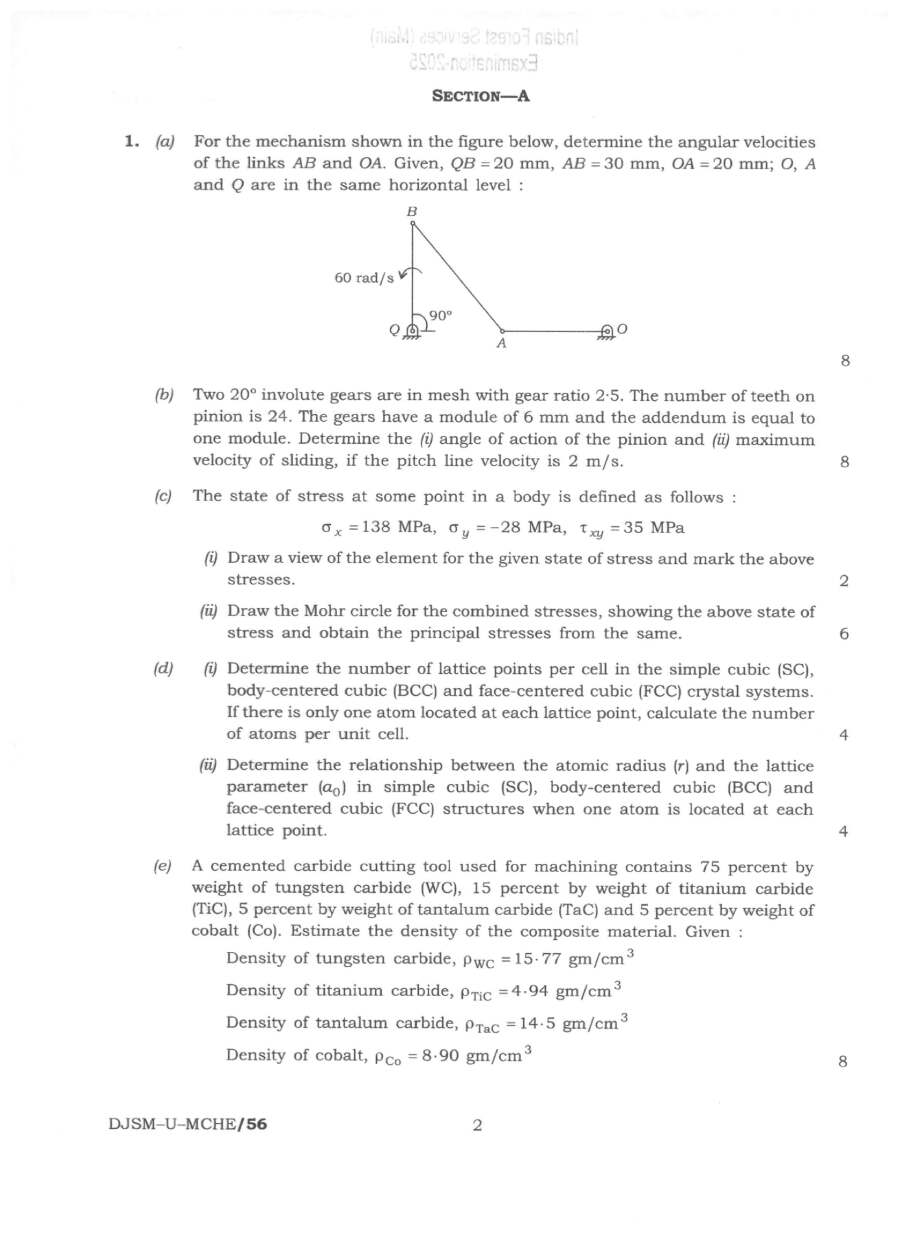
(a) For the mechanism shown in the figure below, determine the angular velocities of the links AB and OA. Given, QB = 20 mm, AB = 30 mm, OA = 20 mm; O, A and Q are in the same horizontal level :

(b) Two 20° involute gears are in mesh with gear ratio 2.5. The number of teeth on pinion is 24. The gears have a module of 6 mm and the addendum is equal to one module. Determine the (i) angle of action of the pinion and (ii) maximum velocity of sliding, if the pitch line velocity is 2 m/s.

(c) The state of stress at some point in a body is defined as follows :
σ_x = 138 MPa, σ_y = -28 MPa, \tauxy = 35 MPa
(i) Draw a view of the element for the given state of stress and mark the above stresses.
(ii) Draw the Mohr circle for the combined stresses, showing the above state of stress and obtain the principal stresses from the same.

(d) (i) Determine the number of lattice points per cell in the simple cubic (SC), body-centered cubic (BCC) and face-centered cubic (FCC) crystal systems. If there is only one atom located at each lattice point, calculate the number of atoms per unit cell.

(ii) Determine the relationship between the atomic radius (r) and the lattice parameter (a0) in simple cubic (SC), body-centered cubic (BCC) and face-centered cubic (FCC) structures when one atom is located at each lattice point.

(e) A cemented carbide cutting tool used for machining contains 75 percent by weight of tungsten carbide (WC), 15 percent by weight of titanium carbide (TiC), 5 percent by weight of tantalum carbide (TaC) and 5 percent by weight of cobalt (Co). Estimate the density of the composite material. Given :
Density of tungsten carbide, \rhoWC = 15.77 gm/cm3
Density of titanium carbide, \rho_{\textTiC} = 4.94 gm/cm3
Density of tantalum carbide, \rhoTaC = 14.5 gm/cm3
Density of cobalt, \rhoCo = 8.90 gm/cm3

Question paper preview

Scanned pages 1–2 for reference. Download the official PDF for the full paper.

Page 1
Indian Forest Service Main 2025 Mechanical Engineering Paper I question paper page 1 instructions scan PDF download
Page 2
Indian Forest Service Main 2025 Mechanical Engineering Paper I question paper page 1 instructions scan PDF download

Free question paper download

Download question paper PDF

  • 2.2 MB
  • 8 pages
  • PDF format

Frequently asked questions

What is the name of the examination?

The examination is the Indian Forest Service (Main) Examination.

What is the year of this question paper?

This question paper is from the year 2025.

Which paper is this?

This is Mechanical Engineering Paper - I.

Who conducts the Indian Forest Service Examination?

The examination is conducted by UPSC (Union Public Service Commission).

What is the total number of questions in the paper?

There are a total of EIGHT questions in the paper.

How many questions need to be attempted?

Candidates need to attempt FIVE questions out of the eight.

← Back to Engineer papers