Mechanical Engineering Paper II 2023 IFS

Central Government Jobs Engineer 2023

  • Year 2023
  • Conducted By BJKE-B-MCHE
  • Questions 8
  • Maximum Marks 200
  • Duration Three Hours
  • Languages English

Exam Details

Detail Information
Examination Indian Forest Service (Main) Examination
Year 2023
Conducting Body BJKE-B-MCHE
Paper Mechanical Engineering
Subject Mechanical Engineering
Duration Three Hours
Maximum Marks 200
Number of Questions 8
Question Type Mixed

This JSON consolidates OCR data from PAGE 1 and PAGE 2 for the Mechanical Engineering Paper II of the Indian Forest Service (Main) Examination, 2023. It includes metadata such as exam name, year, paper details, and the corrected questions visible on page 2 (Q1 with subparts a–e). Page 1 provides the general instructions: eight questions in total, compulsory Q1 and Q5, two sections A and B, English answers, and SI units, along with essential constants. The SEO content includes a detailed FAQ, topics, and keywords to improve search visibility for this exam paper and its topics. The objective questions extracted from page 2 include Q1 with parts (a)-(e) focusing on energy balance, heat conduction in pipes, non-petroleum fuels for IC engines, factors affecting volumetric efficiency, and a heating-water problem.

Major Topics Covered

  • Thermodynamics
  • Energy
  • Enthalpy
  • Internal Energy
  • Paddle Wheel
  • Heat Transfer
  • Conduction
  • Boundary Conditions
  • Temperature Variation
  • Non-Petroleum Fuels
  • Benzol
  • Vegetable Oils
  • Alcohol
  • Acetone
  • Volumetric Efficiency
  • Automotive IC Engine
  • Heating Element
  • Water Heating
  • Convection
  • Heat Transfer Coefficient

Why This Paper is Important

  • Useful for Indian Forest Service (Main) Examination preparation
  • Helps understand the latest exam pattern
  • Useful for practice and self-assessment
  • Covers frequently asked General Studies topics
  • Helpful for analysing question trends

Related Resources

Instructions

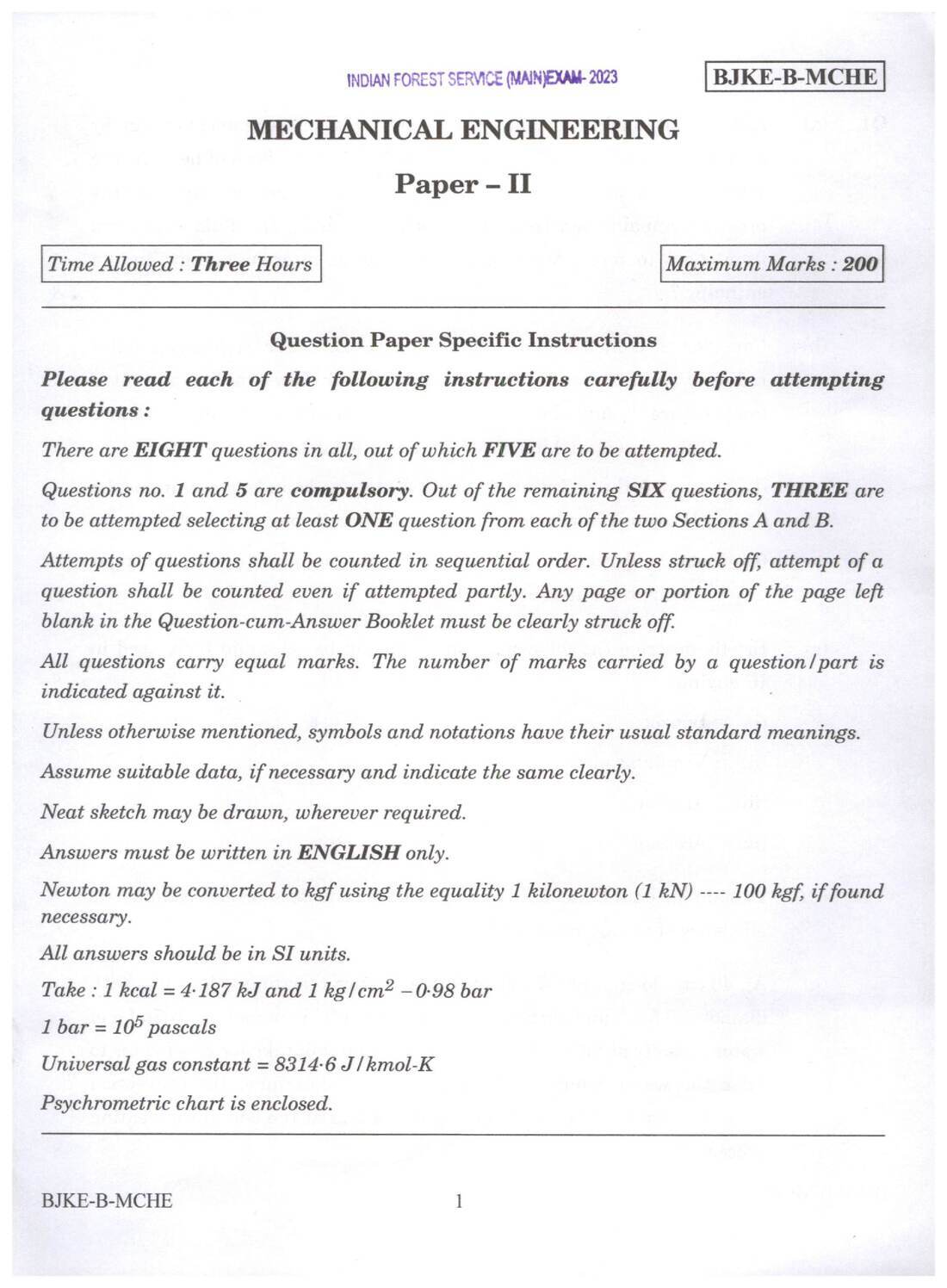
  • There are EIGHT questions in all, out of which FIVE are to be attempted.
  • Out of the remaining SIX questions, THREE are to be attempted selecting at least ONE question from each of the two Sections A and B.
  • Attempts of questions shall be counted in sequential order.
  • Unless struck off, attempt of a question shall be counted even if attempted partly.
  • Any page or portion of the page left blank in the Question-cum-Answer Booklet must be clearly struck off.
  • The number of marks carried by a question/part is indicated against it.
  • Unless otherwise mentioned, symbols and notations have their usual standard meanings.
  • Assume suitable data, if necessary and indicate the same clearly.
  • Neat sketch may be drawn, wherever required.
  • Answers must be written in ENGLISH only.
  • Newton may be converted to kgf using the equality 1 kilonewton (1 \text{ kN}) ---- 100 kgf, if found necessary.
  • Take: 1 kcal = 4. 187 kJ and 1 kg/cm2 - 0. 98 bar 1 bar = 10^5 pascals $20 18 21 56 32 . .
  • Universal gas constant = 8314.6 J/kmol-K Psychrometric chart is enclosed.

Questions (page 2)

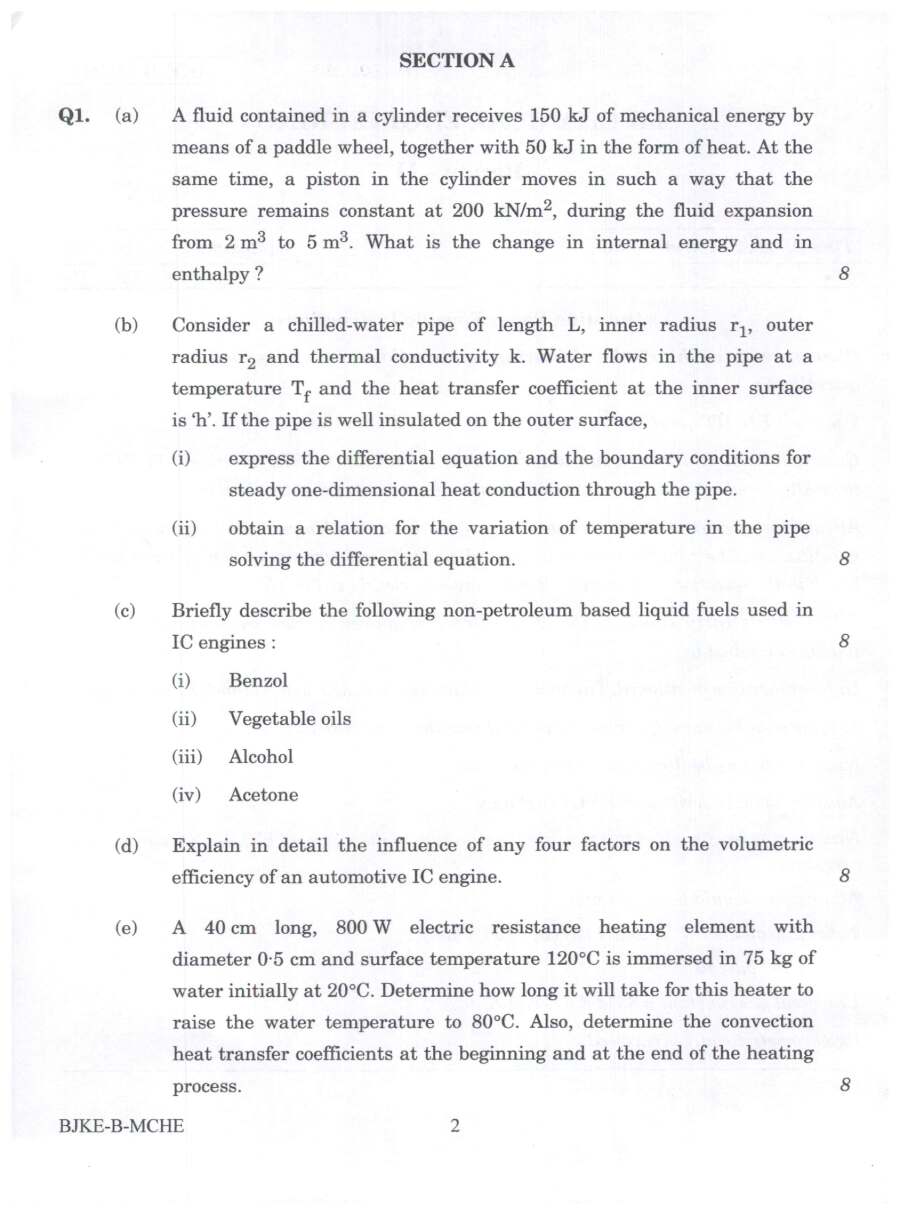
Q1. Q1. A fluid contained in a cylinder receives 150 kJ of mechanical energy by (a) means of a paddle wheel, together with 50 kJ in the form of heat. At the same time, a piston in the cylinder moves in such a way that the pressure remains constant at 200 kN/m^2, during the fluid expansion from 2 m3 to 5 m3. What is the change in internal energy and in enthalpy?

() (a) means of a paddle wheel, together with 50 kJ in the form of heat. If required, apply first law to compute ΔU and ΔH.

() (b) Consider a chilled-water pipe of length L, inner radius r1, outer radius r2 and thermal conductivity k. Water flows in the pipe at a temperature Tf and the heat transfer coefficient at the inner surface is 'h'. If the pipe is well insulated on the outer surface, express the differential equation and the boundary conditions for
(i) steady one-dimensional heat conduction through the pipe; obtain a relation for the variation of temperature in the pipe
(ii) solve the differential equation.

() (c) Briefly describe the following non-petroleum based liquid fuels used in IC engines:
(i) Benzol
(ii) Vegetable oils
(iii) Alcohol
(iv) Acetone

() (d) Explain in detail the influence of any four factors on the volumetric efficiency of an automotive IC engine.

() (e) A 40 cm long, 800 W electric resistance heating element with diameter 0.5 cm and surface temperature 120°C is immersed in 75 kg of water initially at 20°C. Determine how long it will take for this heater to raise the water temperature to 80°C. Also, determine the convection heat transfer coefficients at the beginning and at the end of the heating process.
  • (a) means of a paddle wheel, together with 50 kJ in the form of heat. If required, apply first law to compute ΔU and ΔH.
  • (b) Consider a chilled-water pipe of length L, inner radius r1, outer radius r2 and thermal conductivity k. Water flows in the pipe at a temperature Tf and the heat transfer coefficient at the inner surface is 'h'. If the pipe is well insulated on the outer surface, express the differential equation and the boundary conditions for
  • (c) Briefly describe the following non-petroleum based liquid fuels used in IC engines:
  • (d) Explain in detail the influence of any four factors on the volumetric efficiency of an automotive IC engine.

Question paper preview

Scanned pages 1–2 for reference. Download the official PDF for the full paper.

Page 1
Mechanical Engineering Paper II 2023 IFS — page 1 instructions scan PDF download
Page 2
Mechanical Engineering Paper II 2023 IFS — page 1 instructions scan PDF download

Free question paper download

Download question paper PDF

  • 4.0 MB
  • 10 pages
  • PDF format

Frequently asked questions

What is the exam name and year?

Indian Forest Service (Main) Examination, Mechanical Engineering, Paper II, 2023.

How many questions are in the paper?

Eight questions in total.

Which questions are compulsory?

Questions 1 and 5 are compulsory.

From how many sections should you attempt questions?

You must select at least one question from Section A and one from Section B, with three of the remaining questions to be attempted.

What is the time limit for the paper?

Three hours.

In what language should answers be written?

English.

← Back to Engineer papers