Indian Forest Service 2023 Chemical Engineering Paper I Question Paper PDF

Central Government Jobs Engineer 2023

  • Year 2023
  • Conducted By UPSC
  • Questions 8
  • Maximum Marks 200
  • Duration Three Hours
  • Languages English

Exam Details

Detail Information
Examination Indian Forest Service (Main) Examination
Year 2023
Conducting Body UPSC
Paper Chemical Engineering Paper - I
Subject Chemical Engineering
Duration Three Hours
Maximum Marks 200
Number of Questions 8
Question Type Mixed

This document contains the Chemical Engineering Paper - I for the Indian Forest Service (Main) Examination held in 2023, conducted by UPSC. The paper consists of eight questions, with candidates required to attempt five, including compulsory questions 1 and 5. Candidates must select at least one question from each of the two sections (A and B) from the remaining six questions. All questions carry equal marks, and answers must be written in English. This paper is crucial for aspirants preparing for the Chemical Engineering specialization within the IFS exam, offering insights into the depth and breadth of knowledge assessed.

Major Topics Covered

  • Chemical Engineering
  • Pipes
  • Nominal Diameter
  • Schedule Number
  • Equivalent Diameter
  • Size Reduction
  • Bond's Law
  • Power Consumption
  • Drying
  • Moisture Content
  • Critical Moisture
  • Equilibrium Moisture
  • Absorption Column
  • Mechanical Entrainment
  • Tray Efficiency
  • Nusselt Number
  • Biot Number
  • Head Loss
  • Friction
  • Fluid Mechanics

Why This Paper is Important

  • Useful for Indian Forest Service (Main) Examination preparation
  • Helps understand the latest exam pattern
  • Useful for practice and self-assessment
  • Covers frequently asked General Studies topics
  • Helpful for analysing question trends

Related Resources

  • Indian Forest Service (Main) Examination 2023 - General English
  • Indian Forest Service (Main) Examination 2023 - Paper II
  • UPSC Engineering Services Examination 2023 Chemical Engineering Paper I
  • Indian Forest Service (Main) Examination 2023 Chemical Engineering Paper I Answer Key
  • UPSC IFS 2023 Chemical Engineering Paper I Solutions
  • Indian Forest Service (Main) Examination Chemical Engineering Syllabus
  • UPSC IFS Main Exam Syllabus
  • Indian Forest Service (Main) Examination Pattern

Instructions

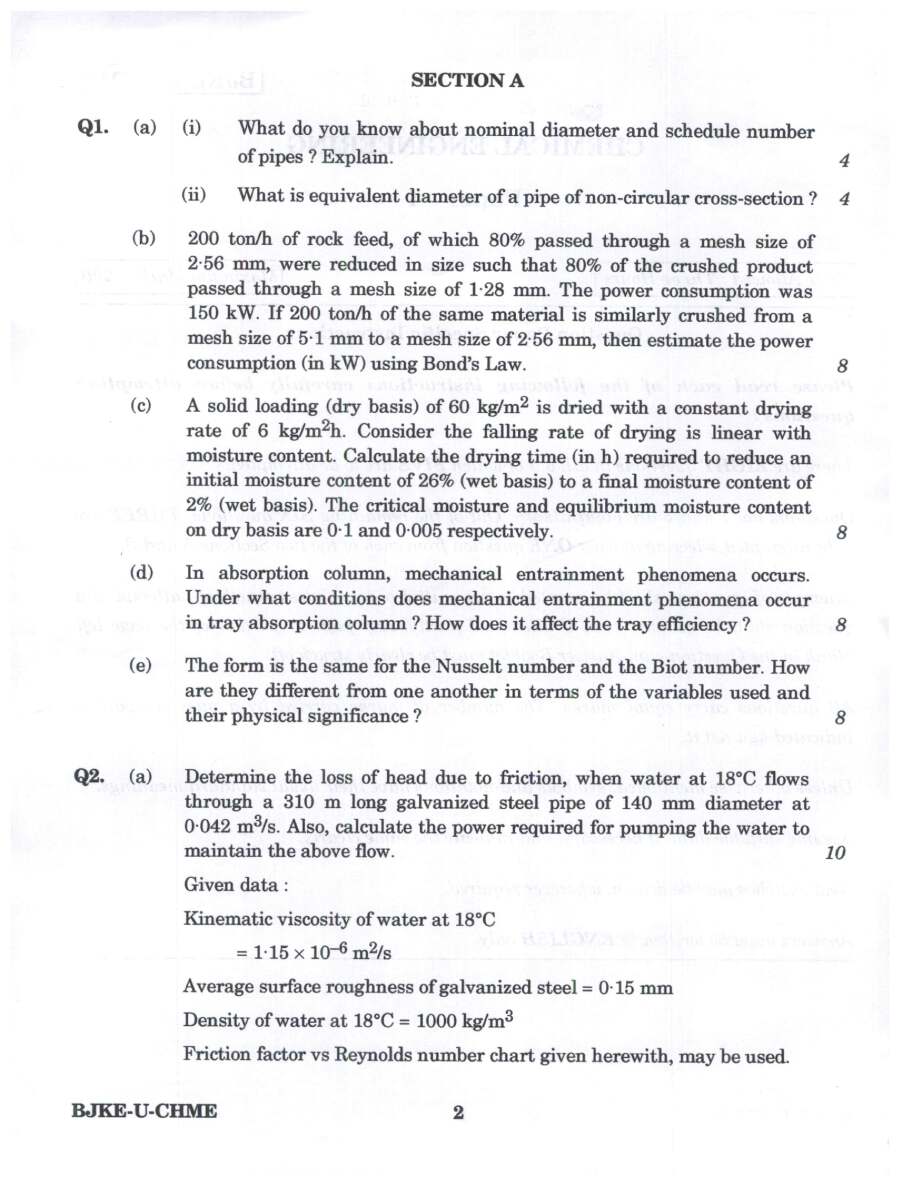
  • There are EIGHT questions in all, out of which FIVE are to be attempted.
  • Out of the remaining SIX questions, THREE are to be attempted selecting at least ONE question from each of the two Sections A and B.
  • Attempts of questions shall be counted in sequential order.
  • Unless struck off, attempt of a question shall be counted even if attempted partly.
  • Any page or portion of the page left blank in the Question-cum-Answer Booklet must be clearly struck off.
  • The number of marks carried by a question/part is indicated against it.
  • Unless otherwise mentioned, symbols and notations have their usual standard meanings.
  • Assume suitable data, if necessary, and indicate the same clearly.
  • Neat sketches may be drawn, wherever required.
  • Answers must be written in ENGLISH only. \sim , \sim ^4 gam, so ^2 .
  • Diki is miswih drasti here I pan plants home and manufactured as not by may be

Questions (page 2)

Section A

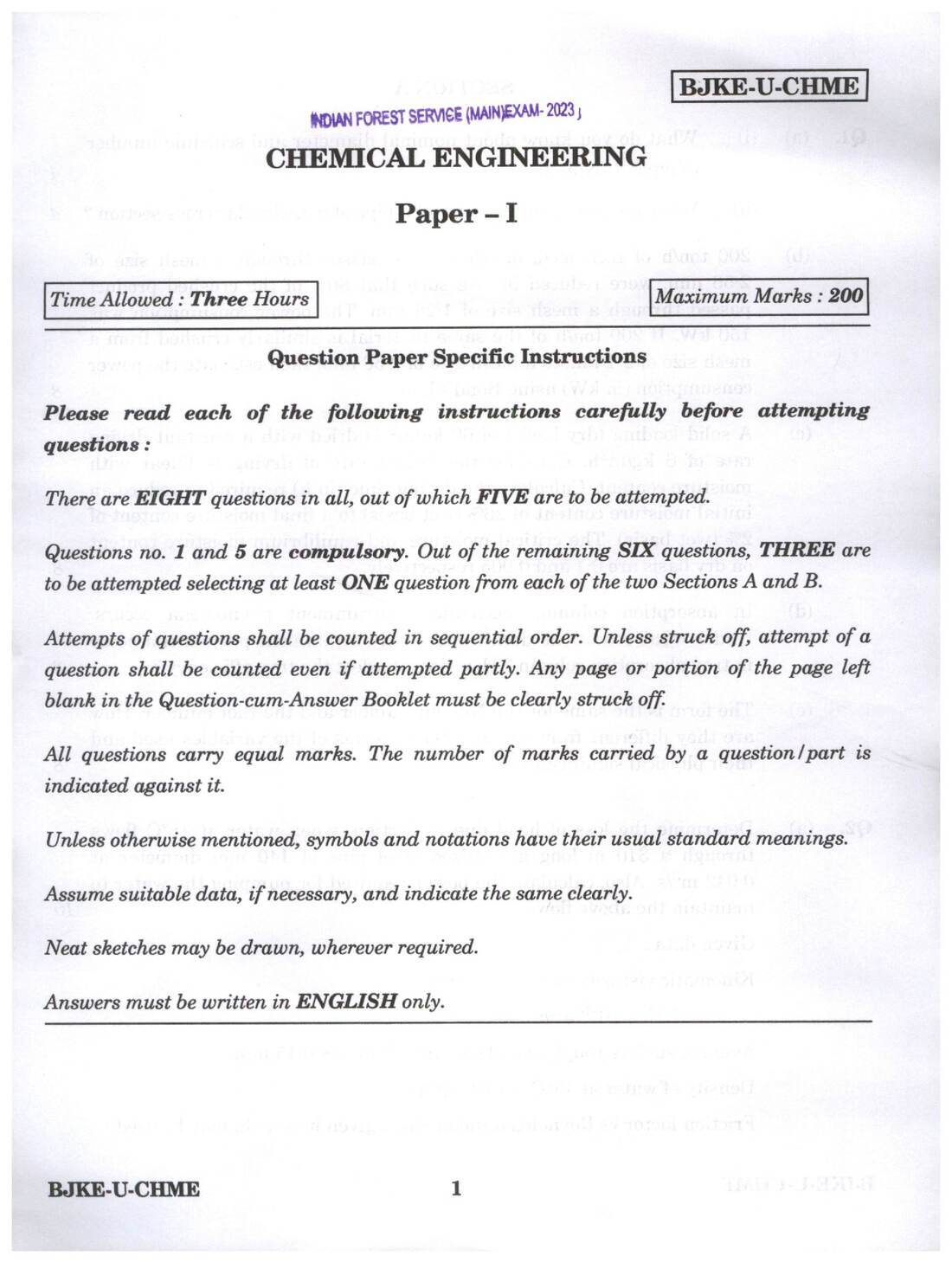
Q1. What do you know about nominal diameter and schedule number of pipes? Explain. What is equivalent diameter of a pipe of non-circular cross-section? 200 ton/h of rock feed, of which 80% passed through a mesh size of 2.56 mm, were reduced in size such that 80% of the crushed product passed through a mesh size of 1.28 mm. The power consumption was 150 kW. If 200 ton/h of the same material is similarly crushed from a mesh size of 5.1 mm to a mesh size of 2.56 mm, then estimate the power consumption (in kW) using Bond's Law. A solid loading (dry basis) of 60 kg/m2 is dried with a constant drying rate of 6 kg/m2h. Consider the falling rate of drying is linear with moisture content. Calculate the drying time (in h) required to reduce an initial moisture content of 26% (wet basis) to a final moisture content of 2% (wet basis). The critical moisture and equilibrium moisture content on dry basis are 0.1 and 0.005 respectively. In absorption column, mechanical entrainment phenomena occurs. Under what conditions does mechanical entrainment phenomena occur in tray absorption column? How does it affect the tray efficiency? The form is the same for the Nusselt number and the Biot number. How are they different from one another in terms of the variables used and their physical significance?

(a) (i)

(b) (ii)

(c) (b)

(d) (c)

(e) (d)

(f) (e)
Section A

Q2. Determine the loss of head due to friction, when water at 18°C flows through a 310 m long galvanized steel pipe of 140 mm diameter at 0.042 m3/s. Also, calculate the power required for pumping the water to maintain the above flow.
Given data :
Kinematic viscosity of water at 18°C = 1.15 × 10⁻⁶ m2/s
Average surface roughness of galvanized steel = 0.15 mm
Density of water at 18°C = 1000 kg/m3
Friction factor vs Reynolds number chart given herewith, may be used.

(a) (a)

Question paper preview

Scanned pages 1–2 for reference. Download the official PDF for the full paper.

Page 1
Indian Forest Service (Main) Examination 2023 Chemical Engineering Paper I page 1 instructions and header scan. UPSC IFS exam previous year paper PDF download.
Page 2
Indian Forest Service (Main) Examination 2023 Chemical Engineering Paper I page 1 instructions and header scan. UPSC IFS exam previous year paper PDF download.

Free question paper download

Download question paper PDF

  • 3.6 MB
  • 8 pages
  • PDF format

Frequently asked questions

What is the name of the examination?

The examination is the Indian Forest Service (Main) Examination.

Which paper is this question paper for?

This is the Chemical Engineering Paper - I.

What is the conducting body for this examination?

The examination is conducted by UPSC.

In which year was this examination held?

The examination was held in 2023.

What is the total number of questions in the paper?

There are eight questions in total.

How many questions are compulsory?

Questions number 1 and 5 are compulsory.

← Back to Engineer papers