IFS 2025 Chemical Engg Paper-I - Paper Details
- Year 2025
- Conducted By Union Public Service Commission
- Questions 8
- Maximum Marks 200
- Duration Three Hours Maximum Marks: 200
- Languages English
Exam Details
| Detail | Information |
|---|---|
| Examination | Indian Forest Services (Main) Examination |
| Year | 2025 |
| Conducting Body | Union Public Service Commission |
| Paper | Chemical Engineering Paper-I |
| Subject | Chemical Engineering |
| Duration | Three Hours Maximum Marks: 200 |
| Maximum Marks | 200 |
| Number of Questions | 8 |
| Question Type | Mixed (mcq + descriptive) |
This SEO payload summarizes the Indian Forest Services (Main) Examination 2025, Chemical Engineering Paper-I. Page 1 provides the exam header, time, marks, and answering instructions, including eight total questions with Q1 and Q5 compulsory and a split of remaining questions across two Sections. Page 2 presents six descriptive sub-questions (1(a)–(f)) spanning topics such as fluidization velocity, crushing power capacity changes, reflux ratio concepts, mass transfer theories, heat transfer in piping, and non-Newtonian flow velocity profiles. The JSON consolidates these details with structured FAQ, topics, keywords, and image metadata for improved search relevance and accessibility.
Major Topics Covered
- Fluidization
- Minimum fluidization velocity
- Crusher power
- Reflux ratio
- Mass transfer coefficients
- Local vs Overall mass transfer coefficient
- Film theory
- Penetration theory
- Heat transfer in piping
- Convective heat transfer
- Radiative heat transfer
- Non-Newtonian fluids
- Velocity profile
- Centreline velocity
- Mean velocity
- Pipe diameter
- Steam heating
- Thermal resistance
- Thermal radiation
- Laminar vs turbulent flow
Why This Paper is Important
- Useful for Indian Forest Services (Main) Examinatio preparation
- Helps understand the latest exam pattern
- Useful for practice and self-assessment
- Covers frequently asked General Studies topics
- Helpful for analysing question trends
Related Resources
- Indian Forest Service 2025 Mechanical Engineering Paper I Question Paper PDF
- Indian Forest Service Civil Engineering Paper II 2025 Question Paper PDF
- Indian Forest Service 2025 Chemical Engineering Paper II Question Paper PDF
- Indian Forest Service 2025 Agricultural Engineering Paper I Question Paper PDF
- Indian Forest Service 2024 Mechanical Engineering Paper II Question Paper PDF
Instructions
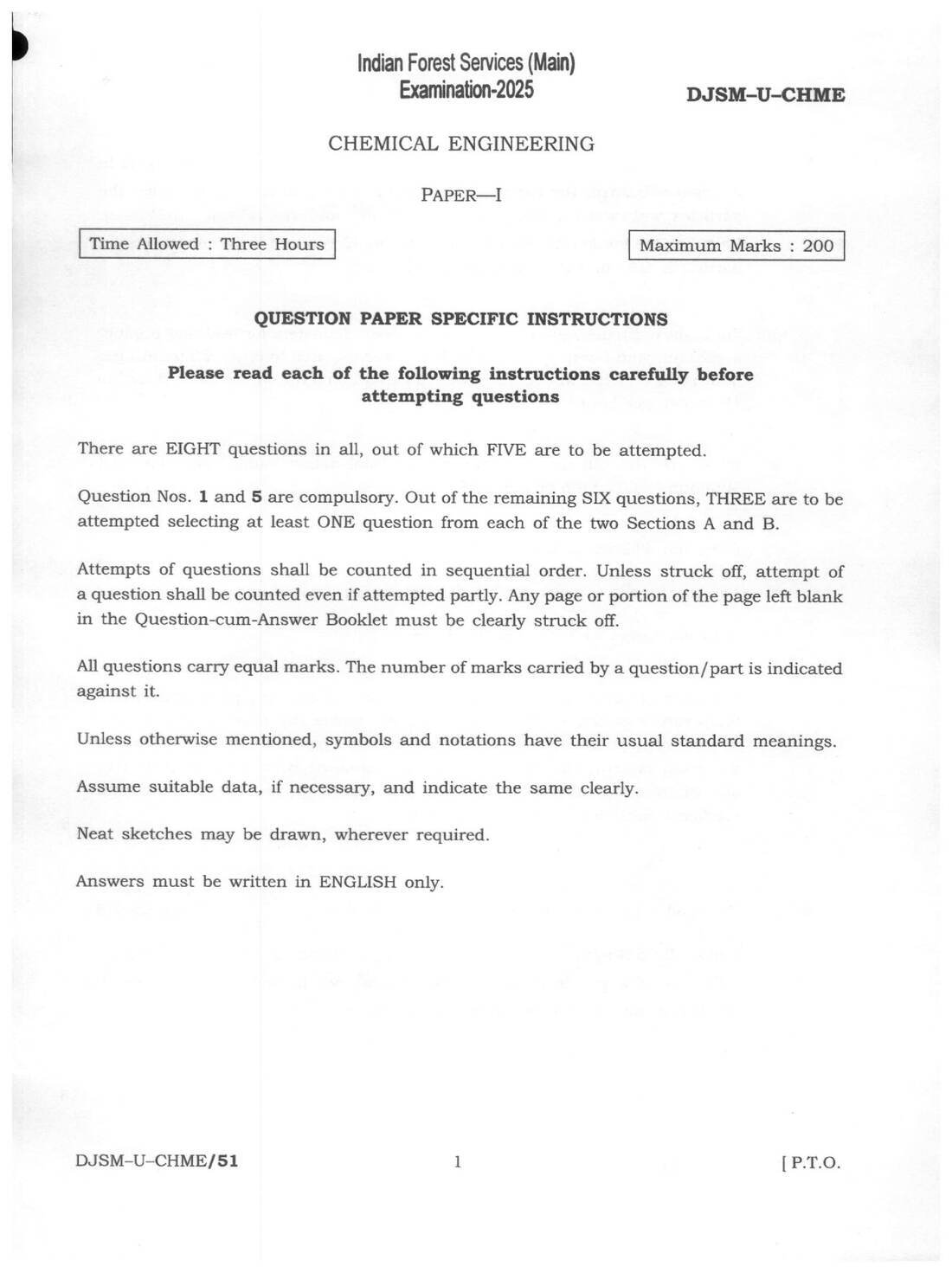
- There are EIGHT questions in all, out of which FIVE are to be attempted.
- Out of the remaining SIX questions, THREE are to be attempted selecting at least ONE question from each of the two Sections A and B.
- Attempts of questions shall be counted in sequential order.
- Unless struck off, attempt of a question shall be counted even if attempted partly.
- Any page or portion of the page left blank in the Question-cum-Answer Booklet must be clearly struck off.
- The number of marks carried by a question/part is indicated against it.
- Unless otherwise mentioned, symbols and notations have their usual standard meanings.
- Assume suitable data, if necessary, and indicate the same clearly.
- Neat sketches may be drawn, wherever required.
- Answers must be written in ENGLISH only.
Questions (page 2)
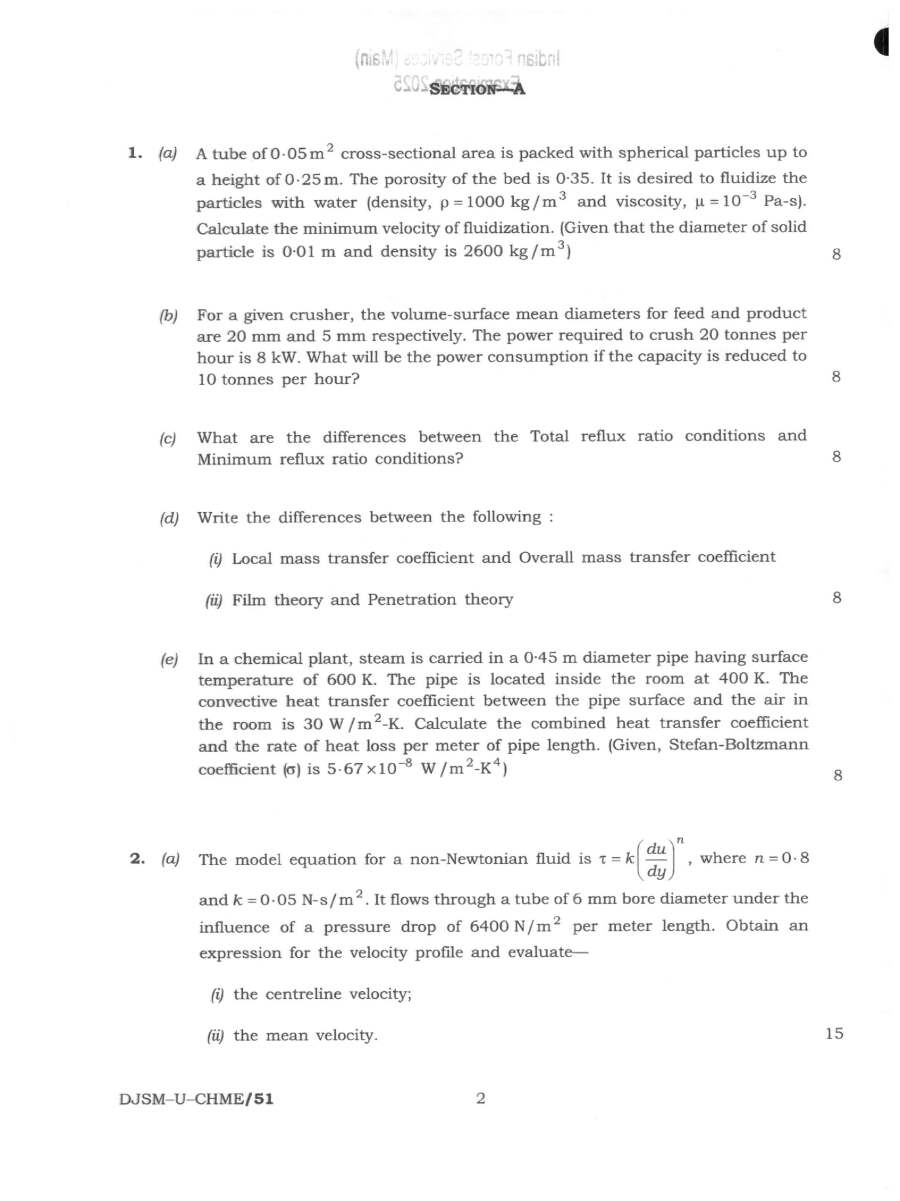
Q2. 1. (b) For a given crusher, the volume-surface mean diameters for feed and product are 20 mm and 5 mm respectively. The power required to crush 20 tonnes per hour is 8 kW. What will be the power consumption if the capacity is reduced to 8–10 tonnes per hour?
Q3.
1.
(c) What are the differences between the Total reflux ratio conditions and Minimum reflux ratio conditions?
Q4.
1. (d) Write the differences between:
(i) Local mass transfer coefficient and Overall mass transfer coefficient
(ii) Film theory and Penetration theory
Q5. 1. (e) In a chemical plant, steam is carried in a 0.45 m diameter pipe having surface temperature of 600 K. The pipe is located inside the room at 400 K. The convective heat transfer coefficient between the pipe surface and the air in the room is 30 W/m^2-K. Calculate the combined heat transfer coefficient and the rate of heat loss per meter of pipe length. (Given, Stefan-Boltzmann coefficient (σ) is 5.67 × 10^-8 W/m^2-K4)
Q6.
1. (f) The model equation for a non-Newtonian fluid is τ = k (du/dy)^n, where n = 0.8 and k = 0.05 N-s/m^2. It flows through a tube of 6 mm bore diameter under the influence of a pressure drop of 6400 N/m^2 per meter length. Obtain an expression for the velocity profile and evaluate-
(i) the centreline velocity;
(ii) the mean velocity.
Question paper preview
Scanned pages 1–2 for reference. Download the official PDF for the full paper.
Free question paper download
Download question paper PDF
Your download starts in 10s
Preparing your question paper file…
Frequently asked questions
How many questions are in the paper?
Eight questions in all.
Which questions are compulsory?
Questions 1 and 5 are compulsory.
From where should the remaining questions be attempted?
Out of the remaining six questions, three must be attempted, selecting at least one from each of Sections A and B.
Can I attempt only part of a question?
Yes. Attempts are counted in sequential order, and a question may be attempted partly unless the page is struck off.
In what language should answers be written?
Answers must be written in English only.
Are sketches allowed?
Yes, neat sketches may be drawn wherever required.