Section A
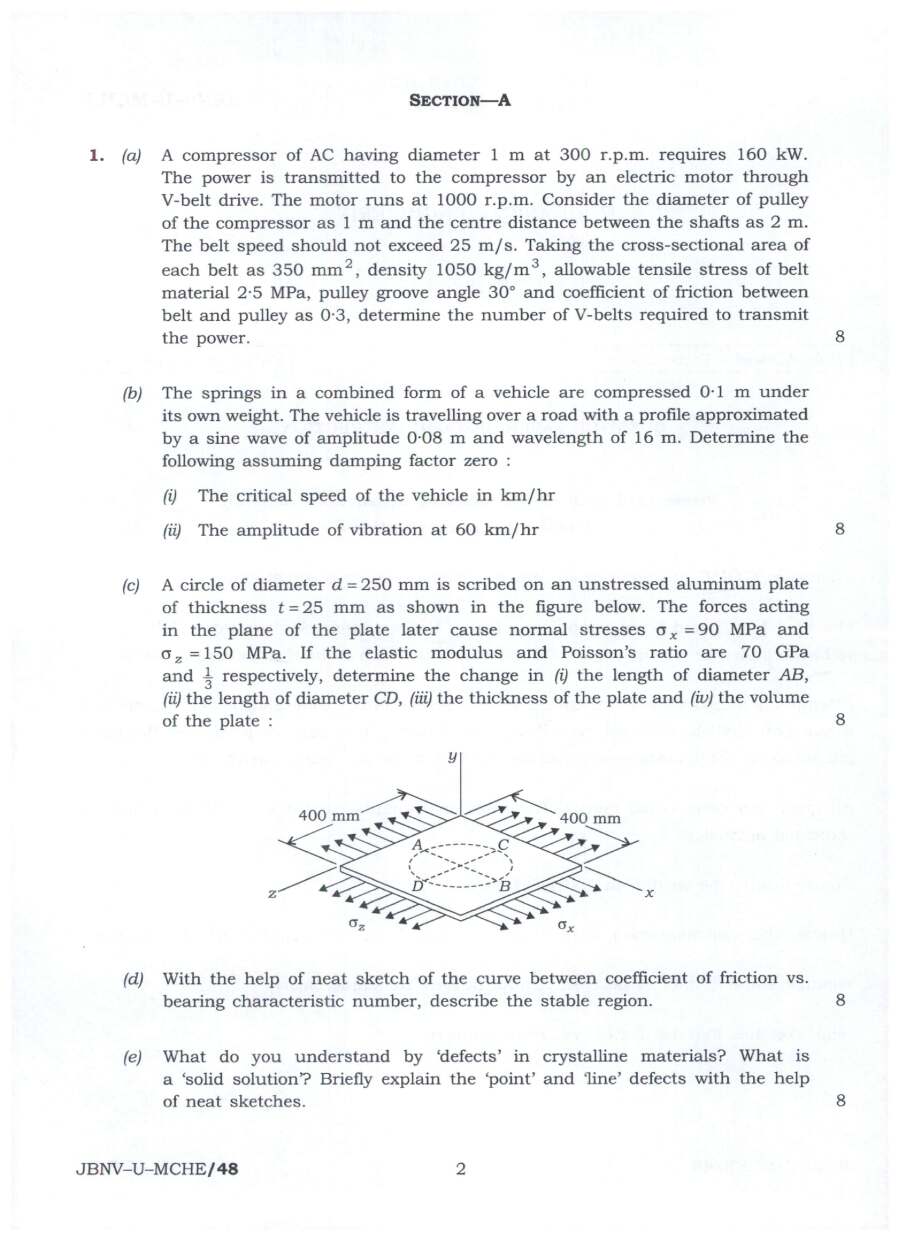
Q1. A compressor of AC having diameter 1 m at 300 r.p.m. requires 160 kW. The power is transmitted to the compressor by an electric motor through V-belt drive. The motor runs at 1000 r.p.m. Consider the diameter of pulley of the compressor as 1 m and the centre distance between the shafts as 2 m. The belt speed should not exceed 25 m/s. Taking the cross-sectional area of each belt as 350 mm2, density 1050 kg/m3, allowable tensile stress of belt material 2.5 MPa, pulley groove angle 30° and coefficient of friction between belt and pulley as 0.3, determine the number of V-belts required to transmit the power. The springs in a combined form of a vehicle are compressed 0.1 m under its own weight. The vehicle is travelling over a road with a profile approximated by a sine wave of amplitude 0.08 m and wavelength of 16 m. Determine the following assuming damping factor zero: A circle of diameter d = 250 mm is scribed on an unstressed aluminum plate of thickness t = 25 mm as shown in the figure below. The forces acting in the plane of the plate later cause normal stresses σ_x = 90 MPa and σ_z = 150 MPa. If the elastic modulus and Poisson's ratio are 70 GPa and 1/3 respectively, determine the change in With the help of neat sketch of the curve between coefficient of friction vs. bearing characteristic number, describe the stable region. What do you understand by 'defects' in crystalline materials? What is a 'solid solution'? Briefly explain the 'point' and 'line' defects with the help of neat sketches.
((i)) The critical speed of the vehicle in km/hr
((ii)) The amplitude of vibration at 60 km/hr
((i)) the length of diameter AB,
((ii)) the length of diameter CD,
((iii)) the thickness of the plate and
((iv)) the volume of the plate :
(a) A compressor of AC having diameter 1 m at 300 r.p.m. requires 160 kW. The power is transmitted to the compressor by an electric motor through V-belt drive. The motor runs at 1000 r.p.m. Consider the diameter of pulley of the compressor as 1 m and the centre distance between the shafts as 2 m. The belt speed should not exceed 25 \text m/s. Taking the cross-sectional area of each belt as 350 mm2, density 1050 kg/m3, allowable tensile stress of belt material 2.5 MPa, pulley groove angle 30° and coefficient of friction between belt and pulley as 0.3, determine the number of V-belts required to transmit 8 the power. The springs in a combined form of a vehicle are compressed 0.1 m under
(b) its own weight. The vehicle is travelling over a road with a profile approximated by a sine wave of amplitude 0.08 m and wavelength of 16 m. Determine the following assuming damping factor zero: The critical speed of the vehicle in km/hr
(i) the length of diameter AB, (ii) the length of diameter CD, (iii) the thickness of the plate and (iv) the volume 8 of the plate: y 400 mm 400 mm σ_z σx With the help of neat sketch of the curve between coefficient of friction vs.
(d) 8 bearing characteristic number, describe the stable region.
(e) What do you understand by 'defects' in crystalline materials? What is a 'solid solution'? Briefly explain the 'point' and 'line' defects with the help of neat sketches. 8 \boldsymbol2 JBNV-U-MCHE/48