Indian Forest Service 2024 Chemical Engineering Paper II UPSC PDF

Central Government Jobs Engineer 2024

  • Year 2024
  • Conducted By UPSC
  • Questions 8
  • Maximum Marks 200
  • Duration Three Hours
  • Languages English

Exam Details

Detail Information
Examination Indian Forest Service (Main) Examination
Year 2024
Conducting Body UPSC
Paper Chemical Engineering Paper - II
Subject Chemical Engineering
Duration Three Hours
Maximum Marks 200
Number of Questions 8
Question Type Mixed

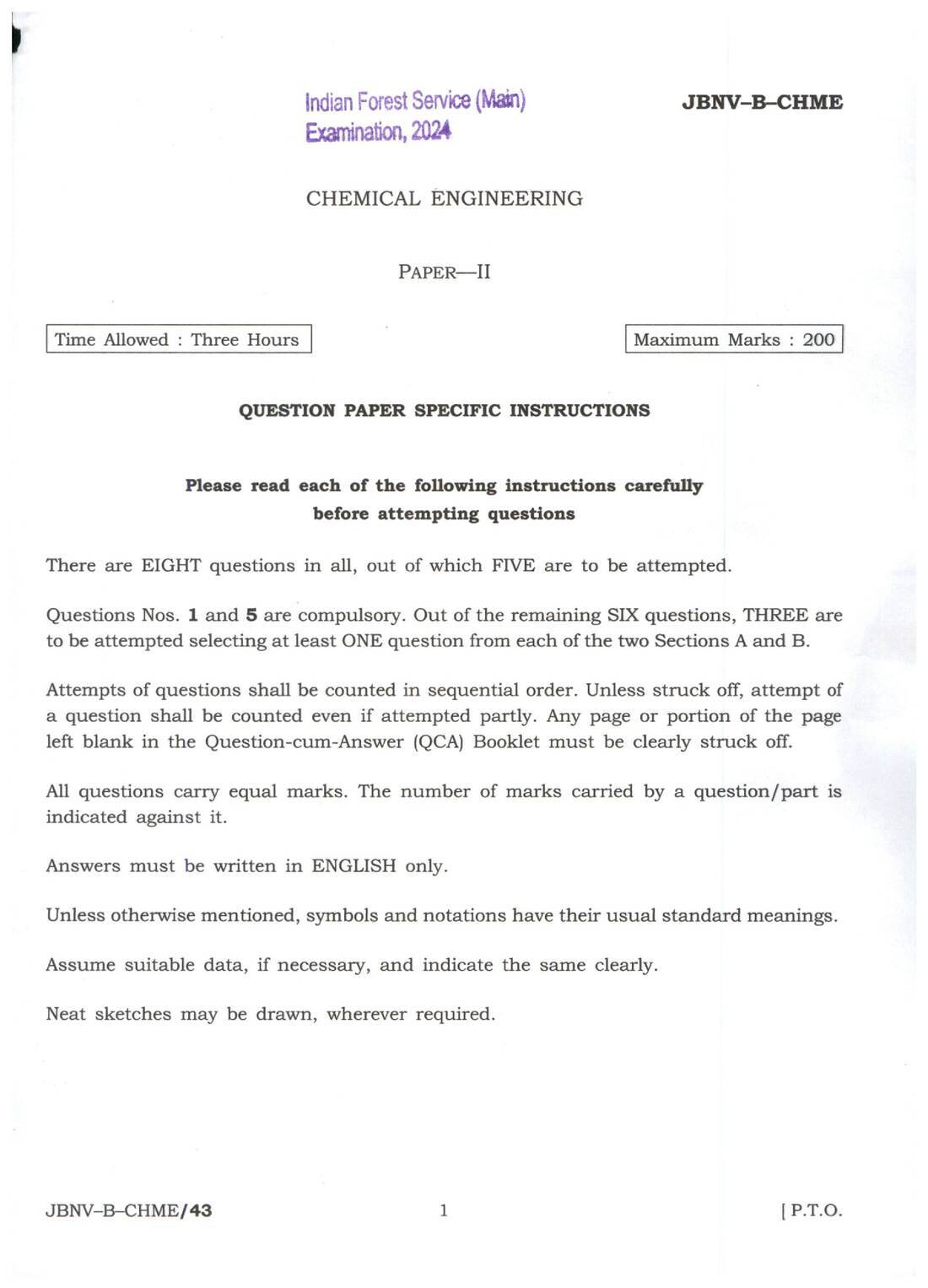
This is the Chemical Engineering Paper II from the Indian Forest Service (Main) Examination 2024, conducted by UPSC. The paper contains 8 questions, of which 5 are to be attempted, with questions 1 and 5 being compulsory. Candidates must select at least one question from each of the two sections (A and B) from the remaining six questions. All questions carry equal marks, and answers must be written in English. This paper is crucial for aspirants aiming for a career in forest services, testing their in-depth knowledge of chemical engineering principles relevant to environmental and resource management.

Major Topics Covered

  • Reactor Operation
  • Reactor Stability
  • Chemical Process
  • Recycle Stream
  • Purge Stream
  • Bypass Stream
  • Inerts
  • Carnot Engine
  • Heterogeneous Catalytic Reactions
  • Pore Diffusion Resistance
  • Coal Analysis
  • Weight Fraction Composition

Why This Paper is Important

  • Useful for Indian Forest Service (Main) Examination preparation
  • Helps understand the latest exam pattern
  • Useful for practice and self-assessment
  • Covers frequently asked General Studies topics
  • Helpful for analysing question trends

Related Resources

  • Indian Forest Service (Main) Examination 2023 Chemical Engineering Paper II
  • Indian Forest Service (Main) Examination 2024 Chemical Engineering Paper I
  • Engineering Services Examination 2024 Chemical Engineering Paper
  • Indian Forest Service (Main) Examination 2024 Chemical Engineering Paper II Answer Key
  • UPSC IFS 2024 Chemical Engineering Paper II Solutions
  • Indian Forest Service (Main) Examination Chemical Engineering Syllabus
  • UPSC IFS Chemical Engineering Topics
  • Indian Forest Service (Main) Examination Pattern

Instructions

  • There are EIGHT questions in all, out of which FIVE are to be attempted.
  • Out of the remaining SIX questions, THREE are to be attempted selecting at least ONE question from each of the two Sections A and B.
  • Attempts of questions shall be counted in sequential order.
  • Unless struck off, attempt of a question shall be counted even if attempted partly.
  • Any page or portion of the page left blank in the Question-cum-Answer (QCA) Booklet must be clearly struck off.
  • The number of marks carried by a question/part is indicated against it.
  • Answers must be written in ENGLISH only.
  • Unless otherwise mentioned, symbols and notations have their usual standard meanings.
  • Assume suitable data, if necessary, and indicate the same clearly.
  • Neat sketches may be drawn, wherever required.

Questions (page 2)

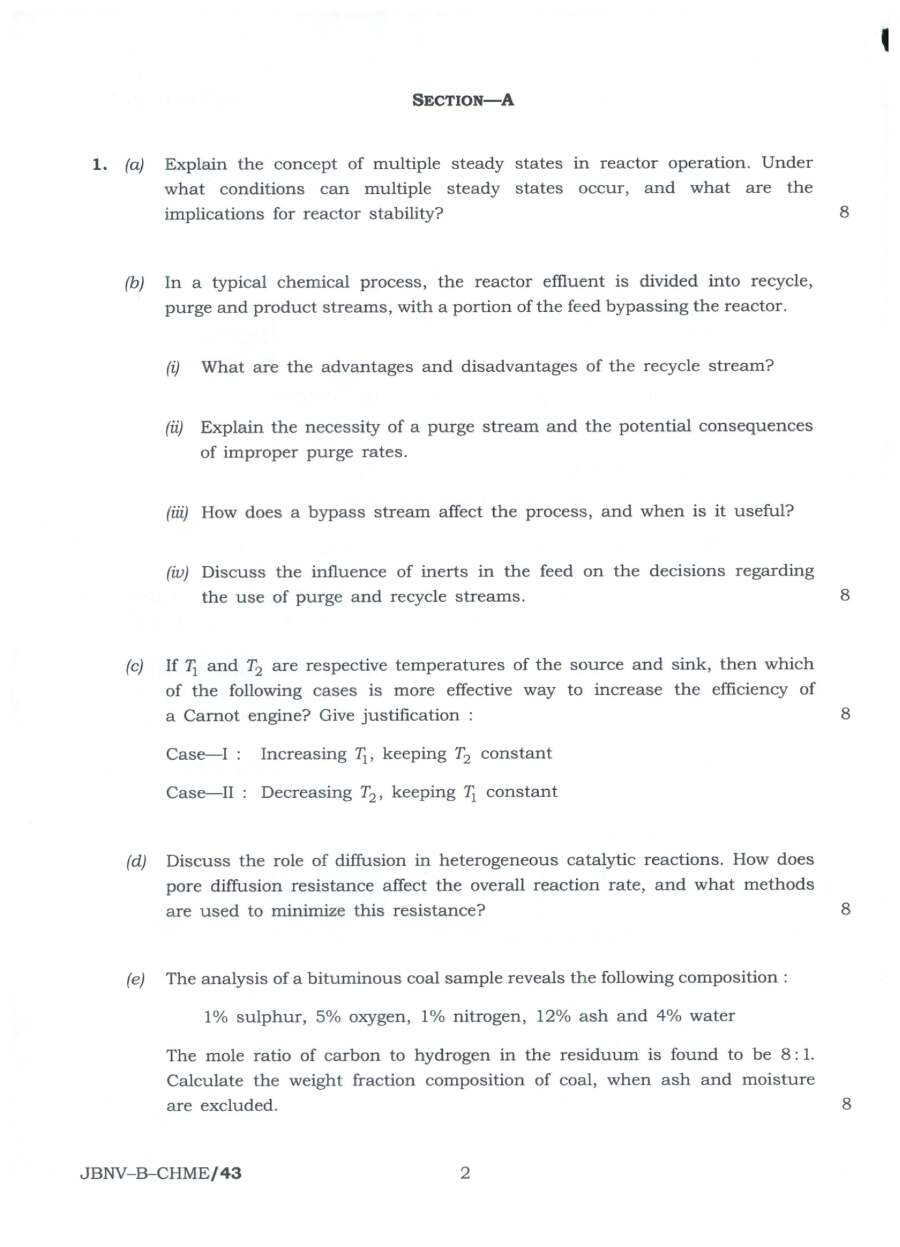
Section A

Q1. Explain the concept of multiple steady states in reactor operation. Under what conditions can multiple steady states occur, and what are the implications for reactor stability? If T1 and T2 are respective temperatures of the source and sink, then which of the following cases is more effective way to increase the efficiency of a Carnot engine? Give justification : Discuss the role of diffusion in heterogeneous catalytic reactions. How does pore diffusion resistance affect the overall reaction rate, and what methods are used to minimize this resistance? The analysis of a bituminous coal sample reveals the following composition :
1% sulphur, 5% oxygen, 1% nitrogen, 12% ash and 4% water
The mole ratio of carbon to hydrogen in the residuum is found to be 8:1. Calculate the weight fraction composition of coal, when ash and moisture are excluded.

(a) In a typical chemical process, the reactor effluent is divided into recycle, purge and product streams, with a portion of the feed bypassing the reactor.

(i) What are the advantages and disadvantages of the recycle stream?

(ii) Explain the necessity of a purge stream and the potential consequences of improper purge rates.

(iii) How does a bypass stream affect the process, and when is it useful?

(iv) Discuss the influence of inerts in the feed on the decisions regarding the use of purge and recycle streams.

(c) Case—I : Increasing T1, keeping T2 constant

(case—ii) Decreasing T2, keeping T1 constant

(b) In a typical chemical process, the reactor effluent is divided into recycle, purge and product streams, with a portion of the feed bypassing the reactor. What are the advantages and disadvantages of the recycle stream?

(d) Discuss the role of diffusion in heterogeneous catalytic reactions. How does pore diffusion resistance affect the overall reaction rate, and what methods 8 are used to minimize this resistance? The analysis of a bituminous coal sample reveals the following composition :

(e) 1% sulphur, 5% oxygen, 1% nitrogen, 12% ash and 4% water The mole ratio of carbon to hydrogen in the residuum is found to be 8:1. Calculate the weight fraction composition of coal, when ash and moisture are excluded. 8 \overline2 JBNV-B-CHME/43
Question paper preview

Scanned pages 1–2 for reference. Download the official PDF for the full paper.

Page 1
Indian Forest Service Main Examination 2024 Chemical Engineering Paper II page 1 instructions scan PDF download UPSC
Page 2
Indian Forest Service Main Examination 2024 Chemical Engineering Paper II page 1 instructions scan PDF download UPSC

Free question paper download

Download question paper PDF

  • 2.4 MB
  • 8 pages
  • PDF format

Frequently asked questions

What is the name of the exam?

The exam is the Indian Forest Service (Main) Examination.

What is the year of this question paper?

This question paper is from the year 2024.

Who conducts the Indian Forest Service Examination?

The examination is conducted by UPSC (Union Public Service Commission).

What is the subject of this paper?

The subject is Chemical Engineering, specifically Paper II.

How many questions are in this paper?

There are a total of 8 questions in this paper.

How many questions need to be attempted?

Candidates need to attempt 5 questions out of the 8.

← Back to Engineer papers