UPSC Engineering Services 2025 Mechanical Engineering Paper II PDF
- Year 2025
- Conducted By UPSC
- Questions 150
- Maximum Marks 300
- Duration Three Hours
- Languages English
Exam Details
| Detail | Information |
|---|---|
| Examination | Engineering Services (Preliminary) Examination |
| Year | 2025 |
| Conducting Body | UPSC |
| Paper | Mechanical Engineering Paper - II |
| Subject | Mechanical Engineering |
| Duration | Three Hours |
| Maximum Marks | 300 |
| Number of Questions | 150 |
| Question Type | Objective (MCQ) |
This document contains the question paper for the UPSC Engineering Services (Preliminary) Examination 2025, specifically Paper II for Mechanical Engineering. The exam, conducted by UPSC, is designed to assess candidates for engineering roles in the government sector. This paper consists of 150 objective-type questions to be answered within three hours, carrying a maximum of 300 marks. Aspirants can use this paper to understand the exam pattern, question types, and difficulty level, aiding their preparation for the competitive IES examination.
Major Topics Covered
- Mechanical Engineering
- Solar Energy
- Thermal Systems
- Heat Transfer
Why This Paper is Important
- Useful for Engineering Services (Preliminary) Exami preparation
- Helps understand the latest exam pattern
- Useful for practice and self-assessment
- Covers frequently asked General Studies topics
- Helpful for analysing question trends
Related Resources
- UPSC Engineering Services 2024 Mechanical Engineering Paper II
- UPSC Engineering Services 2023 Mechanical Engineering Paper II
- GATE Mechanical Engineering 2025 Question Paper
- UPSC Engineering Services 2025 Mechanical Engineering Paper II Answer Key
- UPSC Engineering Services Mechanical Engineering Syllabus
- UPSC Engineering Services Exam Pattern
- UPSC Engineering Services Examination
- SSC Junior Engineer Exam
Instructions
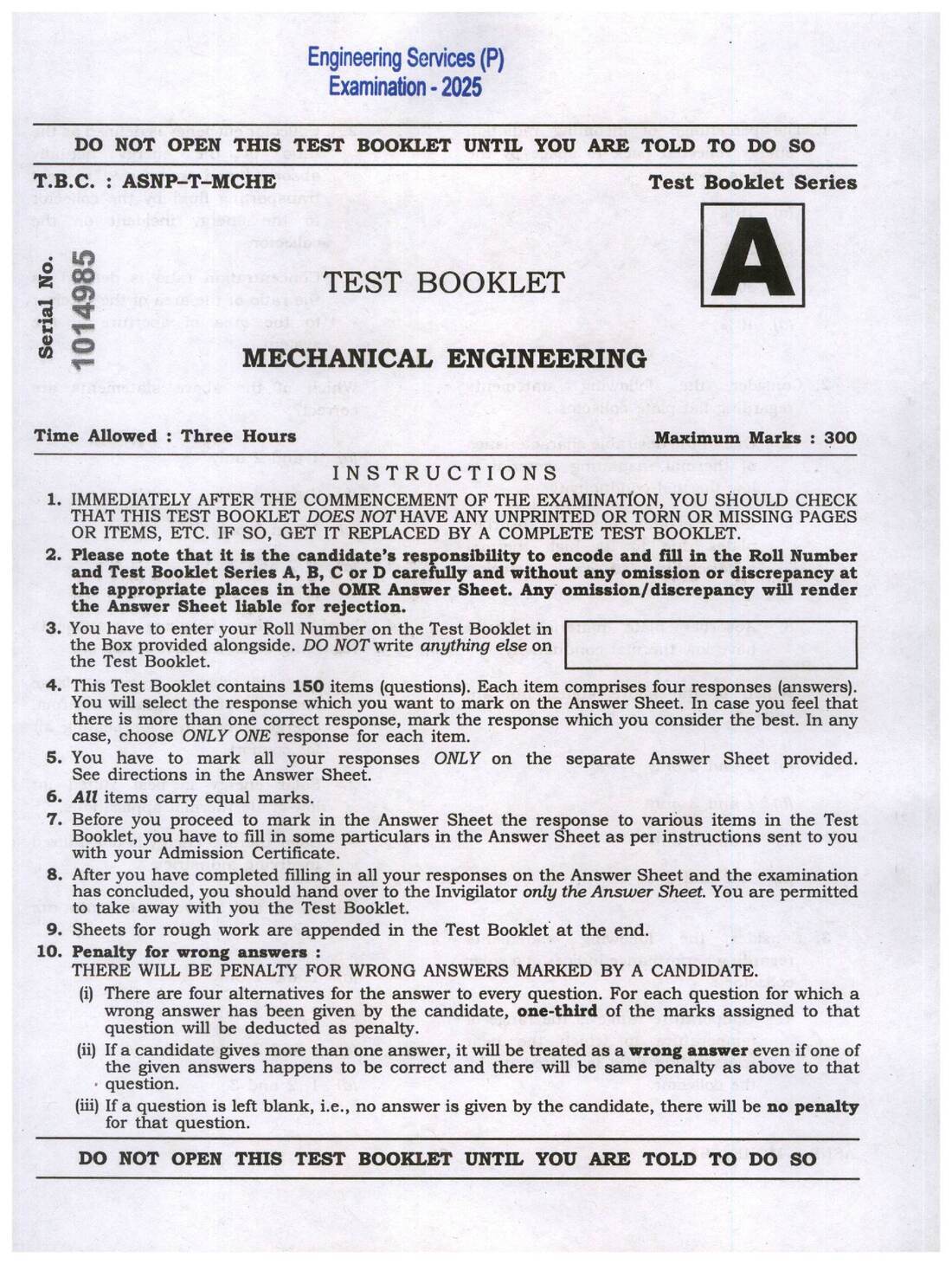
- IMMEDIATELY AFTER THE COMMENCEMENT OF THE EXAMINATION, YOU SHOULD CHECK THAT THIS TEST BOOKLET DOES NOT HAVE ANY UNPRINTED OR TORN OR MISSING PAGES OR ITEMS, ETC.
- IF SO, GET IT REPLACED BY A COMPLETE TEST BOOKLET.
- Please note that it is the candidate's responsibility to encode and fill in the Roll Number and Test Booklet Series A, B, C or D carefully and without any omission or discrepancy at the appropriate places in the OMR Answer Sheet.
- Any omission/discrepancy will render the Answer Sheet liable for rejection.
- You have to enter your Roll Number on the Test Booklet in the Box provided alongside.
- DO NOT write anything else on the Test Booklet.
- This Test Booklet contains 150 items (questions).
- Each item comprises four responses (answers).
- You will select the response which you want to mark on the Answer Sheet.
- In case you feel that there is more than one correct response, mark the response which you consider the best.
- In any case, choose ONLY ONE response for each item.
- You have to mark all your responses ONLY on the separate Answer Sheet provided. See directions in the Answer Sheet.
- Before you proceed to mark in the Answer Sheet the response to various items in the Test Booklet, you have to fill in some particulars in the Answer Sheet as per instructions sent to you with your Admission Certificate.
- After you have completed filling in all your responses on the Answer Sheet and the examination has concluded, you should hand over to the Invigilator only the Answer Sheet.
- You are permitted to take away with you the Test Booklet.
- Sheets for rough work are appended in the Test Booklet at the end.
- Penalty for wrong answers : THERE WILL BE PENALTY FOR WRONG ANSWERS MARKED BY A CANDIDATE.
Questions (page 2)
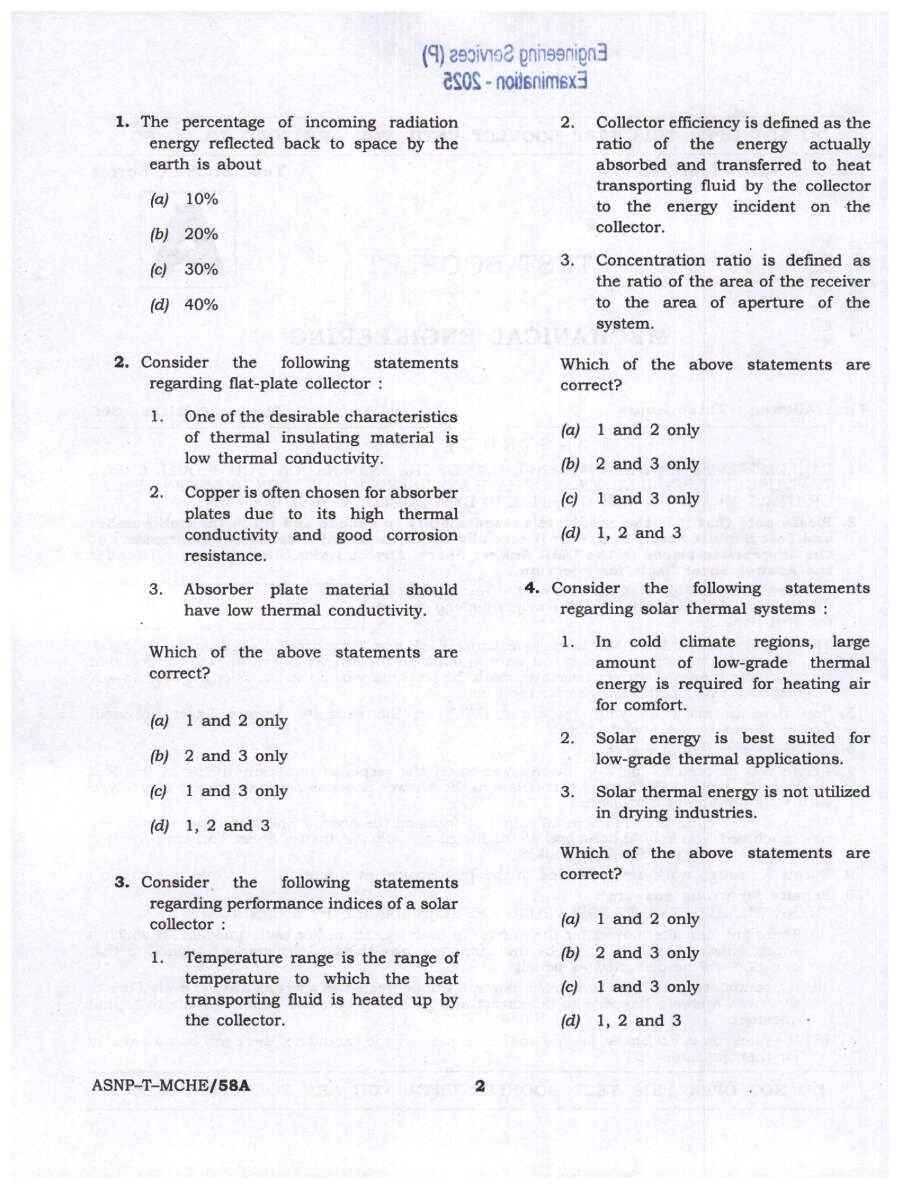
Q2. Consider the following statements regarding flat-plate collector:
- (1) One of the desirable characteristics of thermal insulating material is low thermal conductivity.
- (2) Copper is often chosen for absorber plates due to its high thermal conductivity and good corrosion resistance.
- (3) Absorber plate material should have low thermal conductivity.
Q3. Consider the following statements regarding performance indices of a solar collector:
- (1) Temperature range is the range of temperature to which the heat transporting fluid is heated up by the collector.
Q4. Collector efficiency is defined as the ratio of the energy actually absorbed and transferred to heat transporting fluid by the collector to the energy incident on the collector. Consider the following statements regarding solar thermal systems:
- (1) In cold climate regions, large amount of low-grade thermal energy is required for heating air for comfort.
- (2) Solar energy is best suited for low-grade thermal applications.
- (3) Solar thermal energy is not utilized in drying industries.
Q5. Concentration ratio is defined as the ratio of the area of the receiver to the area of aperture of the system.
Q6. Which of the above statements are correct?
Q8. Which of the above statements are correct?
Question paper preview
Scanned pages 1–2 for reference. Download the official PDF for the full paper.
Free question paper download
Download question paper PDF
Your download starts in 10s
Preparing your question paper file…
Frequently asked questions
What is the name of the examination?
The examination is the Engineering Services (Preliminary) Examination.
Which year is this question paper for?
This question paper is for the 2025 examination.
Who conducts the Engineering Services Examination?
The examination is conducted by UPSC (Union Public Service Commission).
What is the subject of this paper?
This paper is for Mechanical Engineering, specifically Paper II.
What is the total duration of the exam?
The time allowed for this paper is Three Hours.
What are the maximum marks for this paper?
The maximum marks for this paper are 300.