UPSC ESE 2025 Electronics & Telecommunication Engineering Question Paper PDF
- Year 2025
- Conducted By UPSC
- Questions 150
- Maximum Marks 300
- Duration Three Hours
- Languages English
Exam Details
| Detail | Information |
|---|---|
| Examination | Engineering Services Preliminary Examination |
| Year | 2025 |
| Conducting Body | UPSC |
| Paper | Electronics and Telecommunication Engineering |
| Subject | Electronics and Telecommunication Engineering |
| Duration | Three Hours |
| Maximum Marks | 300 |
| Number of Questions | 150 |
| Question Type | Objective (MCQ) |
This is the official question paper for the Engineering Services Preliminary Examination 2025, Paper II, focusing on Electronics and Telecommunication Engineering, conducted by UPSC. The exam is designed to test candidates' knowledge in the field, with a total of 150 objective-type questions to be answered in three hours for a maximum of 300 marks. Aspirants preparing for the ESE exam can use this paper to understand the exam pattern, question difficulty, and important topics covered, aiding in their preparation strategy.
Major Topics Covered
- Electronics
- Telecommunication Engineering
- Engineering Services
- UPSC
- Preliminary Examination
Why This Paper is Important
- Useful for Engineering Services Preliminary Examina preparation
- Helps understand the latest exam pattern
- Useful for practice and self-assessment
- Covers frequently asked General Studies topics
- Helpful for analysing question trends
Related Resources
- UPSC ESE 2024 Electronics and Telecommunication Engineering Question Paper
- UPSC ESE 2023 Electronics and Telecommunication Engineering Question Paper
- UPSC ESE 2025 Paper I General Studies and Engineering Aptitude Question Paper
- UPSC ESE 2025 Electronics and Telecommunication Engineering Answer Key
- UPSC ESE Electronics and Telecommunication Engineering Syllabus
- UPSC ESE Exam Pattern
- UPSC ESE Mains Examination
- SSC JE Examination
Instructions
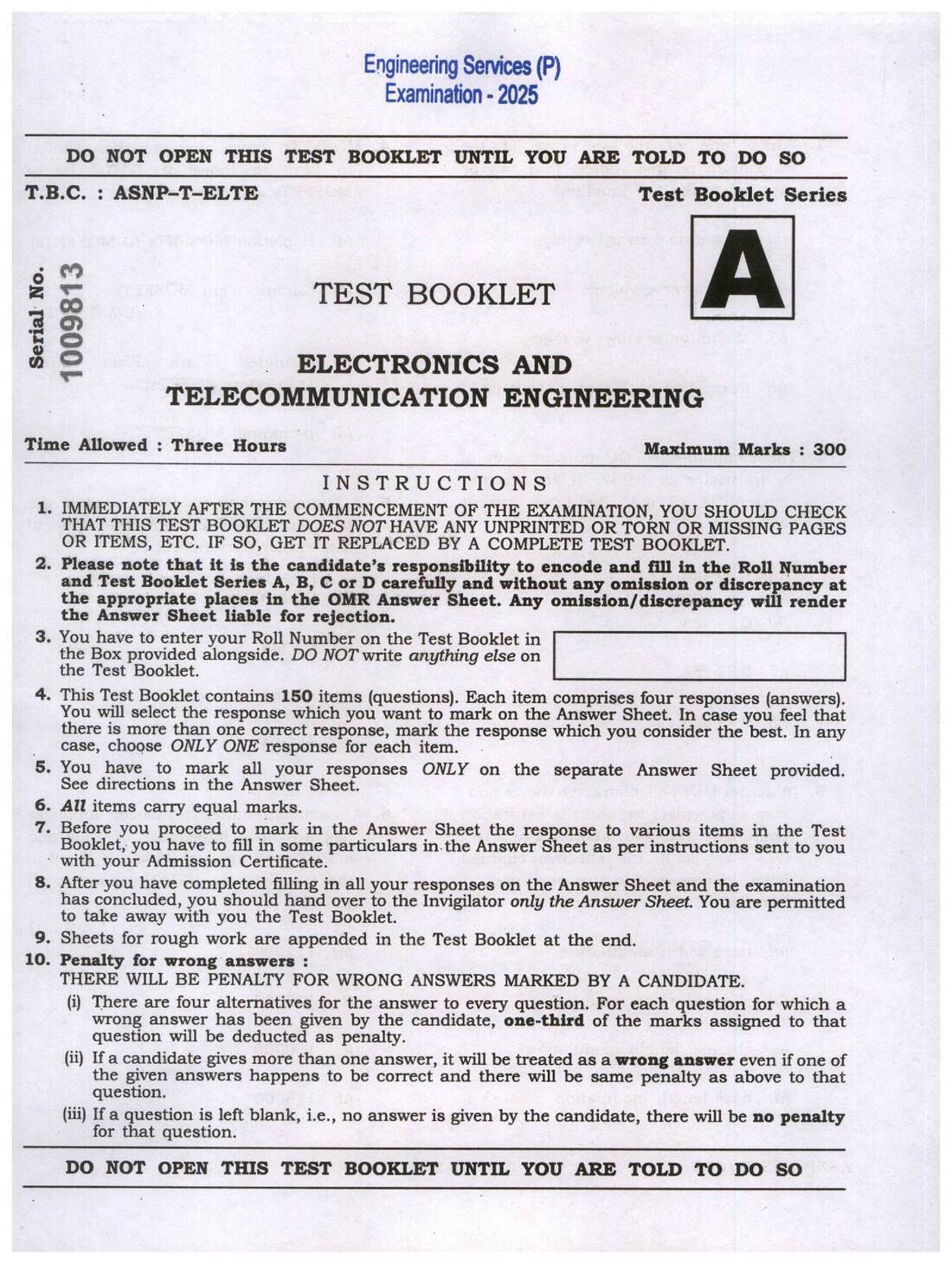
- IMMEDIATELY AFTER THE COMMENCEMENT OF THE EXAMINATION, YOU SHOULD CHECK THAT THIS TEST BOOKLET DOES NOT HAVE ANY UNPRINTED OR TORN OR MISSING PAGES OR ITEMS, ETC.
- IF SO, GET IT REPLACED BY A COMPLETE TEST BOOKLET.
- Please note that it is the candidate's responsibility to encode and fill in the Roll Number and Test Booklet Series A, B, C or D carefully and without any omission or discrepancy at the appropriate places in the OMR Answer Sheet.
- Any omission/discrepancy will render the Answer Sheet liable for rejection.
- You have to enter your Roll Number on the Test Booklet in the Box provided alongside.
- DO NOT write anything else on the Test Booklet.
- This Test Booklet contains 150 items (questions).
- Each item comprises four responses (answers).
- You will select the response which you want to mark on the Answer Sheet.
- In case you feel that there is more than one correct response, mark the response which you consider the best.
- In any case, choose ONLY ONE response for each item.
- You have to mark all your responses ONLY on the separate Answer Sheet provided. See directions in the Answer Sheet.
- Before you proceed to mark in the Answer Sheet the response to various items in the Test Booklet, you have to fill in some particulars in the Answer Sheet as per instructions sent to you with your Admission Certificate.
- After you have completed filling in all your responses on the Answer Sheet and the examination has concluded, you should hand over to the Invigilator only the Answer Sheet.
- You are permitted to take away with you the Test Booklet.
- Sheets for rough work are appended in the Test Booklet at the end.
- Penalty for wrong answers : THERE WILL BE PENALTY FOR WRONG ANSWERS MARKED BY A CANDIDATE.
Questions (page 2)
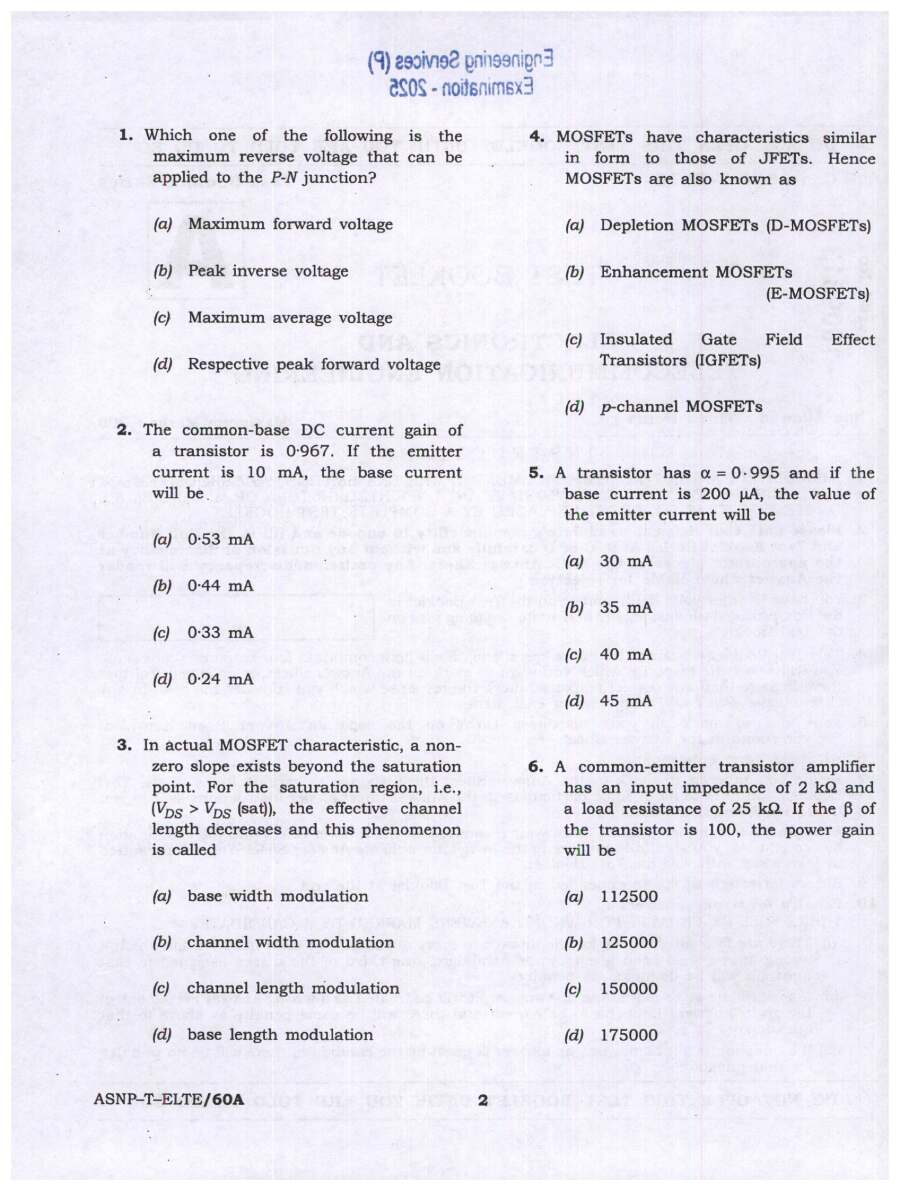
Q2. The common-base DC current gain of a transistor is 0. If the emitter current is 10 mA, the base current will be.
Q3. In actual MOSFET characteristic, a non-zero slope exists beyond the saturation point. For the saturation region, i.e., (V_{DS} > V_{DS} (sat)), the effective channel length decreases and this phenomenon is called
Q4. MOSFETs have characteristics similar in form to those of JFETs. Hence MOSFETs are also known as
Q5. A transistor has α = 0.995 and if the base current is 200 \muA, the value of the emitter current will be
Q6. A common-emitter transistor amplifier has an input impedance of 2 kOmega and a load resistance of 25 kOmega. If the β of the transistor is 100, the power gain will be
Question paper preview
Scanned pages 1–2 for reference. Download the official PDF for the full paper.
Free question paper download
Download question paper PDF
Your download starts in 10s
Preparing your question paper file…
Frequently asked questions
What is the name of the examination?
The examination is the Engineering Services Preliminary Examination.
Which year is this question paper for?
This question paper is for the year 2025.
Who conducts the Engineering Services Examination?
The examination is conducted by UPSC (Union Public Service Commission).
What is the subject of this paper?
This paper is for Electronics and Telecommunication Engineering.
What is the duration of the examination?
The time allowed for the examination is Three Hours.
What are the maximum marks for this paper?
The maximum marks for this paper are 300.