UPSC Engineering Services 2016 Electronics & Telecommunication Paper-I PDF

Central Government Jobs Engineer 2016

  • Year 2016
  • Conducted By UPSC
  • Questions 120
  • Maximum Marks 200
  • Duration Two Hours

Exam Details

Detail Information
Examination Engineering Services Examination
Year 2016
Conducting Body UPSC
Paper Electronics & Telecommunication Engineering Paper-I
Subject Electronics & Telecommunication Engineering
Duration Two Hours
Maximum Marks 200
Number of Questions 120
Question Type Objective (MCQ)

This is the Electronics & Telecommunication Engineering Paper-I from the UPSC Engineering Services Examination held in 2016. The paper consists of objective-type questions, with a maximum of 200 marks and a duration of two hours. It is a crucial resource for aspirants preparing for the Engineering Services Examination, offering insights into the types of questions asked and the exam's difficulty level. Analyzing this paper can help candidates strategize their preparation and identify areas for improvement.

Major Topics Covered

  • Crystalline state of matter
  • Semiconductor conductivity
  • Resistance of a conductor
  • Ionic radii
  • Ceramic crystal structure
  • Band-gap in insulators and semiconductors
  • Extrinsic semiconductor conductivity
  • Photo-electric emission

Why This Paper is Important

  • Useful for Engineering Services Examination preparation
  • Helps understand the latest exam pattern
  • Useful for practice and self-assessment
  • Covers frequently asked General Studies topics
  • Helpful for analysing question trends

Related Resources

  • Engineering Services Examination 2015 Electronics & Telecommunication Paper-I
  • Engineering Services Examination 2017 Electronics & Telecommunication Paper-I
  • GATE 2016 Electronics & Telecommunication Previous Year Papers
  • ESE 2016 Electronics & Telecommunication Paper-I Answer Key
  • ESE Electronics & Telecommunication Syllabus
  • UPSC Engineering Services Exam Syllabus
  • ESE Exam Pattern
  • Engineering Services Examination Pattern

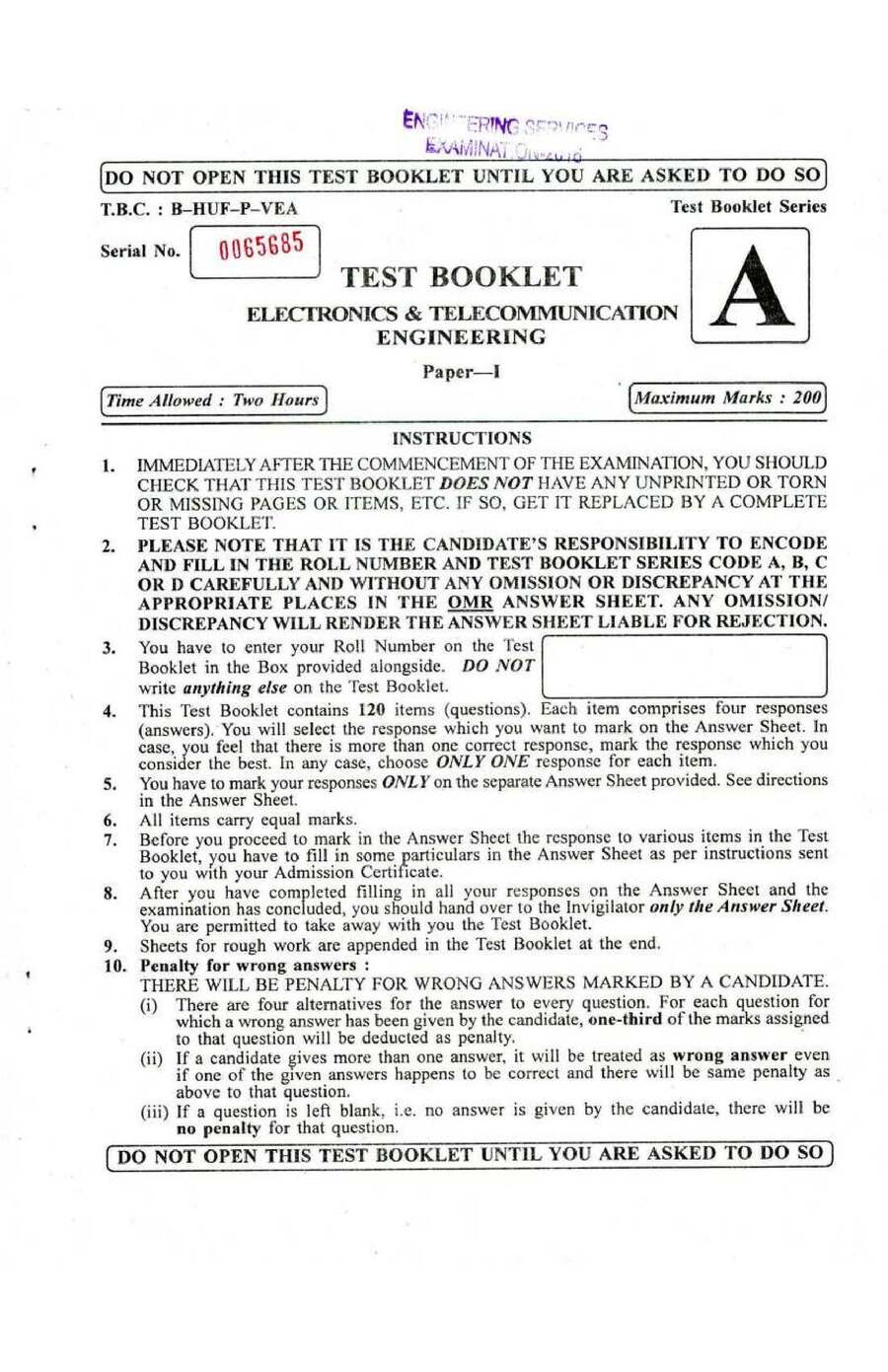
Instructions

  • DO NOT write anything else on the Test Booklet.
  • This Test Booklet contains 120 items (questions).
  • You will select the response which you want to mark on the Answer Sheet.
  • In case, you feel that there is more than one correct response, mark the response which you consider the best.
  • In any case, choose ONLY ONE response for each item.
  • You have to mark your responses ONLY on the separate Answer Sheet provided.
  • in the Answer Sheet. All items carry equal marks.
  • Before you proceed to mark in the Answer Sheet the response to various items in the Test
  • Booklet, you have to fill in some particulars in the Answer Sheet as per instructions sent to you with your Admission Certificate.
  • After you have completed filling in all your responses on the Answer Sheet and the
  • examination has concluded, you should hand over to the Invigilator only the Answer Sheet.
  • You are permitted to take away with you the Test Booklet.
  • Sheets for rough work are appended in the Test Booklet at the end.
  • Penalty for wrong answers: THERE WILL BE PENALTY FOR WRONG ANSWERS MARKED BY A CANDIDATE.
  • There are four alternatives for the answer to every question.
  • For each question for (i) which a wrong answer has been given by the candidate, one-third of the marks assigned to that question will be deducted as penalty.
  • (ii) If a candidate gives more than one answer, it will be treated as wrong answer even if one of the given answers happens to be correct and there will be same penalty as above to that question.
  • (iii) If a question is left blank, i.e. no answer is given by the candidate, there will be no penalty for that question.
  • DO NOT OPEN THIS TEST BOOKLET UNTIL YOU ARE ASKED TO DO SO

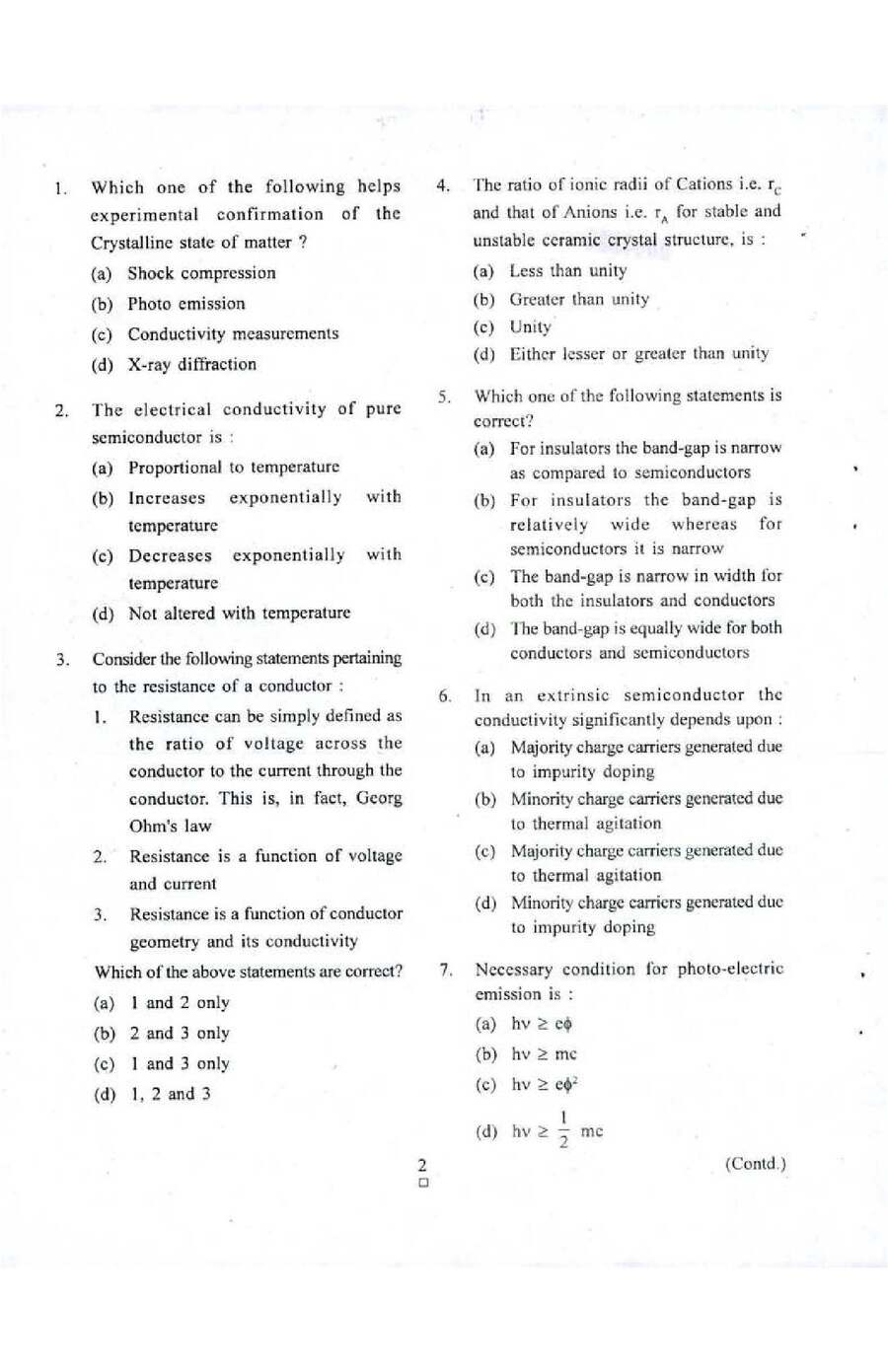
Questions (page 2)

Q1. Which one of the following helps experimental confirmation of the Crystalline state of matter ?

  • (a) Shock compression
  • (b) Photo emission
  • (c) Conductivity measurements
  • (d) X-ray diffraction

Q2. The electrical conductivity of pure semiconductor is :

  • (a) Proportional to temperature
  • (b) Increases exponentially with temperature
  • (c) Decreases exponentially with temperature
  • (d) Not altered with temperature

Q3. Consider the following statements pertaining to the resistance of a conductor :

  • (1) Resistance can be simply defined as the ratio of voltage across the conductor to the current through the conductor. This, in fact, Georg Ohm's law
  • (2) Resistance is a function of voltage and current
  • (3) Resistance is a function of conductor geometry and its conductivity
  • (a) 1 and 2 only
  • (b) 2 and 3 only
  • (c) 1 and 3 only
  • (d) 1, 2 and 3

Q4. The ratio of ionic radii of Cations i. e. rc and that of Anions i. ra for stable and unstable ceramic crystal structure, is :.

  • (a) Less than unity
  • (b) Greater than unity
  • (c) Unity
  • (d) Either lesser or greater than unity

Q5. Which one of the following statements is correct?

  • (a) For insulators the band-gap is narrow as compared to semiconductors
  • (b) For insulators the band-gap is relatively wide whereas for semiconductors it is narrow
  • (c) The band-gap is narrow in width for both the insulators and conductors
  • (d) The band-gap is equally wide for both conductors and semiconductors

Q6. In an extrinsic semiconductor the conductivity significantly depends upon :

  • (a) Majority charge carriers generated due to impurity doping
  • (b) Minority charge carriers generated due to thermal agitation
  • (c) Majority charge carriers generated due to thermal agitation
  • (d) Minority charge carriers generated due to impurity doping

Q7. Necessary condition for photo-electric emission is :

  • (a) hv geq ephi
  • (b) hv geq mc
  • (c) hv geq ephi2
  • (d) hv geq rac{1}{2} mc

Question paper preview

Scanned pages 1–2 for reference. Download the official PDF for the full paper.
Page 1
UPSC Engineering Services 2016 Electronics & Telecommunication Paper-I question paper page 1 instructions scan PDF download
Page 2
UPSC Engineering Services 2016 Electronics & Telecommunication Paper-I question paper page 1 instructions scan PDF download

Free question paper download

Download question paper PDF

  • 1.8 MB
  • 24 pages
  • PDF format

Frequently asked questions

What is the name of the exam?

The exam is the Engineering Services Examination.

Which year is this question paper from?

This question paper is from the year 2016.

Who conducts the Engineering Services Examination?

The Engineering Services Examination is conducted by UPSC (Union Public Service Commission).

What is the subject of this paper?

This paper is for Electronics & Telecommunication Engineering, specifically Paper-I.

What is the maximum marks for this paper?

The maximum marks for this paper are 200.

What is the time allowed for this paper?

The time allowed for this paper is two hours.

← Back to Engineer papers