UPSC Civil Services Mechanical Engineering Paper II 2016 Question Paper PDF

Central Government Jobs Engineer 2016

  • Year 2016
  • Conducted By UPSC
  • Questions 8
  • Maximum Marks 250
  • Duration Three Hours
  • Languages Hindi & English

Exam Details

Detail Information
Examination UPSC Civil Services Main Examination
Year 2016
Conducting Body UPSC
Paper Mechanical Engineering Paper - II
Subject Mechanical Engineering
Duration Three Hours
Maximum Marks 250
Number of Questions 8
Question Type Descriptive / Subjective

This is the Mechanical Engineering Paper II from the UPSC Civil Services Main Examination held in 2016. The paper consists of 8 questions divided into two sections, with candidates required to answer five questions in total. Questions 1 and 5 are compulsory, and at least one question must be attempted from each section. The paper is designed to assess the in-depth knowledge and analytical skills of candidates in various aspects of Mechanical Engineering. It carries a maximum of 250 marks and is to be completed within three hours. This paper is crucial for aspirants aiming for engineering services through the UPSC Civil Services exam.

Major Topics Covered

  • Carnot Engine
  • Centrifugal Compressor
  • Heat Exchanger Analysis
  • Wien's Displacement Law
  • Planck's Law of Radiation
  • Supercharging
  • Internal Combustion Engines
  • Heat Transfer
  • Thermodynamics
  • Fluid Mechanics

Why This Paper is Important

  • Useful for UPSC Civil Services Main Examination preparation
  • Helps understand the latest exam pattern
  • Useful for practice and self-assessment
  • Covers frequently asked General Studies topics
  • Helpful for analysing question trends

Related Resources

  • Mechanical Engineering Paper I - UPSC Civil Services Main Examination 2016
  • Mechanical Engineering Paper II - UPSC Civil Services Main Examination 2015
  • Mechanical Engineering Paper II - UPSC Civil Services Main Examination 2017
  • UPSC Civil Services Mechanical Engineering Paper II 2016 Answer Key
  • UPSC Civil Services Mechanical Engineering Syllabus
  • Mechanical Engineering Topics for UPSC Mains
  • UPSC Civil Services Main Exam Pattern
  • Mechanical Engineering Exam Pattern UPSC Mains

Instructions

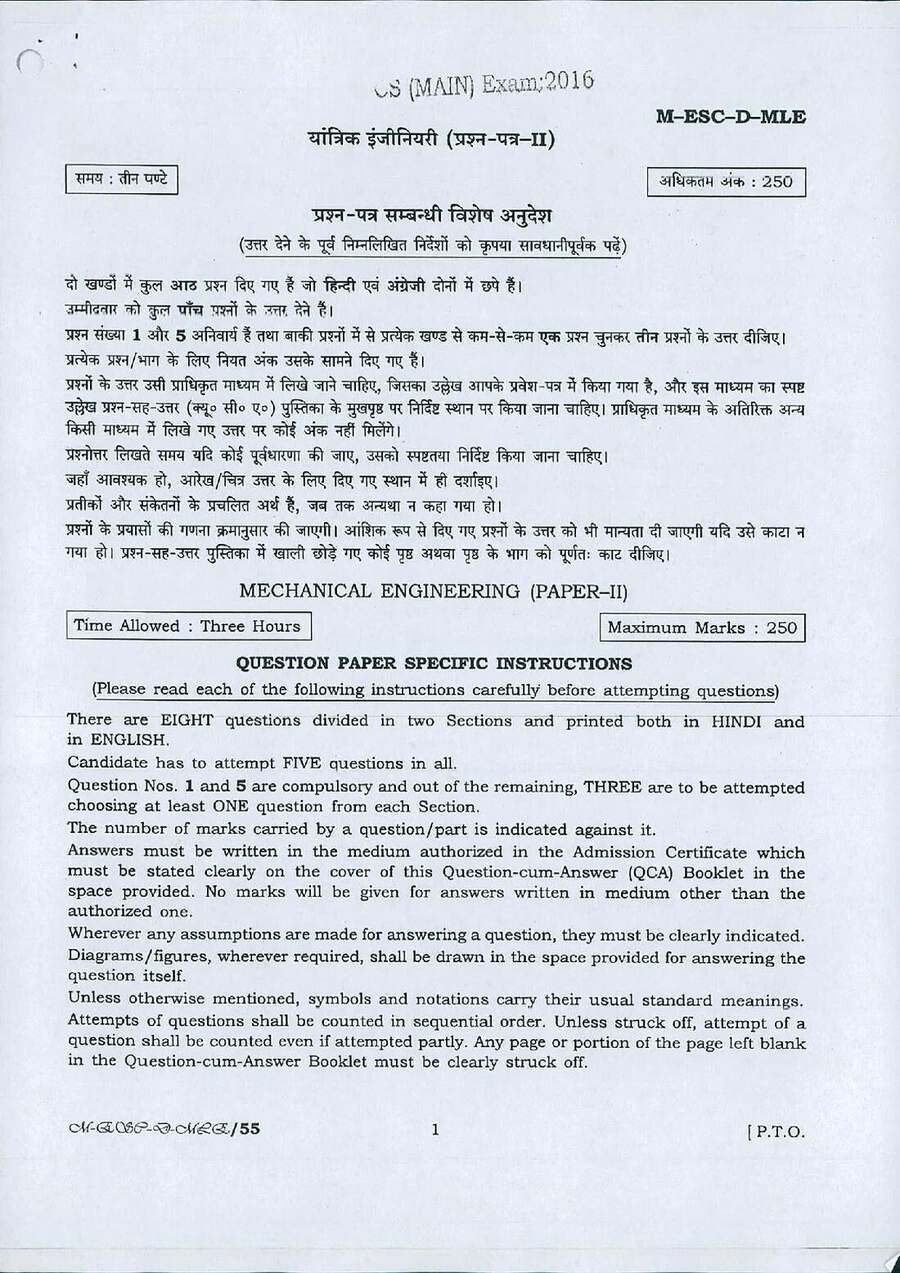
  • दो खण्डों में कुल आठ प्रश्न दिए गए हैं जो हिन्दी एवं अंग्रेजी दोनों में छपे हैं।
  • उम्मीदवार को कुल पाँच प्रश्नों के उत्तर देने हैं।
  • प्रश्न संख्या 1 और 5 अनिवार्य हैं तथा बाकी प्रश्नों में से प्रत्येक खण्ड से कम-से-कम एक प्रश्न चुनकर तीन प्रश्नों के उत्तर दीजिए।
  • प्रत्येक प्रश्न/भाग के लिए नियत अंक उसके सामने दिए गए हैं।
  • प्रश्नों के उत्तर उसी प्राधिकृत माध्यम में लिखे जाने चाहिए, जिसका उल्लेख आपके प्रवेश-पत्र में किया गया है, और इस माध्यम का स्पष्ट उल्लेख प्रश्न-सह-उत्तर (क्यू॰ सी॰ ए॰) पुस्तिका के मुखपृष्ठ पर निर्दिष्ट स्थान पर किया जाना चाहिए।
  • प्राधिकृत माध्यम के अतिरिक्त अन्य किसी माध्यम में लिखे गए उत्तर पर कोई अंक नहीं मिलेंगे।
  • प्रश्नोत्तर लिखते समय यदि कोई पूर्वधारणा की जाए, उसको स्पष्टतया निर्दिष्ट किया जाना चाहिए।
  • जहाँ आवश्यक हो, आरेख/चित्र उत्तर के लिए दिए गए स्थान में ही दर्शाइए।
  • प्रतीकों और संकेतनों के प्रचलित अर्थ हैं, जब तक अन्यथा न कहा गया हो।
  • प्रश्नों के प्रयासों की गणना क्रमानुसार की जाएगी।
  • आंशिक रूप से दिए गए प्रश्नों के उत्तर को भी मान्यता दी जाएगी यदि उसे काटा न गया हो।
  • प्रश्न-सह-उत्तर पुस्तिका में खाली छोड़े गए कोई पृष्ठ अथवा पृष्ठ के भाग को पूर्णतः काट दीजिए।

  • There are EIGHT questions divided in two Sections and printed both in HINDI and in ENGLISH.
  • Candidate has to attempt FIVE questions in all.
  • Question Nos. 1 and 5 are compulsory and out of the remaining, THREE are to be attempted choosing at least ONE question from each Section.
  • The number of marks carried by a question/part is indicated against it.
  • Answers must be written in the medium authorized in the Admission Certificate which must be stated clearly on the cover of this Question-cum-Answer (QCA) Booklet in the space provided.
  • No marks will be given for answers written in medium other than the authorized one.
  • Wherever any assumptions are made for answering a question, they must be clearly indicated.
  • Diagrams/figures, wherever required, shall be drawn in the space provided for answering the question itself.
  • Unless otherwise mentioned, symbols and notations carry their usual standard meanings.
  • Attempts of questions shall be counted in sequential order.
  • Unless struck off, attempt of a question shall be counted even if attempted partly.
  • Any page or portion of the page left blank in the Question-cum-Answer Booklet must be clearly struck off.

Questions (page 2)

Section A

Q1.

(a) Which is the more effective way to increase the efficiency of a Carnot engine-to increase T1 keeping T2 constant or to decrease T2 keeping T1 constant?
कार्नो इंजन की दक्षता बढ़ाने के लिये इनमें से कौन-सा उपाय ज्यादा प्रभावी है—T2 को स्थिर रखते हुए T1 को बढ़ाना या कि T1 को स्थिर रखते हुए T2 को घटाना?

(b) What is the pressure coefficient of a centrifugal compressor? Derive that \psip = 1 - \phi2 \cotβ_2, where \phi2 = flow coefficient.
एक अपकेन्द्री सम्पीडक का दाब गुणांक क्या होता है? व्युत्पन्न कीजिये कि \psip = 1 - \phi2 \cotβ_2, जहाँ \phi2 = प्रवाह गुणांक।

(c) Define effectiveness, NTU and heat capacity ratio in case of heat exchanger analysis, and also establish a relationship among them for counterflow heat exchanger.
ऊष्मा विनिमायक के विश्लेषण के संबंध में प्रभाविता, NTU तथा ऊष्मा धारिता अनुपात को परिभाषित कीजिये एवं प्रतिगामी-प्रवाह ऊष्मा विनिमायक के लिये इनमें आपसी संबंध स्थापित कीजिये।

(d) Derive Wien's displacement law from Planck's law of radiation.
वीन के विस्थापन के नियम को विकिरण के प्लैंक के नियम से व्युत्पन्न कीजिये।

(e) What are the supercharging limits of SI and CI engines? What are the modifications recommended for supercharging an IC engine?
SI तथा CI इंजनों की अधिभरण सीमाएँ क्या हैं? एक अंतर्दहन (IC) इंजन के अधिभरण के लिये कौन-से रूपांतरों की सिफारिश की जाती है?
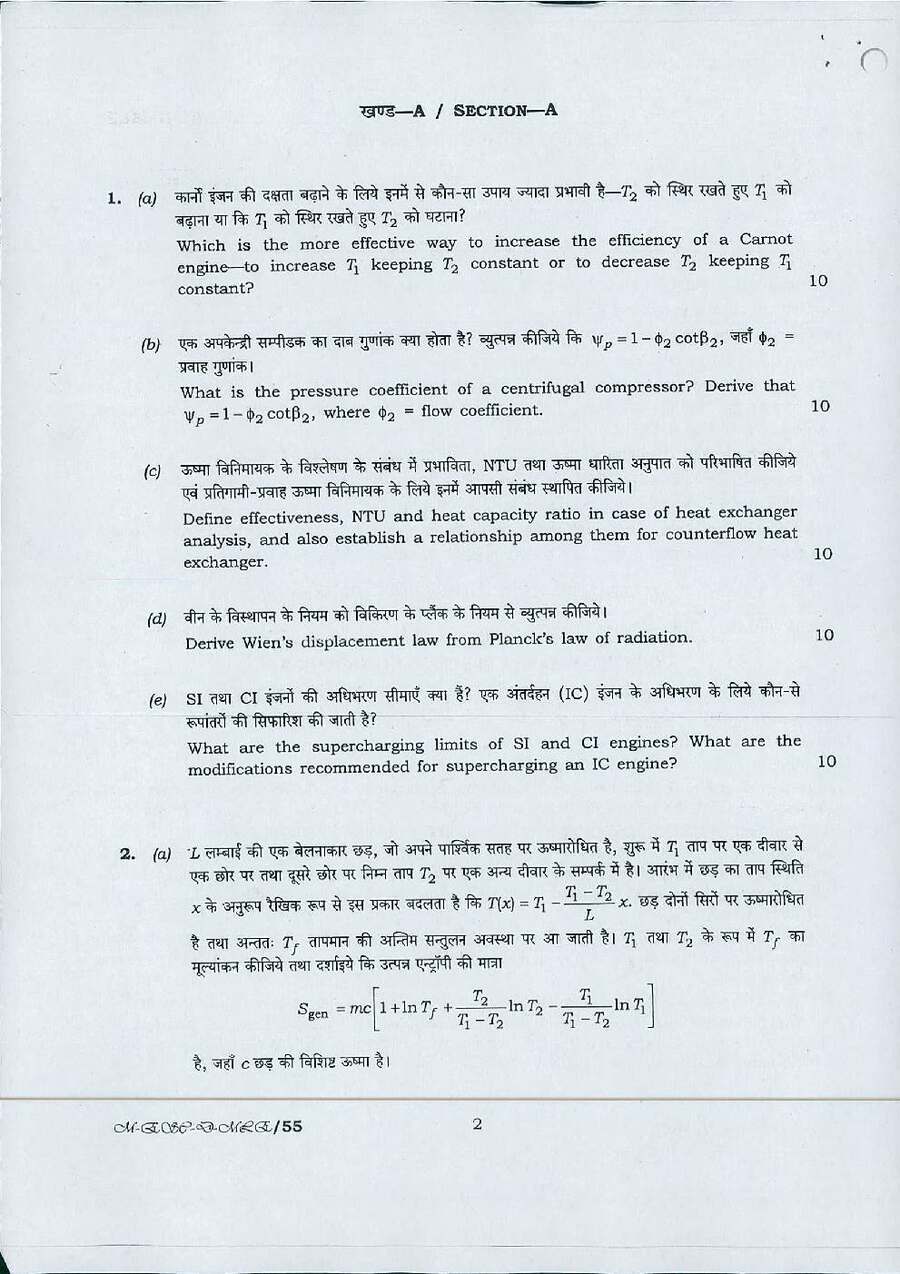
Q2.

(a) L लम्बाई की एक बेलनाकार छड़, जो अपने पार्श्विक सतह पर ऊष्मारोधित है, शुरू में T1 ताप पर एक दीवार से एक छोर पर तथा दूसरे छोर पर निम्न ताप T2 पर एक अन्य दीवार के सम्पर्क में है। आरंभ में छड़ का ताप स्थिति x के अनुरूप रैखिक रूप से इस प्रकार बदलता है कि T(x) = T1-\dfracT1-T2Lx. छड़ दोनों सिरों पर ऊष्मारोधित है तथा अन्ततः Tf तापमान की अन्तिम सन्तुलन अवस्था पर आ जाती है। T1 तथा T2 के रूप में Tf का मूल्यांकन कीजिये तथा दर्शाइये कि उत्पन्न एन्ट्रॉपी की मात्रा S_{\textgen} = mc 1 + ln Tf + (T2)/(T1 - T2) ln T2 - (T1)/(T1 - T2) ln T1 है, जहाँ c छड़ की विशिष्ट ऊष्मा है।
A cylindrical rod of length L, insulated on its lateral surface, is initially in contact with a wall at temperature T1 at one end and with another wall at low temperature T2 at the other end. Initially, the temperature distribution in the rod varies linearly with position x such that T(x) = T1-\dfracT1-T2Lx. The rod is insulated at both ends and finally reaches a steady-state equilibrium temperature Tf. Evaluate Tf in terms of T1 and T2 and show that the generated entropy is S_{\textgen} = mc 1 + ln Tf + (T2)/(T1 - T2) ln T2 - (T1)/(T1 - T2) ln T1 , where c is the specific heat of the rod.

Question paper preview

Scanned pages 1–2 for reference. Download the official PDF for the full paper.

Page 1
UPSC Civil Services Main Examination 2016 Mechanical Engineering Paper II question paper page 1 instructions scan PDF download
Page 2
UPSC Civil Services Main Examination 2016 Mechanical Engineering Paper II question paper page 1 instructions scan PDF download

Free question paper download

Download question paper PDF

  • 8.0 MB
  • 12 pages
  • PDF format

Frequently asked questions

What is the name of the exam?

The exam is the UPSC Civil Services Main Examination.

What is the year of this question paper?

This question paper is from the year 2016.

Who conducts the Civil Services Main Examination?

The examination is conducted by the UPSC (Union Public Service Commission).

What is the subject of this paper?

This paper is for Mechanical Engineering, specifically Paper II.

What is the maximum marks for this paper?

The maximum marks for this paper are 250.

What is the time allowed to complete this paper?

The time allowed is Three Hours.

← Back to Engineer papers