ELECTRONICS AND TELECOMMUNICATION ENGINEERING PAPER-I

Central Government Jobs Engineer 2025

  • Year 2025
  • Conducted By NESP-O-ENTE
  • Questions 8
  • Maximum Marks 300
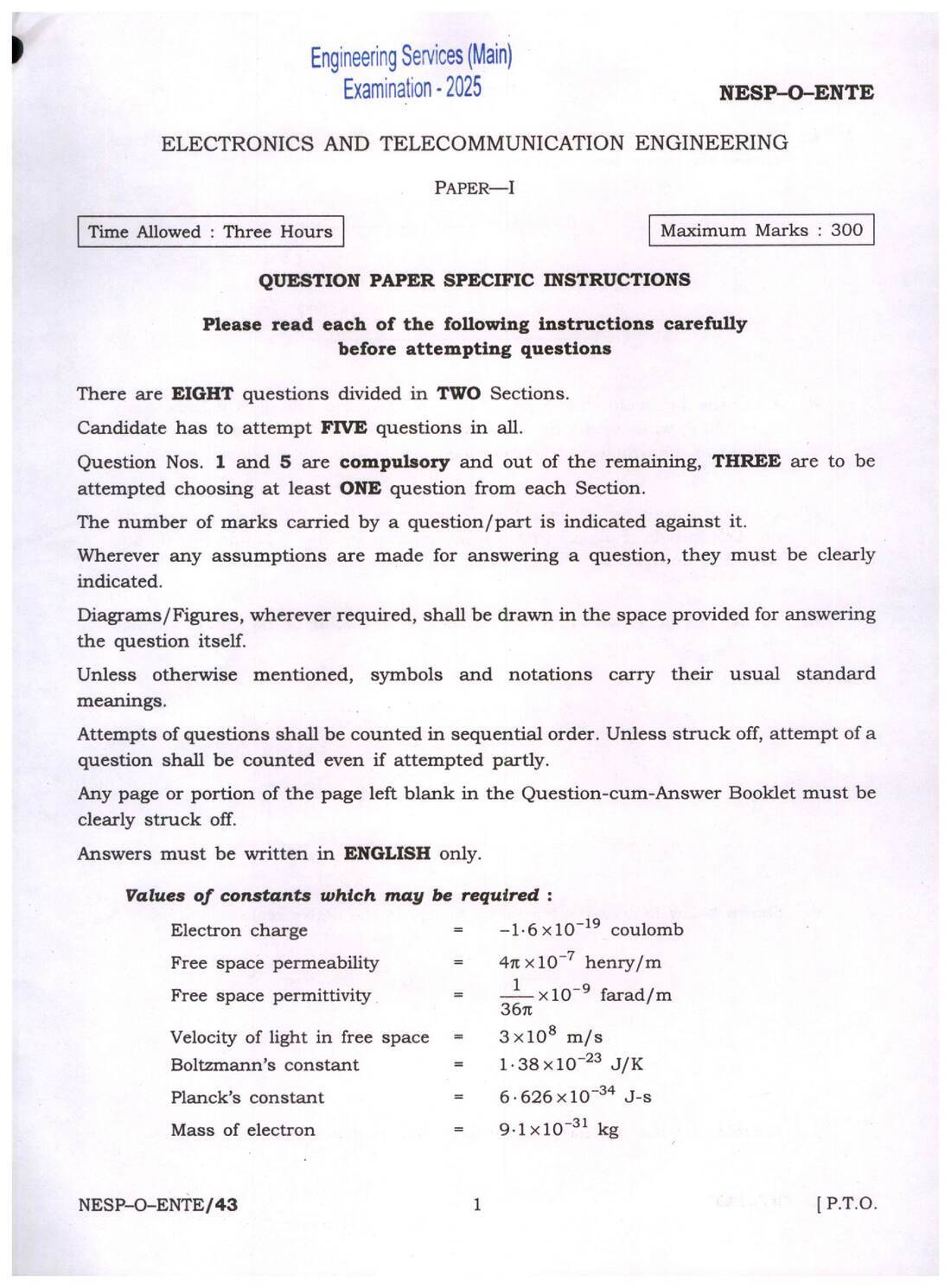
  • Duration Three Hours Maximum Marks: 300 Question Paper Specific Instructions Please Read Each Of The Following Instructions Carefully Before Attempting Questions There Are
  • Languages English

Exam Details

Detail Information
Examination Engineering Services (Main) Examination
Year 2025
Conducting Body NESP-O-ENTE
Paper ELECTRONICS AND TELECOMMUNICATION ENGINEERING PAPER-I
Subject Electronics and Telecommunication Engineering
Duration Three Hours Maximum Marks: 300 Question Paper Specific Instructions Please Read Each Of The Following Instructions Carefully Before Attempting Questions There Are
Maximum Marks 300
Number of Questions 8
Question Type Mixed

This document consolidates Page 1 and Page 2 content for the Electronics and Telecommunication Engineering Paper-I of the Engineering Services (Main) Examination 2025. Page 1 provides the exam header, rules, and constants, setting the context for the two-section, eight-question paper with five questions to attempt. Page 2 presents Section-A content featuring physics and electrical engineering problems, including diode circuits, DC motors, crystallography with Miller indices, circuit voltage calculation with complex impedances, and transistor biasing. The combined material informs the SEO-ready metadata, question repair, and topic scaffolding for a comprehensive question paper overview and related educational resources.

Major Topics Covered

  • Diodes
  • DC motors
  • Back EMF
  • Armature voltage
  • Torque
  • Power
  • Crystallography
  • Miller indices
  • Unit cell
  • Simple cubic structure
  • Crystal normals
  • Plane normals
  • Angles between planes
  • Electrical circuit analysis
  • Complex impedance
  • Phasors
  • Pole-zero concepts
  • NPN transistor
  • Active region
  • Transistor biasing

Why This Paper is Important

  • Useful for Engineering Services (Main) Examination preparation
  • Helps understand the latest exam pattern
  • Useful for practice and self-assessment
  • Covers frequently asked General Studies topics
  • Helpful for analysing question trends

Related Resources

Instructions

  • There are EIGHT questions divided in TWO Sections.
  • Candidate has to attempt FIVE questions in all.
  • Question Nos. 1 and 5 are compulsory and out of the remaining, THREE are to be attempted choosing at least ONE question from each Section.
  • The number of marks carried by a question/part is indicated against it.
  • Wherever any assumptions are made for answering a question, they must be clearly indicated.
  • Diagrams/Figures, wherever required, shall be drawn in the space provided for answering the question itself.
  • Unless otherwise mentioned, symbols and notations carry their usual standard meanings.
  • Attempts of questions shall be counted in sequential order.
  • Unless struck off, attempt of a question shall be counted even if attempted partly.
  • Any page or portion of the page left blank in the Question-cum-Answer Booklet must be clearly struck off.
  • Answers must be written in ENGLISH only.
  • Values of constants which may be required : = -1.6 \times 10^{-19} coulomb Electron charge Free space permeability = 4\pi \times 10^{-7} henry/m Free space permittivity = \frac{1}{36\pi} \times 10^{-9} farad/m Velocity of light in free space = 3 \times 10^8 m/s 1.38 \times 10^{-23} J/K Boltzmann's constant = 6.626 \times 10^{-34} J-s Planck's constant = 9.1 \times 10^{-31} kg Mass of electron =

Questions (page 2)

Q1. A certain d.c. motor has RA = 1.3 Ω, IA = 10 A, and produces a back emf EA = 240 V, while operating at a speed of 1200 r.p.m. Determine the voltage applied to the armature, the developed torque and the developed power.
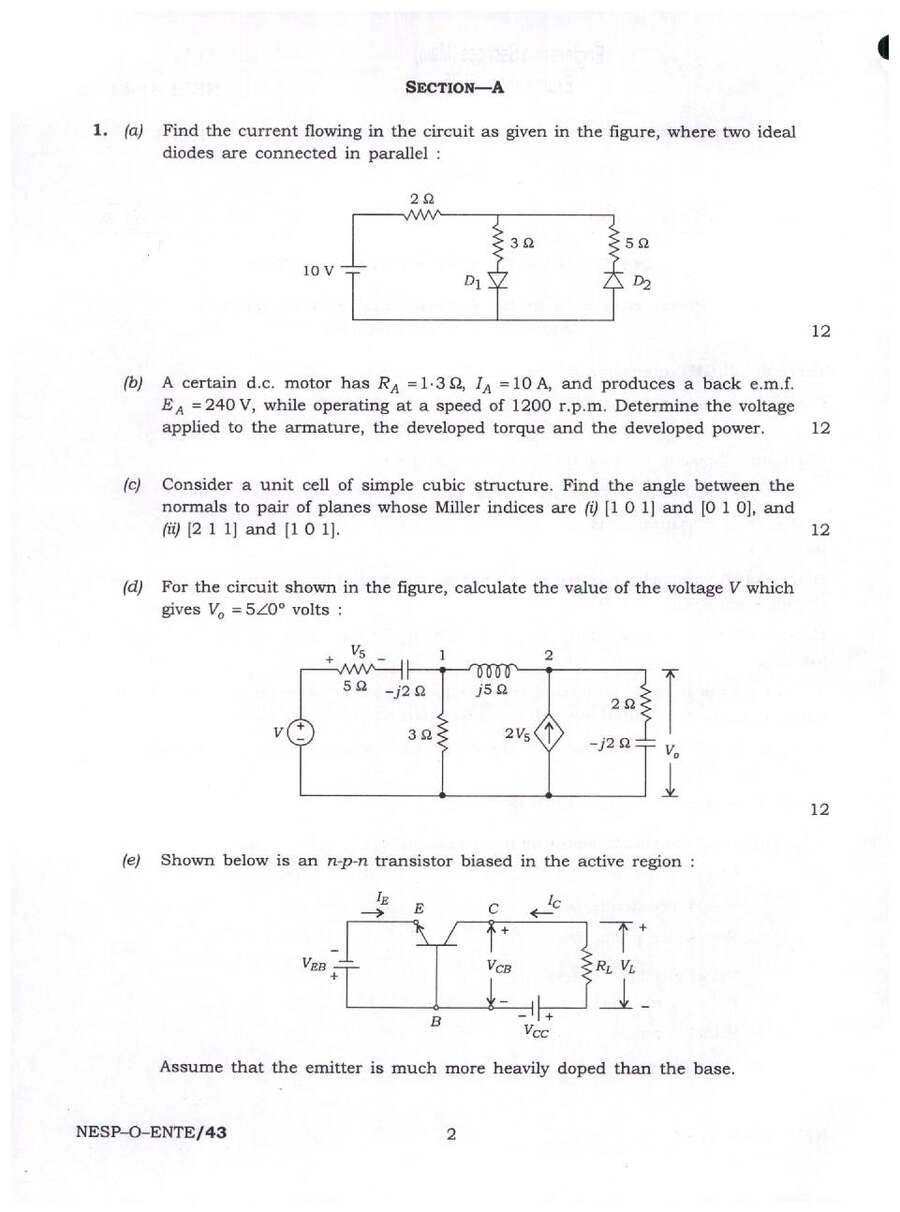
(a) 1. Find the current flowing in the circuit as given in the figure, where two ideal diodes are connected in parallel : 2Ω 3Ω 5Ω 10V D1

(b) A certain d.c. motor has RA = 1.3 Ω, IA = A, and produces a back emf EA = 240 V, while operating at a speed of 1200 r.p.m. Determine the voltage applied to the armature, the developed torque and the developed power.

  • (a) 1. Find the current flowing in the circuit as given in the figure, where two ideal diodes are connected in parallel : 2Ω 3Ω 5Ω 10V D1
  • (b) A certain d.c. motor has RA = 1.3 Ω, IA = A, and produces a back emf EA = 240 V, while operating at a speed of 1200 r.p.m. Determine the voltage applied to the armature, the developed torque and the developed power.

Q2. 2. Consider a unit cell of simple cubic structure. Find the angle between the normals to pair of planes whose Miller indices are
(i) [1 0 1] and [0 1 0], and
(ii) [2 1 1] and [1 0 1].

Q3. 3. For the circuit shown in the figure, calculate the value of the voltage V which gives Vo = 5∠0° volts: elements include j5Ω, -j2Ω, 2V5, 3Ω

Q4. 4. Shown below is an n-p-n transistor biased in the active region: (e) VEB, B VCC. Assume that the emitter is much more heavily doped than the base.

Question paper preview

Scanned pages 1–2 for reference. Download the official PDF for the full paper.

Page 1
Engineering Services (Main) Examination 2025 ELECTRONICS AND TELECOMMUNICATION ENGINEERING PAPER-I NESP-O-ENTE question paper page 1 instructions scan PDF download
Page 2
Engineering Services (Main) Examination 2025 ELECTRONICS AND TELECOMMUNICATION ENGINEERING PAPER-I NESP-O-ENTE question paper page 1 instructions scan PDF download

Free question paper download

Download question paper PDF

  • 4.1 MB
  • 12 pages
  • PDF format

Frequently asked questions

What is the full name and year of the examination?

Engineering Services (Main) Examination, 2025.

Which paper is this content for?

Electronics and Telecommunication Engineering Paper-I.

How many questions are there and how many must be attempted?

There are eight questions in total; candidates must attempt five questions.

Which questions are compulsory?

Question Nos. 1 and 5 are compulsory.

In what language should answers be written?

Answers must be written in English unless stated otherwise.

Are diagrams allowed to be drawn in the answer space?

Yes, diagrams/figures should be drawn in the space provided for answering the question.

← Back to Engineer papers