IFS 2018 Civil Engineering Paper I: Objective & Descriptive (FSI-P-CVLE)

Central Government Jobs Engineer 2018

  • Year 2018
  • Conducted By FSI-P-CVLE
  • Questions 8
  • Maximum Marks 200
  • Duration Three Hours
  • Languages English

Exam Details

Detail Information
Examination I.F.S. EXAM-(M) 2018
Year 2018
Conducting Body FSI-P-CVLE
Paper CIVIL ENGINEERING
Subject CIVIL ENGINEERING
Duration Three Hours
Maximum Marks 200
Number of Questions 8
Question Type Descriptive / Subjective

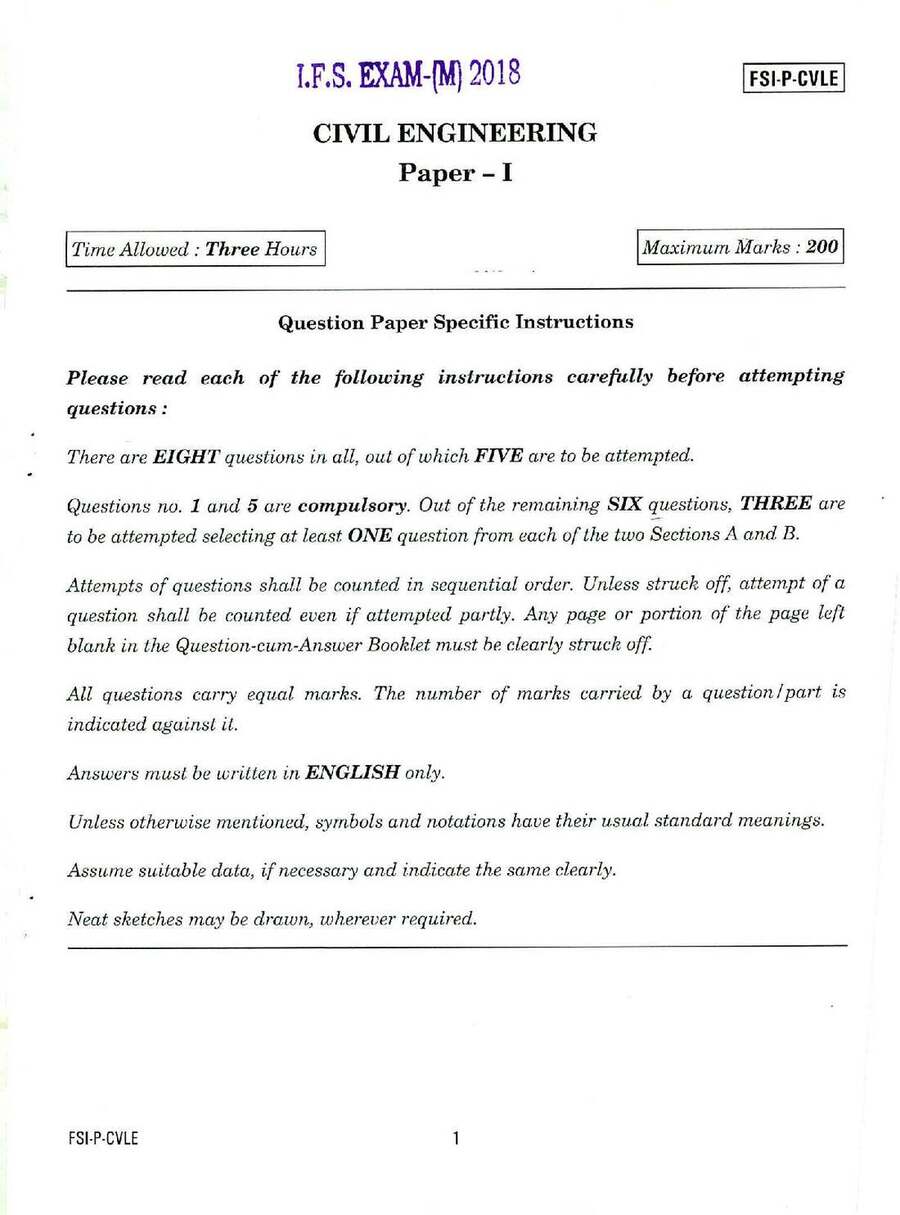
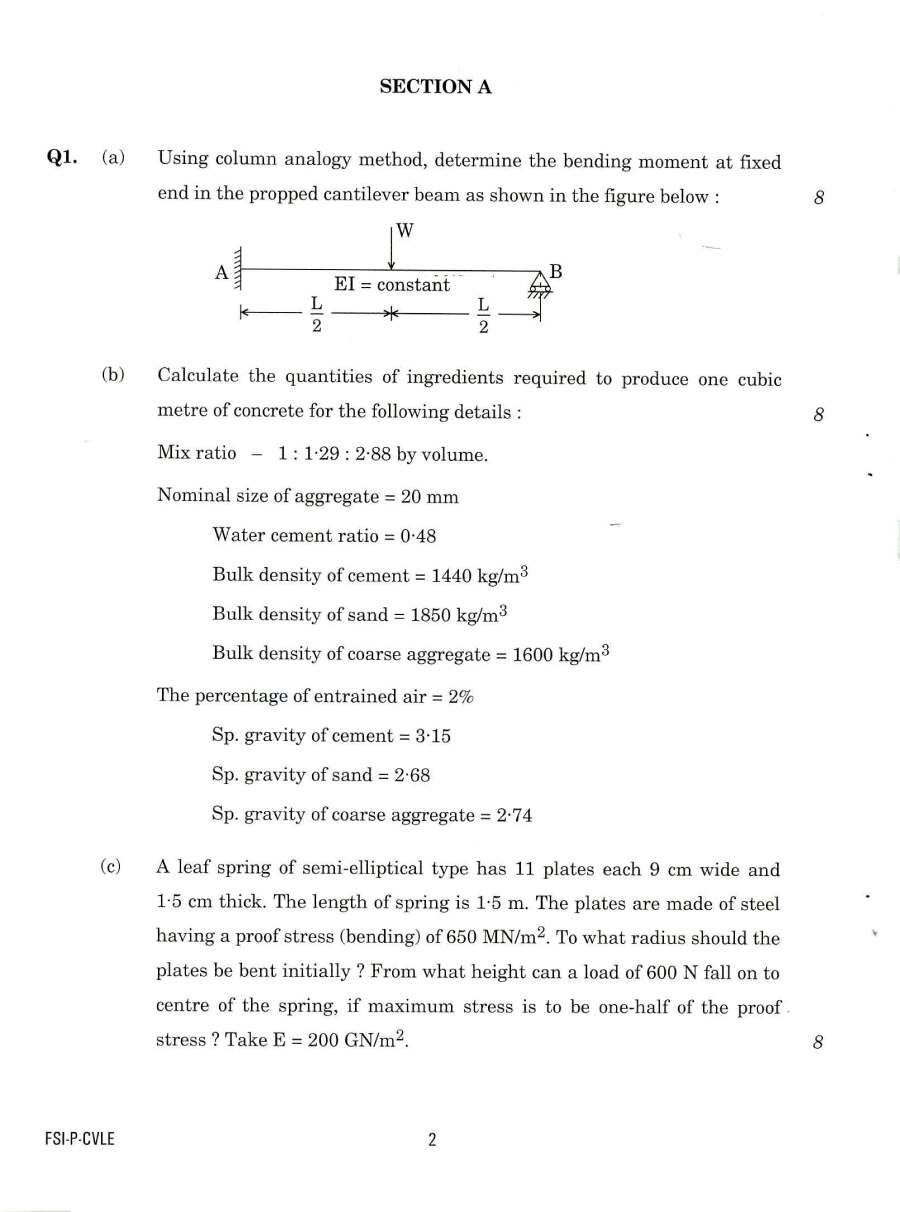
This document summarizes the I.F.S. EXAM-(M) 2018 Civil Engineering Paper I (code FSI-P-CVLE). Page 1 contains the exam header, conducting body, paper details and general instructions: eight questions in total, withQs 1 and 5 compulsory and a choice to answer three from the remaining three sections. Page 2 begins Section A with a representative question (Q1) that comprises three sub-parts: (a) bending moment in a propped cantilever, (b) concrete mix design quantities by volume, and (c) leaf spring design problems involving radius of bend and load height to achieve specified stress. The OCR repair merges several lines into single items; the corrected structure presents each sub-part as a separate descriptive item with appropriate marks. The SEO metadata below covers page 1 and 2 themes: exam format, key topics, and typical question types, to assist discoverability and relevance for competitive exams preparation.

Major Topics Covered

  • Civil Engineering
  • Structural Analysis
  • Beam Theory
  • Propped Cantilever
  • Leaf Spring
  • Concrete Technology
  • Mix Design
  • Reinforced Concrete
  • Material Properties
  • Elastic Theory
  • Stress and Strain
  • Section A: Objective Questions
  • Section B: Descriptive Problems
  • Engineering Mechanics
  • Statics
  • Dynamics
  • Machine Elements
  • Design of Beams
  • Bending Moments
  • Engineering Mathematics

Why This Paper is Important

  • Useful for I.F.S. EXAM-(M) 2018 preparation
  • Helps understand the latest exam pattern
  • Useful for practice and self-assessment
  • Covers frequently asked General Studies topics
  • Helpful for analysing question trends

Related Resources

Instructions

  • There are EIGHT questions in all, out of which FIVE are to be attempted.
  • Out of the remaining SIX questions, THREE are to be attempted selecting at least ONE question from each of the two Sections A and B.
  • Attempts of questions shall be counted in sequential order.
  • Unless struck off, attempt of a question shall be counted even if attempted partly.
  • Any page or portion of the page left blank in the Question-cum-Answer Booklet must be clearly struck off.
  • The number of marks carried by a question/part is indicated against it.
  • Answers must be written in ENGLISH only.
  • Unless otherwise mentioned, symbols and notations have their usual standard meanings.
  • Assume suitable data, if necessary and indicate the same clearly.
  • Neat sketches may be drawn, wherever required.

Questions (page 2)

Q1.

(a) SECTION A Using column analogy method, determine the bending moment at fixed Q1. end in the propped cantilever beam as shown in the figure below : A \overrightarrowEI = \textconstant Calculate the quantities of ingredients required to produce one cubic

(b) metre of concrete for the following details : Mix ratio -1:1:29:2:88 by volume. Nominal size of aggregate = mm Water cement ratio = 0.48 Bulk density of cement = 1440 \text kg/m^3 Bulk density of sand = 1850 \text kg/m^3 Bulk density of coarse aggregate = 1600 \text kg/m^3 The percentage of entrained air = 2\% Sp. gravity of cement = 3.15 Sp. gravity of sand =
Q1.

(a) SECTION A Using column analogy method, determine the bending moment at fixed Q1. end in the propped cantilever beam as shown in the figure below : A \overrightarrowEI = \textconstant Calculate the quantities of ingredients required to produce one cubic

(b) metre of concrete for the following details : Mix ratio -1:1:29:2:88 by volume. Nominal size of aggregate = mm Water cement ratio = 0.48 Bulk density of cement = 1440 \text kg/m^3 Bulk density of sand = 1850 \text kg/m^3 Bulk density of coarse aggregate = 1600 \text kg/m^3 The percentage of entrained air = 2\% Sp. gravity of cement = 3.15 Sp. gravity of sand =

Q2. Q1. (b) Calculate the quantities of ingredients required to produce one cubic metre of concrete for the following details : 8 Mix ratio -1:1:29:2:88 by volume. Nominal size of aggregate = 20 mm. Water cement ratio = 0.48. Bulk density of cement = 1440 kg/m3. Bulk density of sand = 1850 kg/m3. Bulk density of coarse aggregate = 1600 kg/m3. The percentage of entrained air = 2%. Sp. gravity of cement = 3.15. Sp. gravity of sand = 2.68. Sp. gravity of coarse aggregate = 2.74

Q2. 68 Sp. gravity of coarse aggregate = 2.74
(c) A leaf spring of semi-elliptical type has 11 plates each 9 cm wide and 1.5 cm thick. The length of spring is 1.5 m. The plates are made of steel having a proof stress (bending) of 650 MN/m 2 . To what radius should the plates be bent initially? From what height can a load of 600 N fall on to centre of the spring, if maximum stress is to be one-half of the proof. stress? Take E = 200 GN/m 2 . \boldsymbol8

Q3. Q1.
(c) A leaf spring of semi-elliptical type has 11 plates each 9 cm wide and 1.5 cm thick. The length of spring is 1.5 m. The plates are made of steel having a proof stress (bending) of 650 MN/m2. To what radius should the plates be bent initially? From what height can a load of 600 N fall on to centre of the spring, if maximum stress is to be one-half of the proof stress? Take E = 200 GN/m2.

Question paper preview

Scanned pages 1–2 for reference. Download the official PDF for the full paper.

Page 1
IFS 2018 Civil Engineering Paper I: Objective & Descriptive (FSI-P-CVLE) — page 1 instructions scan PDF download
Page 2
IFS 2018 Civil Engineering Paper I: Objective & Descriptive (FSI-P-CVLE) — page 1 instructions scan PDF download

Free question paper download

Download question paper PDF

  • 5.8 MB
  • 12 pages
  • PDF format

Frequently asked questions

What is the full form of IFS?

In this context, IFS refers to the I.F.S. EXAM-(M) 2018 paper; the page uses IFS as part of the exam nomenclature and paper code.

How many questions are in the paper?

Eight questions in all.

Which questions are compulsory?

Questions 1 and 5 are compulsory.

How many questions must I attempt?

Out of the remaining six questions, three are to be attempted, selecting at least one from Section A and one from Section B.

In what language should answers be written?

Answers must be written in English.

What is the time allotted for the exam?

Three hours.

← Back to Engineer papers