UPSC Engineering Service 2019 General Studies & Engineering Aptitude Paper PDF

Central Government Jobs Engineer 2019

  • Year 2019
  • Conducted By UPSC
  • Questions 100
  • Maximum Marks 200
  • Duration Two Hours
  • Languages English

Exam Details

Detail Information
Examination Engineering Service (Preliminary) Examination
Year 2019
Conducting Body UPSC
Paper General Studies and Engineering Aptitude Paper
Subject General Studies and Engineering Aptitude
Duration Two Hours
Maximum Marks 200
Number of Questions 100
Question Type Objective (MCQ)

This is the official question paper for the UPSC Engineering Service (Preliminary) Examination 2019, specifically the General Studies and Engineering Aptitude Paper. This paper carries a maximum of 200 marks and is allotted a duration of two hours. It comprises 100 objective-type questions designed to assess candidates' knowledge in general studies and engineering aptitude. Aspirants can use this paper to understand the exam pattern, difficulty level, and types of questions asked, which is crucial for effective preparation for the Engineering Service Examination.

Major Topics Covered

  • Capital Receipts
  • Social Development
  • Social Change
  • Convergent Theory
  • Perfect Competition
  • Marketing of Securities
  • Fiscal Policy

Why This Paper is Important

  • Useful for Engineering Service Examination preparation
  • Helps understand the latest exam pattern
  • Useful for practice and self-assessment
  • Covers frequently asked General Studies topics
  • Helpful for analysing question trends

Related Resources

  • UPSC Engineering Service Examination 2020 General Studies and Engineering Aptitude Paper
  • UPSC Engineering Service Examination 2018 General Studies and Engineering Aptitude Paper
  • UPSC Engineering Service Examination 2019 Engineering Optional Paper
  • UPSC Engineering Service 2019 General Studies and Engineering Aptitude Answer Key
  • UPSC Engineering Service Examination Syllabus
  • General Studies Syllabus for ESE
  • Engineering Aptitude Syllabus for ESE
  • UPSC Engineering Service Examination Pattern

Instructions

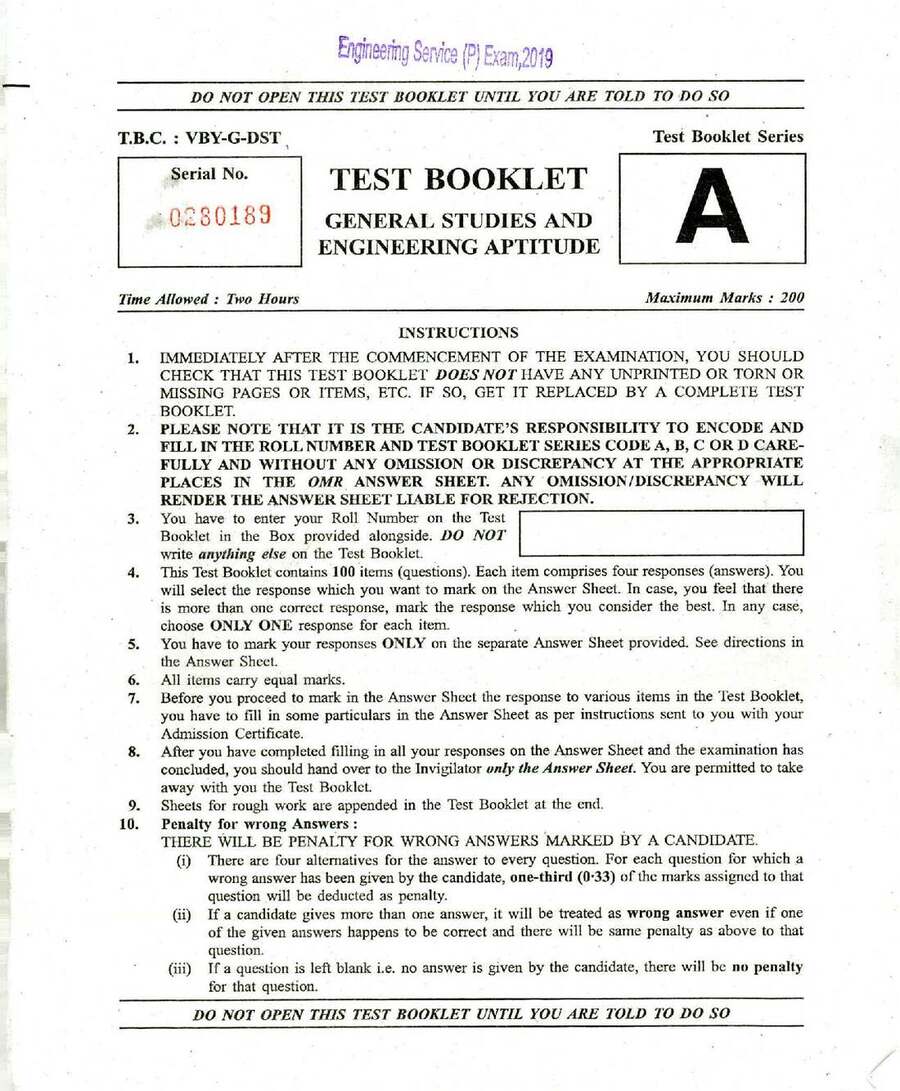
  • CHECK THAT THIS TEST BOOKLET DOES NOT HAVE ANY UNPRINTED OR TORN OR MISSING PAGES OR ITEMS, ETC.
  • IF SO, GET IT REPLACED BY A COMPLETE TEST BOOKLET.
  • PLEASE NOTE THAT IT IS THE CANDIDATE'S RESPONSIBILITY TO ENCODE AND
  • FILL IN THE ROLL NUMBER AND TEST BOOKLET SERIES CODE A, B, C OR D CARE- FULLY AND WITHOUT ANY OMISSION OR DISCREPANCY AT THE APPROPRIATE PLACES IN THE OMR ANSWER SHEET.
  • ANY OMISSION/DISCREPANCY WILL RENDER THE ANSWER SHEET LIABLE FOR REJECTION.
  • You have to enter your Roll Number on the Test
  • DO NOT write anything else on the Test Booklet.
  • This Test Booklet contains 100 items (questions).
  • Each item comprises four responses (answers).
  • will select the response which you want to mark on the Answer Sheet.
  • In case, you feel that there is more than one correct response, mark the response which you consider the best.
  • In any case, choose ONLY ONE response for each item.
  • You have to mark your responses ONLY on the separate Answer Sheet provided.
  • the Answer Sheet. All items carry equal marks.
  • Before you proceed to mark in the Answer Sheet the response to various items in the Test Booklet,
  • you have to fill in some particulars in the Answer Sheet as per instructions sent to you with your Admission Certificate.
  • After you have completed filling in all your responses on the Answer Sheet and the examination has
  • concluded, you should hand over to the Invigilator only the Answer Sheet.
  • You are permitted to take away with you the Test Booklet.
  • Sheets for rough work are appended in the Test Booklet at the end.
  • THERE WILL BE PENALTY FOR WRONG ANSWERS MARKED BY A CANDIDATE.
  • There are four alternatives for the answer to every question.
  • For each question for which a (i) wrong answer has been given by the candidate, one-third (0.33) of the marks assigned to that question will be deducted as penalty.
  • If a candidate gives more than one answer, it will be treated as wrong answer even if one (ii) of the given answers happens to be correct and there will be same penalty as above to that question.
  • (iii) If a question is left blank i.e. no answer is given by the candidate, there will be no penalty for that question.
  • DO NOT OPEN THIS TEST BOOKLET UNTIL YOU ARE TOLD TO DO SO

Questions (page 2)

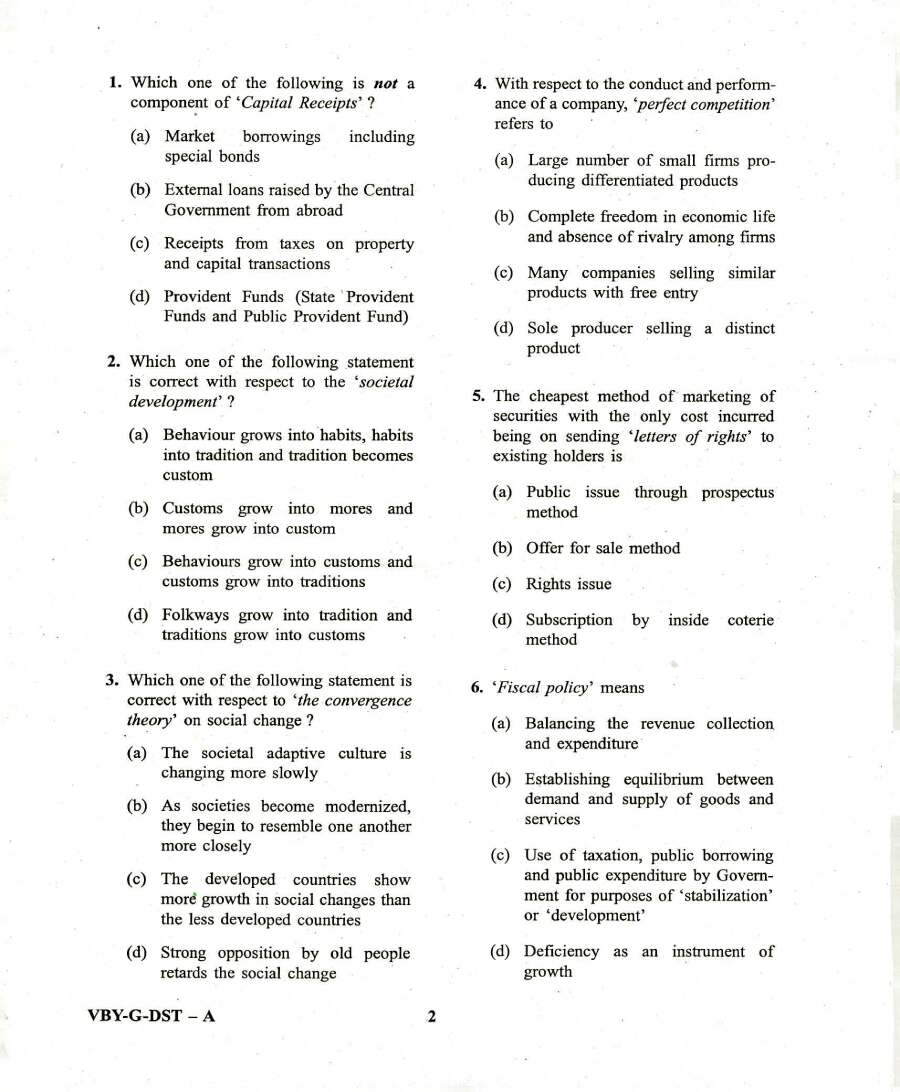
Q1. Which one of the following is not a component of 'Capital Receipts' ?

  • (a) Market borrowings including special bonds
  • (b) External loans raised by the Central Government from abroad
  • (c) Receipts from taxes on property and capital transactions
  • (d) Provident Funds (State Provident Funds and Public Provident Fund)
Q2. Which one of the following statement is correct with respect to the 'societal development' ?

  • (a) Behaviour grows into habits, habits into tradition and tradition becomes custom
  • (b) Customs grow into mores and mores grow into custom
  • (c) Behaviours grow into customs and customs grow into traditions
  • (d) Folkways grow into tradition and traditions grow into customs

Q3. Which one of the following statement is correct with respect to 'the convergence theory' on social change ?

  • (a) The societal adaptive culture is changing more slowly
  • (b) As societies become modernized, they begin to resemble one another more closely
  • (c) The developed countries show more growth in social changes than the less developed countries
  • (d) Strong opposition by old people retards the social change

Q4. With respect to the conduct and performance of a company, 'perfect competition' refers to

  • (a) Large number of small firms producing differentiated products
  • (b) Complete freedom in economic life and absence of rivalry among firms
  • (c) Many companies selling similar products with free entry
  • (d) Sole producer selling a distinct product

Q5. The cheapest method of marketing of securities with the only cost incurred being on sending 'letters of rights' to existing holders is

  • (a) Public issue through prospectus method
  • (b) Offer for sale method
  • (c) Rights issue
  • (d) Subscription by inside coterie method

Q6. 'Fiscal policy' means

  • (a) Balancing the revenue collection and expenditure
  • (b) Establishing equilibrium between demand and supply of goods and services
  • (c) Use of taxation, public borrowing and public expenditure by Government for purposes of 'stabilization' or 'development'
  • (d) Deficiency as an instrument of growth

Question paper preview

Scanned pages 1–2 for reference. Download the official PDF for the full paper.

Page 1
UPSC Engineering Service 2019 General Studies and Engineering Aptitude question paper page 1 instructions scan PDF download
Page 2
UPSC Engineering Service 2019 General Studies and Engineering Aptitude question paper page 1 instructions scan PDF download

Free question paper download

Download question paper PDF

  • 13.9 MB
  • 20 pages
  • PDF format

Frequently asked questions

What is the name of the exam?

The exam is the Engineering Service (Preliminary) Examination.

Which year is this question paper from?

This question paper is from the year 2019.

Who conducts the Engineering Service Examination?

The Union Public Service Commission (UPSC) conducts the Engineering Service Examination.

What is the name of this specific paper?

This paper is the General Studies and Engineering Aptitude Paper.

What is the maximum marks for this paper?

The maximum marks for this paper are 200.

What is the time allowed for this paper?

The time allowed for this paper is Two Hours.

← Back to Engineer papers